

Wondering how to check if content was written by AI? Whether you are an editor reviewing a freelancer’s submission, a teacher checking student work, a blogger auditing outsourced articles, or simply a reader who suspects something feels off — this guide gives you both free AI content detector tools and eight manual signs you can spot without any software. By the end, you will be able to detect AI writing in any piece of text within minutes.
Why Knowing How to Detect AI Writing Matters in 2026
AI writing tools — ChatGPT, Claude, Gemini, Llama, and dozens of others — can now produce polished articles on virtually any topic in seconds. This has fundamentally changed the content landscape. Blog posts, product descriptions, news summaries, academic essays, job applications, and social media content are increasingly generated by machines and published without disclosure. For most readers, a casual skim reveals nothing unusual.
That is precisely why knowing how to tell if an article is AI written has become a valuable skill for anyone who consumes, commissions, or publishes written content. The ability to spot AI content protects against misinformation, ensures academic integrity, helps editors maintain brand authenticity, and assists SEO professionals verifying whether content meets Google’s quality standards. Learning to identify AI written articles manually — without relying entirely on an AI text checker — is the most transferable skill you can develop in this space.
Google’s spam systems have become increasingly focused on scaled AI content that lacks original value. In March 2024, Google penalised thousands of sites publishing unedited, low-effort machine-generated articles. Understanding how AI generated text checkers work — and what signals they look for — helps you stay ahead of both detection tools and algorithm updates. Whether you are checking someone else’s work or auditing your own before publishing, the process is the same.
How AI Content Detection Works — The Science Behind It
Before using any AI writing detector, it helps to understand what these tools are actually measuring. Every major AI text checker free tool analyses text using two primary statistical signals: perplexity and burstiness. These two metrics together create a reliable fingerprint that separates machine-generated text from human writing. Understanding them also helps you apply the manual signs more effectively.
Perplexity — How Predictable Is the Writing?
Perplexity measures how surprising each word choice is given the words that came before it. AI language models are trained to predict the most statistically likely next word at every step — which makes their output statistically predictable. A low perplexity score AI detectors measure means the text flows exactly as any language model would have predicted. Human writers, by contrast, make unexpected word choices, use idioms, go on tangents, and select lower-probability words that are contextually appropriate but statistically surprising. When you use a ChatGPT content detector or any similar tool, perplexity is one of the first signals calculated.
Burstiness — The Rhythm of Sentence Length Variation
Human writing naturally alternates between short, punchy sentences and longer, more complex constructions. This variation — called burstiness AI detection specialists rely on — is a hallmark of authentic writing. AI models produce text with unnaturally uniform sentence lengths because they optimise for fluency at each step rather than writing with rhythmic, stylistic intent. A piece of text where every sentence is roughly the same length is a strong signal of machine generation — and something you can check manually without any AI plagiarism checker tool at all.
Stylometric Analysis — Which Model Generated This?
Advanced AI content checkers go beyond perplexity and burstiness to perform stylometric analysis — comparing the text against known stylistic fingerprints of specific AI models. Each major system — ChatGPT, Claude, Gemini, Llama, DeepSeek — has characteristic patterns in how it constructs arguments, handles transitions, and produces hedging language. Sophisticated detectors including GPTZero free tier and Sapling can sometimes identify not just that text was AI-generated, but which model likely produced it.
8 Manual Signs That Content Was Written by AI
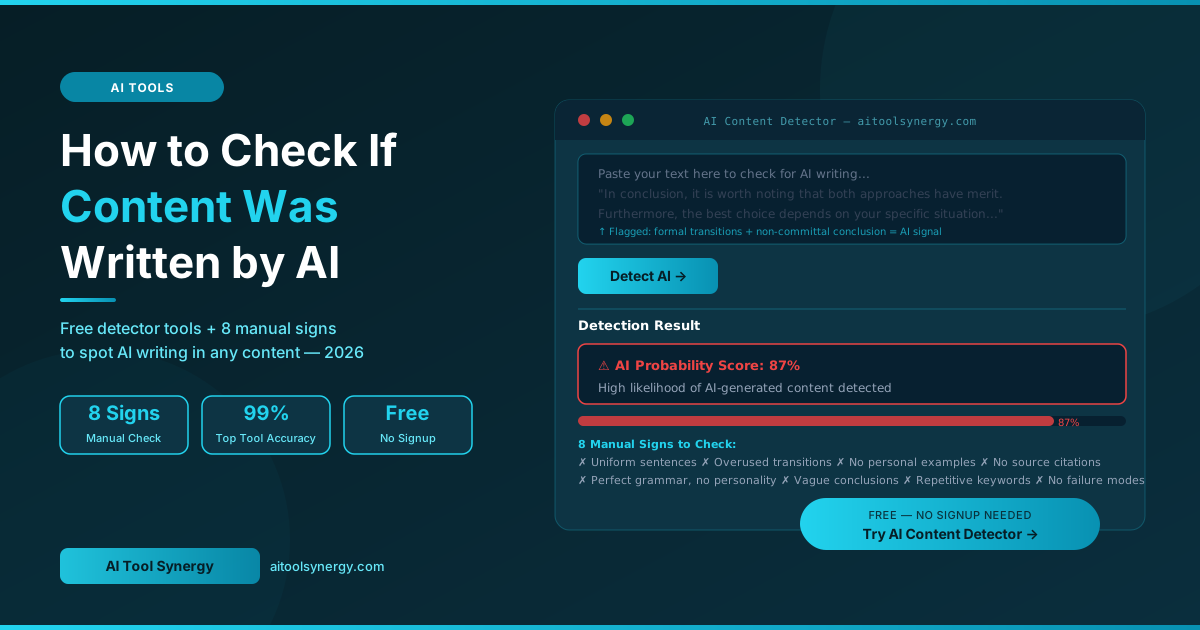
The fastest way to check if text is AI generated without any tool is to read for these eight patterns. Any single sign is not conclusive — but three or more appearing together in the same piece is a very strong indicator of machine generation, and a signal to run the text through a proper AI content checker no signup tool for confirmation.
Unnaturally Uniform Sentence Structure
Read three consecutive paragraphs out loud. Human writing varies — short declarative sentences, long complex ones, fragments for emphasis. AI-generated text tends to produce a metronomic rhythm: medium-length sentence, medium-length sentence, medium-length sentence. Every paragraph follows the same basic architecture. If you notice this uniformity, it is one of the strongest manual signals for detecting AI writing before you even open a detector tool.
Overuse of Transitional Phrases
AI models are trained to produce “coherent” text and do so by inserting explicit connective tissue between ideas. Watch for phrases like “Furthermore,” “It is worth noting that,” “In conclusion,” “It is important to consider,” “Additionally,” and “Moreover” appearing repeatedly. Human writers use these sparingly. When you see four or five of these phrases in a single blog post, you are very likely reading AI written content — and any free AI checker will confirm it.
No Personal Experience, No Specific Examples
One of the most reliable ways to tell if something was written by ChatGPT or another AI is to ask: does the author mention a specific person, client, date, or personal failure? Human writers draw from lived experience — they name the client whose project taught them a lesson, reference the specific tool that broke their workflow, or mention the year they made a particular mistake. AI generates plausible generalities. If an article about SEO never mentions a specific site, campaign, or real result — and you are trying to figure out is this AI written — this absence of specificity is your clearest signal.
Overly Balanced, Non-Committal Conclusions
AI models are trained to avoid controversy and present “balanced” perspectives. This produces conclusions that acknowledge every possible viewpoint without committing to one. A human writer on a topic they know well takes a position. An AI says “while both approaches have merit, the best choice depends on your specific situation.” If the conclusion hedges every claim and lands nowhere definitive, you are looking at a classic sign of AI generated writing — one that even readers with no SEO knowledge intuitively feel as unsatisfying.
Perfect Grammar with Zero Personality
Human writing has fingerprints — a dash used for emphasis, a sentence fragment for dramatic effect, an occasional colloquialism, an imperfect comma splice. AI text is grammatically flawless and stylistically sterile. Not a single typo, not a regional expression, not a moment of authentic voice. If a piece reads like it was written by someone who has never had an opinion — that sterility is a human authenticity check that most AI generated content fails immediately. This is also why signs of AI written content are easier to spot in long-form articles than in short social posts.
Vague Statistics Without Named Sources
AI models hallucinate facts with complete confidence. They produce statistics like “studies show that 73% of users…” without citing which study, which year, or which organisation conducted it. When you see numerical claims with no hyperlink, no author name, and no publication — especially when the percentage is oddly round — treat it as a red flag. This is one of the most dangerous characteristics of AI written articles, particularly in health, finance, and legal content where accuracy is critical.
Repetitive Keyword Usage Without Variation
AI content often repeats the same keyword phrase multiple times in nearly identical constructions — not because of deliberate SEO strategy, but because the model returns to high-probability phrases it has been trained on. If you notice the same 3-4 word phrase appearing in the introduction, two subheadings, and the conclusion with minimal variation, this repetitive pattern is worth running through a ZeroGPT detector or similar tool for confirmation. Human writers naturally vary their phrasing across a long piece.
No Real-World Limitations or Failures Mentioned
Authentic expertise includes knowing what does not work. Human writers who truly know a subject mention failure modes, caveats, exceptions, and scenarios where the usual advice breaks down. AI models present the textbook version of everything. If an article about building backlinks never acknowledges that guest posting has become saturated, or an article about AI detection never mentions false positives for non-native speakers — that selective optimism is a human authenticity check that most AI-generated pieces fail. Real expertise is defined as much by what it acknowledges as what it asserts.
Best Free AI Content Detector Tools in 2026
Manual reading catches many cases, but for faster, more systematic checking you need a dedicated AI writing detector. These are the most reliable free tools available in 2026 — each tested against clearly AI-generated text and human writing, with genuine strengths and honest limitations worth understanding before you rely on them.
AI Tool Synergy — AI Content Detector FREE
Our own free AI Content Detector gives you an instant AI probability score for any pasted text — no signup, no character limits, no daily cap. Paste your article, blog post, or essay and get results in seconds. Works on content from ChatGPT, Claude, Gemini, and all major AI writing tools. Built specifically for bloggers, editors, and content teams who need a fast, reliable AI text checker free without friction or subscriptions.
GPTZero FREE TIER
The most widely validated AI generated text checker available. GPTZero was independently benchmarked on RAID — a comprehensive third-party dataset — where it detected 95.7% of AI texts while incorrectly flagging only 1% of human texts. It is also the only major detector specifically de-biased for non-native English speakers, significantly reducing false positives for writers from Pakistan, India, and the Middle East. The GPTZero free tier covers documents under 10,000 characters — enough for most blog posts and essays.
Copyleaks FREE TIER
Copyleaks combines an AI plagiarism checker with AI detection in one platform, making it particularly useful for editors who need to check both originality and AI authorship simultaneously. Supports over 30 languages and claims over 99% accuracy on clearly AI-generated text. The free tier allows up to 25,000 characters per scan — enough for most blog posts. Trusted by universities and large editorial teams, it is one of the most thorough tools when you need to detect ChatGPT writing in academic or professional contexts.
ZeroGPT FREE
The ZeroGPT detector is one of the most accessible free tools — no account required, no character limit on the free version, and results delivered within seconds. It provides a percentage score and highlights specific sentences it identifies as AI-generated, making it useful for identifying which sections of a mixed human-AI document were machine-written. A solid choice when you need to check if text is AI generated quickly without any setup.
Sapling AI Detector FREE
Sapling’s detector covers the newest AI models including GPT-5, Claude 4.5, Gemini 2.5, Qwen3, and DeepSeek-V3 — making it one of the most current tools for detecting output from the latest generation of language models. It analyses text at both document and sentence level using complementary techniques, and offers a browser extension that lets you detect AI writing on any webpage without copying and pasting text manually.
Quillbot AI Detector FREE
Quillbot’s AI content checker goes beyond a simple yes/no answer — it distinguishes between entirely AI-written, entirely human-written, and human-written with AI refinement. This three-way classification is useful for editors reviewing content drafted by a human and then polished with AI assistance, which is increasingly common in professional workflows. Requires a minimum of 80 words for accurate results — short samples produce unreliable scores across all detectors.
How to Use a Free AI Detector — Step by Step
Using our AI Content Detector or any similar tool takes under 60 seconds. Here is the exact process for anyone learning how to check if content was written by AI for the first time:
- Copy the text you want to check. Select the full article or section you are suspicious about. For best accuracy, use at least 200 words — shorter samples produce less reliable results across all detectors, including the best free AI checkers.
- Go to the detector tool. Visit aitoolsynergy.com/ai-content-detector — no account needed, works instantly on any device.
- Paste the text and click Detect. The tool analyses the text and returns an AI probability score. Above 80% indicates likely AI generation. Between 40–80% suggests mixed or heavily edited AI content. Below 40% is likely human-written.
- Review highlighted sections. Most detectors highlight specific sentences with the highest AI probability — focus your manual review on those using the eight signs from earlier in this guide.
- Cross-reference with manual signs. If the score is in the ambiguous 40–70% range, apply the eight manual signs above. Tool scores combined with manual reading gives the most accurate overall assessment.
Accuracy and Limitations — What AI Detectors Cannot Do
Every AI writing detector has limitations that matter before using results to make significant decisions — especially in academic or professional contexts where a false accusation carries real consequences.
| Limitation | What It Means in Practice |
|---|---|
| False positives | Human text flagged as AI-generated. Particularly common for non-native English speakers (61.3% false positive rate in some studies) and formal, structured academic writing that resembles AI in its clarity |
| Heavily edited AI text | AI content substantially rewritten by a human editor significantly reduces detection accuracy — some edited AI passes as human-written even through the best AI content checkers |
| Short text under 200 words | All detectors perform worse on short samples — perplexity and burstiness patterns need sufficient text to produce reliable scores. Do not rely on any AI text checker free tool for very short samples |
| Newest AI models | Detectors trained before GPT-5 or Claude 4 may not reliably identify their output — always use tools that are actively updated and cover recent model releases |
| Mixed content | Articles blending human writing with AI-generated sections are harder to classify at document level — use sentence-level highlighting in tools like ZeroGPT to catch mixed usage |
Does AI Content Hurt SEO and Google Rankings?
This is the most common question from bloggers and content managers auditing their existing articles. The short answer is: it depends entirely on quality, not on whether AI was involved in writing it.
Google’s official guidance on helpful content states that AI can be a useful tool for research and drafting, but that creating many pages at scale without adding original value can violate spam policies. In March 2024, Google penalised sites using AI to flood their indexes with low-effort, repetitive content that provided no genuine insight beyond what was already ranking. The sites that were penalised shared one characteristic: the content was published unedited, at volume, with no human review.
However, AI-assisted content that has been human-edited, fact-checked, enriched with original data or specific examples, and written with genuine reader value in mind has ranked successfully across competitive niches. The distinction Google draws is not “human vs AI” — it is “helpful vs unhelpful.” If you are using our AI Content Detector to audit your own blog posts before publishing, you are taking exactly the right step. Use it to identify high-probability AI sections, then rewrite those sections with specific examples, named sources, and genuine opinions that a machine could not have produced on its own.
Understanding how to detect AI writing in your own content is ultimately the same skill as understanding how to make it better. The signals that detectors flag — low perplexity, uniform structure, vague transitions, missing specificity — are the same signals that make content feel hollow to human readers. Fix those and you improve both your AI detection score and your content quality simultaneously. Track how that improved content affects your authority over time with our free Domain Rating Checker.
How to Check AI Writing on Different Content Types
How to Check If a Blog Post Was Written by AI
Blog posts are the most common content type flagged for AI detection. Key signals include no personal anecdotes, no named sources, overly comprehensive coverage of every angle without depth, and conclusions that say nothing actionable. Paste the full post into our AI Content Detector and then manually review any highlighted paragraphs using the eight signs above. For SEO blog content specifically, also check whether the URL slug and meta description match the actual content — AI generators sometimes produce inconsistent signals across page elements.
How to Tell If an Essay Is AI Written
Academic essays show AI authorship through unnaturally formal transitions, perfectly structured argument progression, no acknowledgement of counterarguments from specific scholars, and conclusions that summarise rather than advance new insight. GPTZero and Copyleaks are particularly well-suited for essay checking as both were built partly for academic integrity use cases and have been validated in educational environments.
How to Detect AI Writing in Social Media Posts
AI social media content typically lacks platform-specific voice — it sounds like a press release adapted for the platform rather than something written natively for it. Watch for formal sentence structure, mechanical hashtag usage, and an absence of casual abbreviations and slang native to each platform. Short text is harder to check if text is AI generated with tools — rely more on the manual signs for very short content under 100 words.
Frequently Asked Questions
Final Thoughts
Knowing how to check if content was written by AI has become an essential skill in 2026. The combination of free detector tools and the eight manual signs covered in this guide gives you a reliable, practical system that works on any content type without paid subscriptions or technical expertise. Use the tools for speed and the manual checklist for depth — together they cover the full range of AI-generated content from clearly unedited machine output to lightly touched AI drafts.
The most important takeaway is that no single signal is conclusive. Use AI detector scores as a starting point, apply the manual checklist to ambiguous results, and always reserve judgment in high-stakes contexts where a false positive could harm someone unfairly. For your own content, the goal is not to avoid AI entirely — it is to ensure every published piece has genuine value that a machine alone could not have produced. That means specific examples, original observations, named sources, and a human voice that takes real positions.
✅ Free AI Content Detector — No Signup, Instant Results
Check any text for AI writing instantly. Works on blog posts, essays, articles, product descriptions, and any long-form content. 100% free, forever — no account required.
Open Free AI Content Detector →