


Most people try a morning routine for success, stick with it for three days, then abandon it entirely by week two. The alarm goes off, the snooze button wins, and that carefully planned routine stays in a journal untouched. Sound familiar?
The problem isn’t your discipline — it’s your design. Most morning routines for success fail because they were built wrong from the start: too long, too rigid, or too borrowed from someone else’s lifestyle.
This guide gives you the science of what’s happening in your brain during the first 60 minutes after waking, the habits that research actually validates, three time-based templates for different schedules, and a 30-day step-by-step plan for building a morning routine for success that becomes automatic — not something you have to force every day.
Why Most Morning Routines Fail Within Two Weeks
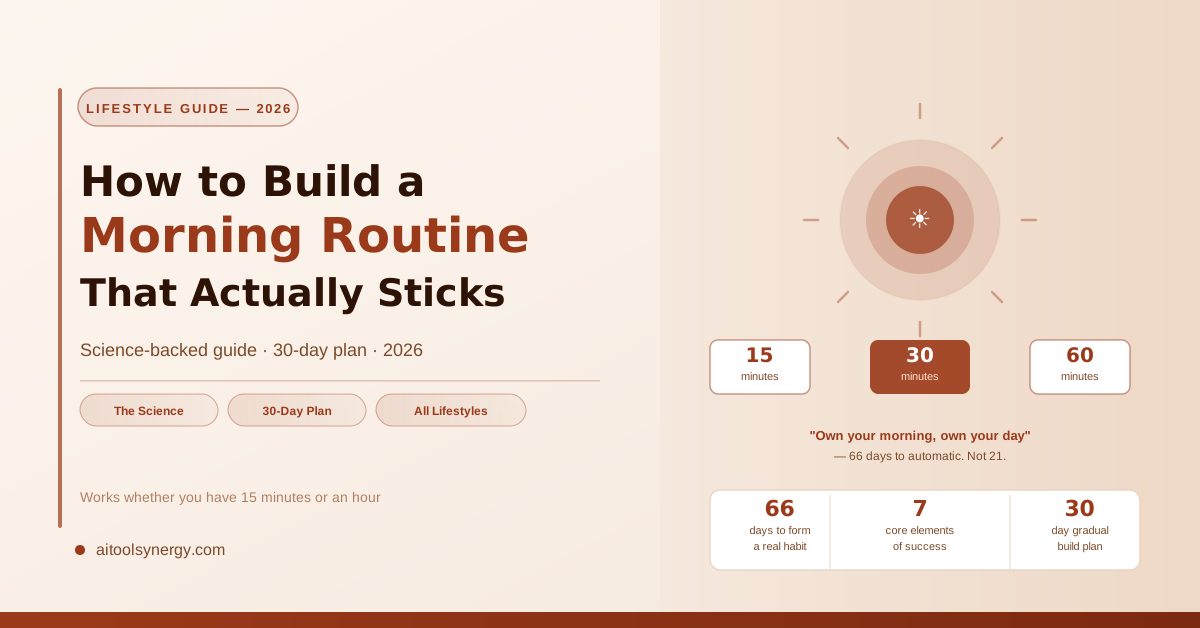
Research from University College London found it takes an average of 66 days to form a new habit — not the commonly cited 21. Yet most morning routine guides hand you a list of 8 things to do and call it a plan.
There’s no implementation framework, no gradual build-up, and no strategy for the days when everything falls apart. That gap between “here’s what to do” and “here’s how to make it automatic” is where routines go to die.
The three most common reasons a morning routine for success collapses:
- Starting with too many habits at once. Adding six new behaviors simultaneously overwhelms your willpower and makes every morning feel like a performance rather than a ritual.
- Copying someone else’s routine without adapting it. Tim Cook’s 3:45AM start works for Tim Cook. It won’t work for a parent of a newborn or a shift worker finishing at midnight.
- No failure recovery system. Missing one morning feels like failure, which triggers guilt, which makes the next morning harder. Without a “miss one, not two” rule, the whole routine collapses.
Understanding why routines fail is more valuable than any specific habit recommendation. Fix the design flaws first, then add the habits.
The Science Behind Mornings — What Happens in Your Brain When You Wake Up
Within the first 30 to 45 minutes after waking, your body produces a natural spike in cortisol known as the cortisol awakening response (CAR). This isn’t stress — it’s your brain’s built-in activation system, sharpening focus and priming cognitive function for the day ahead.
A study published in Psychoneuroendocrinology found that people with stronger CAR responses showed significantly better working memory, sustained attention, and executive function throughout the morning. The CAR is your biological head start — and what you do in those first 30 minutes either amplifies it or blunts it.
Your brain also begins producing dopamine and serotonin more actively in the morning — both directly influenced by light exposure, movement, and social connection. These aren’t optional wellness additions to your morning routine for success. They’re the biological infrastructure of a good day.
According to the Sleep Foundation, your circadian rhythm — the internal 24-hour biological clock — determines when these systems fire most powerfully. Working with it, rather than against it, is the foundation of any effective morning routine.
What Successful People’s Morning Routines Actually Have in Common
Everyone from Robin Sharma to Oprah to Tim Cook has written or spoken about their morning routines. The specifics vary wildly — Cook starts at 3:45AM, Oprah meditates and journals, Jeff Bezos prioritizes sleep above all else. But look past the individual habits and a clear pattern emerges.
| Element | Tim Cook | Oprah Winfrey | Jeff Bezos | Tom Bilyeu |
|---|---|---|---|---|
| No phone first thing | ✅ | ✅ | ✅ | ✅ |
| Physical movement | ✅ | ✅ | ✅ | ✅ |
| Quiet time (meditation/journal) | — | ✅ | — | ✅ |
| Intentional breakfast | ✅ | ✅ | ✅ | ✅ |
| Priority task review | ✅ | — | ✅ | ✅ |
| Consistent wake time | ✅ | ✅ | ✅ | ✅ |
The common thread isn’t the specific activities — it’s the deliberate protection of the first hour. Every person above guards those early minutes from reactive demands (email, news, social media) and uses them to set their own mental agenda.
As behavioral scientist James Clear notes in Atomic Habits, habit stacking — pairing new habits with existing anchor behaviors — is one of the most reliable ways to make routines stick. Successful morning routines don’t ask you to find new time. They restructure the time you already have.
The Anti-Hustle Warning — You Don’t Need a 5AM Routine to Succeed
The 5AM morning routine has been sold aggressively as the universal key to success. Robin Sharma’s The 5AM Club popularized it, and countless productivity influencers have followed. But the science tells a more nuanced story.
Your chronotype — whether you’re naturally a morning person, an evening person, or somewhere in the middle — is approximately 50% genetically determined, according to research from the American Psychological Association. Night owls forced to operate on early-morning schedules show elevated cortisol stress markers, reduced cognitive performance, and worse long-term health outcomes than those working with their natural rhythm.
The 2026 slow living movement — which McKinsey research shows is driving behavior change for over 22% of millennials experiencing regular burnout — is actively pushing back against hustle-culture morning routines. The emphasis has shifted from doing more in the morning to doing the right things in the morning, regardless of what time that is.
The goal of a morning routine for success isn’t to wake up earlier. It’s to own the first hour of your day, whatever time that hour starts.
The 7 Core Elements of a Morning Routine for Success
These seven elements appear consistently in the research on high-performance morning routines. You don’t need all seven in your routine — but a strong morning routine for success will typically include at least four of them.
Hydration Before Caffeine
Your body loses approximately 1 litre of water during sleep through breathing and perspiration. Starting with 400–500ml of water before any caffeine rehydrates your cells, jumpstarts your metabolism, and supports the cortisol awakening response.
Many people reach for coffee before water and then wonder why they feel sluggish despite the caffeine. Water first, coffee second — this simple sequence makes a measurable difference in morning energy levels.
Physical Movement (Even 7 Minutes)
You don’t need a 45-minute gym session in your morning routine for success. Seven minutes of movement — stretching, a short walk, bodyweight exercises, or yoga — triggers the release of BDNF (brain-derived neurotrophic factor), which directly improves learning, memory, and focus.
A 2020 study in Frontiers in Human Neuroscience found that even brief morning exercise improved executive function and cognitive flexibility for up to 4 hours afterward. The minimum effective dose is much lower than most people assume.
No Phone for the First 30 Minutes
Checking your phone within minutes of waking immediately shifts your brain into reactive mode — responding to other people’s agendas before you’ve set your own. This suppresses the cortisol awakening response and fragments your attention before you’ve had a chance to focus it.
This is the single highest-leverage change in any morning routine for success, and it costs nothing. Keep your phone in a separate room overnight, or use a physical alarm clock to remove the temptation entirely.
One Anchor Habit
An anchor habit is the centerpiece of your morning — the one activity you commit to regardless of how rushed or disrupted the rest of the routine is. Common choices include journaling (5–10 minutes), meditation, reading, or a brief gratitude practice.
The anchor habit isn’t about the specific activity — it’s about having something that signals to your brain “the morning routine has happened.” Even on days when you skip everything else, doing your anchor habit maintains the identity of being someone with a morning routine.
Protein-Based Breakfast Within 60 Minutes
Blood sugar stability in the morning directly affects cognitive performance, mood, and afternoon energy levels. A protein-focused breakfast (eggs, Greek yogurt, nuts, cottage cheese) stabilizes blood glucose far more effectively than carbohydrate-heavy options like cereal or toast.
Research published in the American Journal of Clinical Nutrition found that high-protein breakfasts reduced afternoon cravings, improved satiety, and led to better cognitive performance compared to high-carbohydrate equivalents with the same calorie count.
Write Down Your 3 Priority Tasks
Before opening any email, messaging app, or work system, write down the three most important things you need to accomplish today. Not a full to-do list — just three. This practice forces you to distinguish between urgent and important before the day’s noise makes that distinction blurry.
The act of writing (not typing) activates the encoding process in the brain more effectively, making you more likely to follow through on what you’ve written. Keep a physical notebook next to where you have breakfast for this.
Strategic Caffeine Timing
Drinking coffee immediately upon waking — before cortisol has peaked — reduces caffeine’s effectiveness and accelerates tolerance buildup. Waiting 60 to 90 minutes after waking means your coffee hits during the natural cortisol dip, providing maximum alertness with minimum tolerance development.
Your caffeine timing also determines your sleep quality that night. If you want to understand how caffeine’s half-life affects both your morning and your evening, our free Caffeine Half-Life Calculator shows you the exact window when caffeine is still active in your system.
Morning Routine Templates by Time Available
One reason morning routines for success fail is that they assume everyone has an hour to spare. Most people don’t. Here are three templates built around realistic time constraints — choose the one that matches your current schedule, not your ideal schedule.
The 15-Minute Morning Routine
| Time | Activity | Why It Matters |
|---|---|---|
| 0–2 min | Drink 400ml water | Rehydration + cortisol support |
| 2–9 min | 7-minute stretch or walk | BDNF + dopamine activation |
| 9–13 min | Write 3 priority tasks | Intentional vs reactive day |
| 13–15 min | No phone / quiet start | Protect focus window |
The 30-Minute Morning Routine
| Time | Activity | Why It Matters |
|---|---|---|
| 0–2 min | Water + brief daylight exposure | CAR amplification |
| 2–12 min | Exercise (walk, bodyweight, yoga) | BDNF + energy |
| 12–17 min | Journaling or meditation | Anchor habit + mental clarity |
| 17–25 min | Protein breakfast | Blood sugar + cognitive performance |
| 25–30 min | 3 priority tasks + day intention | Proactive vs reactive mode |
The 60-Minute Morning Routine
| Time | Activity | Why It Matters |
|---|---|---|
| 0–5 min | Water + cold face wash | Full cortisol activation |
| 5–25 min | Full workout or 20-min walk | Sustained BDNF release |
| 25–35 min | Meditation or journaling | Emotional regulation + clarity |
| 35–50 min | Protein breakfast + reading | Nutrition + ideas input |
| 50–58 min | Review goals + 3 priority tasks | Alignment with long-term focus |
| 58–60 min | First strategic caffeine | Maximum effectiveness window |
What NOT to Do in Your First 30 Minutes
A morning routine for success isn’t only about what you add. It’s equally about what you remove. These seven habits reliably sabotage the effectiveness of any morning routine — avoid all of them in the first 30 minutes after waking.
- Checking your phone within 5 minutes of waking. This immediately places you in reactive mode and suppresses the cortisol awakening response. The most common morning routine mistake by a significant margin.
- Hitting snooze multiple times. Fragmented sleep in the final 30–60 minutes produces sleep inertia — a groggy, disoriented state that can last 2–4 hours. One alarm, get up.
- Skipping water for coffee. Dehydrated cells absorb caffeine poorly and the cortisol activation is blunted. Water first, every time.
- Starting with email or Slack. Email is other people’s agenda. Reviewing it before your own priorities means your first mental energy of the day goes to solving someone else’s problems.
- Skipping breakfast entirely. Intermittent fasting has its place — but pushing breakfast too late while trying to perform cognitively depletes blood glucose and degrades decision-making quality in the morning hours.
- Consuming news or social media first thing. Negativity bias means alarming content is processed faster and sticks longer. Starting the day with news sets an anxious baseline that affects mood and performance for hours.
- Making the routine different every day. Consistency is the mechanism by which habits become automatic. A morning routine for success requires the same sequence each morning — variation is the enemy of automaticity.
How to Build Your Morning Routine From Scratch — The 30-Day Plan
The reason most morning routines fail isn’t lack of motivation — it’s trying to install six new habits simultaneously. This 30-day plan adds one habit per week, allowing each to become automatic before the next is added.
One habit only: No phone for the first 30 minutes
Put your phone in another room the night before. Use a separate alarm clock. This one change restructures the entire morning before you’ve added anything else.
Focus only on this. Don’t add anything new this week. Let it become the default before you build on it.
Add: Hydration + 7 minutes of movement
Place a glass of water on your nightstand. Drink it before anything else. Immediately follow with 7 minutes of movement — this can be as simple as a brisk walk around the block or a YouTube stretch routine.
Stack these onto the phone-free habit: wake up → water → movement → phone-free buffer. You now have a 10-minute foundation.
Add: Your anchor habit (journaling or meditation)
Choose ONE. Five minutes of journaling (write whatever comes to mind — no structure needed yet) or five minutes of focused breathing. This is your identity marker: it signals to your brain that you are someone who has a morning routine.
The anchor habit doesn’t need to be profound. It needs to be consistent.
Add: 3 priority tasks + intentional breakfast
Write your three most important tasks for the day in a physical notebook over breakfast. By week four, the earlier habits are becoming automatic. You’re now adding the highest-leverage cognitive habit — intentional priority-setting — on top of a stable foundation.
By day 30, you have a complete 25–35 minute morning routine for success that took four weeks to build rather than one chaotic day to attempt and abandon.
Morning Routines for Different Lifestyles
A morning routine for success looks different depending on your life circumstances. These adaptations are designed for four common situations where generic morning routine advice doesn’t apply cleanly.
Parents With Young Children
If your mornings are controlled by a toddler, a rigid 60-minute routine is fantasy. The adapted approach: wake 20 minutes before your children and use that window for the highest-priority element (usually the anchor habit or the phone-free buffer). Even 15 minutes of owned morning time produces meaningful benefit over zero.
The priority shifts from building a long routine to protecting a short one. Twenty consistent minutes beats an elaborate routine that gets abandoned when the baby wakes up early.
Remote Workers and Expats (UAE, Gulf, Global)
Remote workers face the unique challenge of blurred boundaries — no commute means the home office is always a few steps away, making it easy to start work immediately upon waking. This is one of the most common ways professionals destroy their morning routine for success without realizing it.
The fix is a deliberate “pre-work ritual” — a specific sequence of activities that signals the transition from personal time to work mode. This is especially important for expats in the UAE and Gulf region, where the work week runs Sunday to Thursday and the boundary between personal and professional time can be particularly blurry.
Use our free Salary to Hourly Calculator to understand the real value of each morning hour — knowing exactly what each productive hour is worth can be a powerful motivator for protecting your morning routine.
Shift Workers and Non-Traditional Hours
If your shift starts at 2PM or ends at 6AM, a “morning” routine is whatever happens in your first waking hour — regardless of the clock. The same biological principles apply: hydration, movement, no phone, anchor habit. The time of day is irrelevant; the sequence is what matters.
Shift workers should prioritize consistent sleep timing above all other elements of a morning routine. The circadian rhythm is the foundation — without consistent sleep and wake times (even for irregular schedules), no morning routine will function optimally.
Night Owls
If you’re a natural night owl, stop trying to become a morning person and start optimizing the first hour of YOUR waking, whenever that is. A morning routine starting at 9AM followed consistently will produce better results than a 5AM routine abandoned by day four.
Night owls can still benefit from every element described in this guide — the science doesn’t care what time it is, only what you do when you first wake up.
Best Apps and Tools for Your Morning Routine in 2026
The right tools remove friction from your morning routine and make it easier to stay consistent. These are the best options available in 2026, across different needs and budgets.
| App / Tool | Best For | Cost | Platform |
|---|---|---|---|
| Headspace | Guided meditation and breathing | Free / $12.99/mo | iOS, Android |
| Finch | Gentle habit tracking (self-care focus) | Free / $3.99/mo | iOS, Android |
| Notion | Morning journaling and priority tasks | Free tier available | All platforms |
| Streaks | Habit streak tracking — up to 12 habits | $4.99 one-time | iOS |
| Five Minute Journal (app) | Structured daily journaling | Free / $39.99/yr | iOS, Android |
| Oak — Meditation | Simple, free meditation timer | Free | iOS |
| Physical alarm clock | Removing phone from bedroom | $10–30 | — |
| Gratitude journal (physical) | Low-friction, no screen anchor habit | $10–25 | — |
The most important tool recommendation: a physical alarm clock. It costs under $20 and solves the single most common morning routine failure — reaching for your phone to turn off the alarm and never putting it down again.
Why Your Morning Routine Keeps Failing — And How to Fix It
If you’ve tried building a morning routine for success multiple times and it keeps not sticking, one of these is the reason:
Your routine is too long for your actual life
If your morning routine takes 90 minutes but you have 30 minutes before you need to leave, it will fail every single day. Cut it ruthlessly. A 15-minute routine maintained for 6 months is infinitely more valuable than a 60-minute routine maintained for 5 days.
You start from zero rather than building gradually
The 30-day plan in this guide exists precisely to solve this. Starting with one habit, making it automatic, then adding the next is the only approach that produces durable routines.
The routine doesn’t match your chronotype
Stop setting alarms 2 hours earlier than your body naturally wants to wake. Work with your biology, not against it. The best time for your morning routine is the time that doesn’t require extreme willpower just to begin.
You skip the night before
A morning routine for success actually begins the night before. Laying out workout clothes, filling a water glass, putting your phone in another room, and writing tomorrow’s three priority tasks the night before removes all the friction points that cause morning routines to collapse.
Perfectionism kills consistency
A “perfect” morning routine that happens twice a week is worse than a “mediocre” morning routine that happens every single day. Consistent and simple always beats perfect and occasional. Use the miss-one-not-two rule, accept imperfect days, and keep showing up.
Know the Real Value of Every Morning Hour
Your morning routine for success directly affects your productivity — and your productivity directly affects your earning power. Use our free Salary to Hourly Calculator to see the exact monetary value of each focused hour in your day.
Calculate Your Hourly Value →






One Response
[…] Related Articles HealthHow Caffeine Affects Sleep & Your Best Cutoff Time HealthCaffeine Half Life Calculator — How Long Does It Stay in Your System? HealthWhat Is a Healthy BMI — And Why Your Number Might Be Misleading HealthHow to Build a Morning Routine for Success That Actually Sticks […]