

Ideal Sentence Length for Readability (Research-Backed Guide)
The ideal sentence length for readability is 15–20 words on average. This isn’t a guess — it’s backed by decades of reader comprehension research, and it’s the same range recommended by GOV.UK’s own content design guidance and most professional style guides. Push much past that range and comprehension starts dropping fast, even for highly literate readers.
This guide breaks down the actual research behind that number, shows how sentence length interacts with your Flesch reading ease score, and gives you a practical way to check your own average as you write. If you’d rather check your text right now, paste it into our free word counter and look at the sentence length breakdown in the Full Analysis view.
Check Your Average Sentence Length Instantly
Paste any text into our free word counter to see your average sentence length, sentence-length distribution, and Flesch score in real time — no signup required.
Check My Sentences →Why 15–20 Words Is the Ideal Sentence Length for Readability
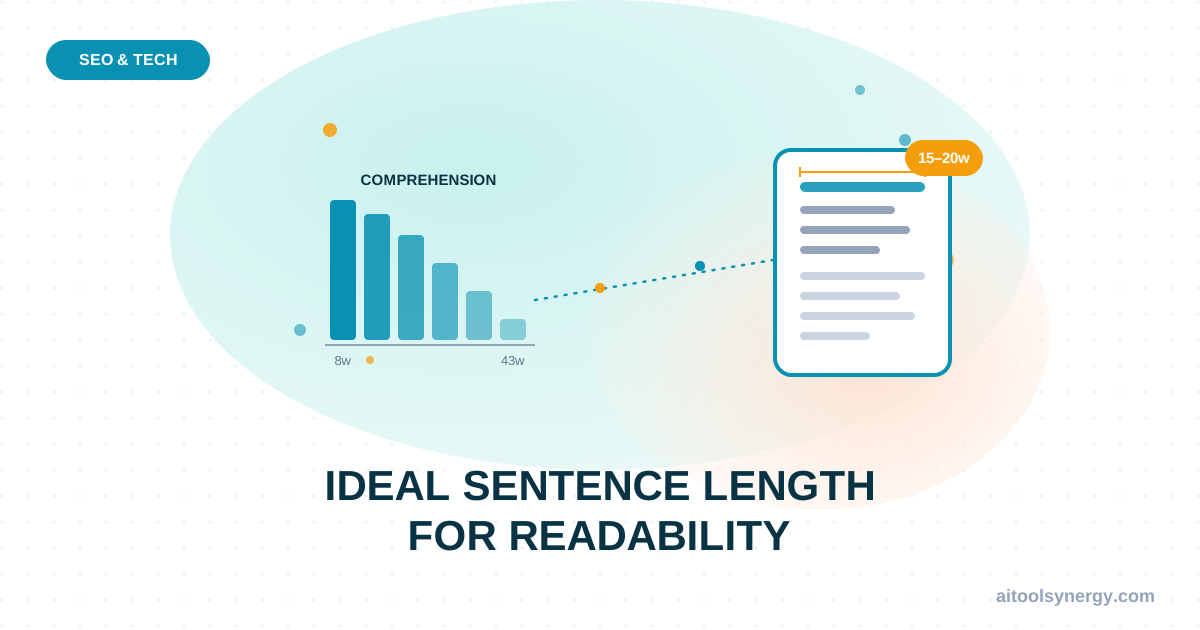
Comprehension research has repeatedly found that reader understanding holds steady through short sentences, then drops sharply as sentences get longer. This pattern is the entire reason 15–20 words became the accepted target across journalism, government writing, and web content alike — it’s the last point on the curve before comprehension starts falling meaningfully.
At 8 words or fewer, comprehension is close to 100%. At 14 words — near the low end of that ideal range — it’s still above 90%. By 28 words it’s already fallen to roughly 50–59%, and past 43 words it drops below 10%. That’s not a gentle slope; it’s a cliff.
What Official Style Guides Say About Sentence Length
This isn’t just marketing advice — government agencies that are legally required to communicate clearly land on nearly the same number. The official GOV.UK content design guidance instructs writers not to use sentences longer than 25 words, and to split or condense anything that runs longer. The U.S. Federal Plain Language Guidelines point in the same direction, recommending short, direct sentences as one of the core tools for making public-facing writing understandable.
Sentence Length and Your Flesch Reading Ease Score
Average sentence length isn’t just a readability guideline on its own — it’s one of only two inputs in the Flesch reading ease formula, alongside average syllables per word, as documented on Wikipedia’s overview of the Flesch–Kincaid tests. Every extra word you add to your average sentence length pulls your Flesch reading ease score down by roughly a full point. We cover the full formula and score benchmarks in our guide to what counts as a good Flesch reading ease score — sentence length is the lever that moves it fastest.
Why Readers Need Short Sentences More Than Ever
Part of why the ideal sentence length for readability matters so much online specifically comes down to how people actually read web pages. Nielsen Norman Group’s foundational research found that 79% of web users scan a new page rather than reading it word by word — only 16% read carefully all the way through. Long, dense sentences are the easiest thing for a scanning reader to skip entirely.
See Your Sentence-Length Breakdown
Our free word counter doesn’t just give you an average — it shows what share of your sentences are short, medium, long, or very long, so you can spot a monotonous draft even when the average looks fine.
Analyze My Text →Average Isn’t Everything: Why Sentence Variety Matters
Here’s what that number doesn’t tell you: two passages can share the exact same average and read completely differently. A paragraph where every sentence is precisely 18 words feels flat and mechanical. A paragraph mixing short, punchy sentences with a longer explanatory one feels natural — and it can hit the same average sentence length while reading nothing alike.
- Read your draft out loud. If every sentence has identical rhythm, some need breaking up and others need combining.
- Use short sentences to make key points land. A five-word sentence after several longer ones creates emphasis.
- Reserve your longest sentences for connective or explanatory material — not for the point you most need readers to remember.
Ideal Sentence Length for Readability vs. Grade Level
| Average Sentence Length | Approx. Comprehension | Typical Use Case |
|---|---|---|
| 8 words or fewer | ~100% | Ads, headlines, children’s content |
| 14 words | ~90% | General web and blog content |
| 15–20 words | ~80–90% | Ideal range for most adult readers |
| 25 words | ~65–75% | GOV.UK’s upper limit |
| 28 words | ~50–59% | Starting to lose readers |
| 43+ words | Under 10% | Academic / legal only, and rarely justified |
FAQ: Ideal Sentence Length for Readability
What is the ideal sentence length for readability?
15–20 words on average, based on reader comprehension research and echoed in official style guides like GOV.UK’s content design guidance.
What’s the maximum sentence length before readability suffers badly?
Once individual sentences exceed 30–35 words, comprehension drops sharply, even if your overall average sits within the ideal range. Treat 35 words as a hard ceiling for any single sentence.
Does shorter always mean more readable?
Not necessarily. Sentences under 5–6 words repeated over and over can feel choppy and disconnected. Readability comes from a mix of lengths, not from minimizing every sentence.
How does sentence length affect SEO?
Google’s featured snippets tend to pull from passages with short, direct sentences that answer a question clearly. Long, hedge-heavy sentences are less likely to get extracted.
Is 20 words per sentence okay for a novel or story?
Yes — creative writing isn’t held to the same standard as web or business content. Sentence length there is a stylistic choice.
What’s the fastest way to check my average sentence length?
Paste your text into a readability tool rather than counting manually — a free word counter calculates it instantly along with your Flesch score.