


Flesch-Kincaid Grade Level Chart: What Your Score Means
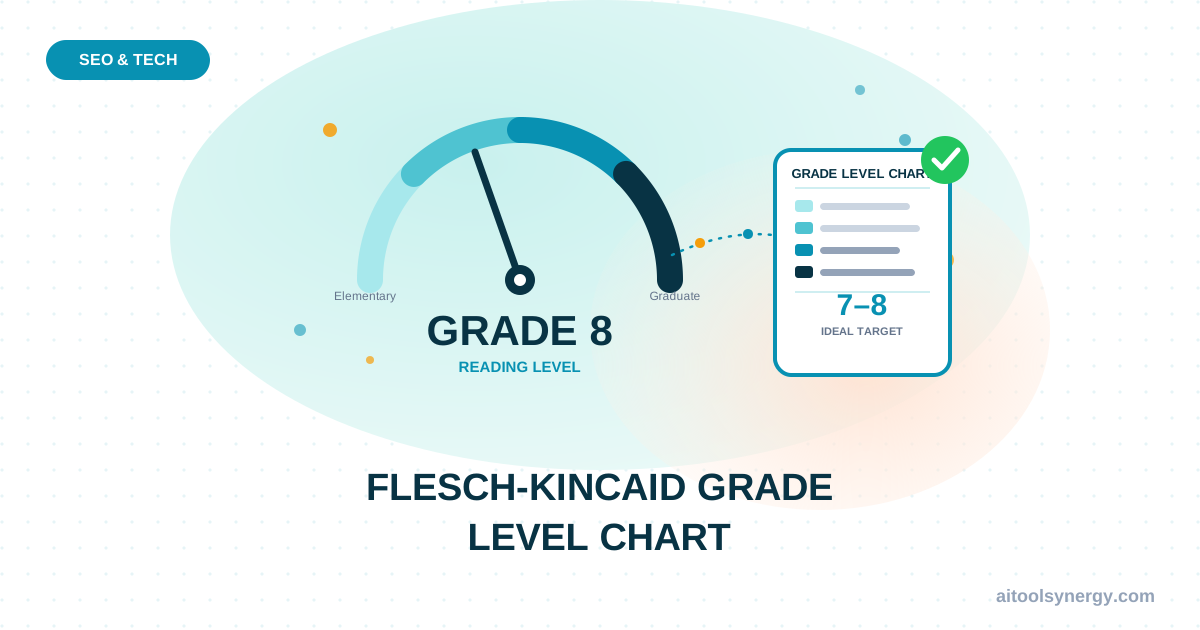
This Flesch-Kincaid grade level chart maps every score to a U.S. school grade: a score of 8 means an eighth grader can understand the text, while a score of 14 means it takes some college education to read comfortably. Unlike the Flesch reading ease score, which runs 0–100, the Flesch-Kincaid grade level speaks in years of education — lower is easier, higher is harder.
Both metrics come from the same two inputs — average sentence length and average syllables per word — but they answer different questions. If you haven’t yet, see our companion guide on what counts as a good Flesch reading ease score for the 0–100 version of this formula. Below is the full Flesch-Kincaid grade level chart, how the formula works, and how accurate it actually is.
Check Your Own Flesch-Kincaid Grade Level
Paste any text into our free word counter to see your Flesch reading ease score alongside your average sentence length and syllable count — the same inputs behind the Flesch-Kincaid grade level.
Check My Text →Flesch-Kincaid Grade Level Chart: Full Breakdown
| Flesch-Kincaid Grade Level | Reading Level | Approx. Flesch Reading Ease |
|---|---|---|
| Below 1 | Kindergarten | 90–100 |
| 1–3 | Early elementary school | 80–90 |
| 4–6 | Upper elementary school | 70–80 |
| 7–8 | Middle school (general audience target) | 60–70 |
| 9–10 | High school | 50–60 |
| 11–12 | High school senior | 30–50 |
| 13–16 | College | 10–30 |
| 17+ | Graduate / post-college | 0–10 |
Most plain-language guidelines target a Flesch-Kincaid grade level of 7–8 for general public content — this Flesch-Kincaid grade level chart is why that range keeps showing up as the recommended target across government, healthcare, and marketing writing guides alike.
How the Flesch-Kincaid Grade Level Formula Works
The formula behind every Flesch-Kincaid grade level chart is straightforward:
Flesch-Kincaid Grade Level = 0.39 × (Total Words ÷ Total Sentences) + 11.8 × (Total Syllables ÷ Total Words) − 15.59
J. Peter Kincaid and his team developed this version in 1975 under contract to the U.S. Navy, adapting Rudolf Flesch’s original 1948 reading ease formula into a grade-level output that was easier for Navy instructors to apply directly to technical training manuals — a history documented in the original 1975 Navy research report and summarized on Wikipedia’s Flesch–Kincaid readability tests overview. The two formulas share the same inputs but weight them differently, which is why a high Flesch reading ease score corresponds to a low Flesch-Kincaid grade level, and vice versa.
Is the Flesch-Kincaid Grade Level Score Accurate?
The Flesch-Kincaid grade level is genuinely useful but not a precise measurement of comprehension difficulty — it only measures sentence length and syllable count, not vocabulary familiarity, sentence structure complexity, or reader background knowledge. A peer-reviewed evaluation of Flesch-Kincaid grade level readability scores notes the formula can be gamed — short, choppy sentences score as “easy” even when the underlying ideas are genuinely complex, and technical jargon written in short sentences can score deceptively low.
There’s also a practical quirk worth knowing: Microsoft Word’s built-in Flesch-Kincaid grade level tool caps its output at 12, according to Harvard’s accessibility guidance — so if Word reports a grade level of “12,” your text may actually be far more advanced than that number suggests. Other tools, including this site’s own analysis, don’t apply that ceiling.
See Both Scores at Once
Rather than relying on a single grade-level number, check your Flesch reading ease score and sentence-length breakdown together for a fuller picture of your text’s readability.
Analyze My Text →Flesch-Kincaid Grade Level vs. Flesch Reading Ease: Which Should You Use?
Use the Flesch reading ease score when you want a quick 0–100 signal, and the Flesch-Kincaid grade level chart when you need to communicate a target in terms non-writers understand — “aim for an 8th-grade level” lands better with a stakeholder than “aim for a 65.” Most professional writing tools, including Microsoft Word and Yoast SEO, report both side by side for exactly this reason.
FAQ: Flesch-Kincaid Grade Level Chart
What is a good Flesch-Kincaid grade level?
7–8 is the widely recommended target for general audience content, corresponding to a Flesch reading ease score of roughly 60–70. Lower is easier; a grade level of 5–6 works well for very broad, simple communication.
What does a Flesch-Kincaid grade level of 14 mean?
A grade level of 14 corresponds to sophomore-year college reading difficulty — appropriate for academic papers, technical documentation, or specialist content, but too advanced for general web or marketing copy.
What is Flesch-Kincaid grade level 14.2 specifically?
The decimal doesn’t change the interpretation meaningfully — 14.2 still falls in the “college” range on this Flesch-Kincaid grade level chart, roughly equivalent to a second-year college student’s reading level.
Is the Flesch-Kincaid grade level score accurate?
It’s a useful proxy, not a precise measurement. It only accounts for sentence length and syllable count, so it can be gamed by short, choppy sentences and doesn’t account for vocabulary difficulty or reader background knowledge.
What’s the difference between Flesch-Kincaid grade level and Flesch reading ease?
Both use the same inputs but different weightings. Flesch reading ease reports a 0–100 score where higher is easier; Flesch-Kincaid grade level reports a U.S. school grade where lower is easier. They move in opposite directions.
Does Microsoft Word calculate the Flesch-Kincaid grade level?
Yes, built into its Editor/spell-check readability statistics — but Word caps its reported grade level at 12, so highly advanced text will still show “12” even if the true grade level is much higher.
Related Readability & Character Limit Guides
Get Your Full Readability Breakdown
Use our free word counter to check your Flesch reading ease score, sentence length average, and syllable count — the same numbers behind every Flesch-Kincaid grade level chart.
Try the Free Word Counter →