

Content creation has always been time-intensive, skill-dependent, and expensive at scale. In 2026, AI tools are revolutionizing content creation in ways that would have seemed impossible just three years ago — allowing solo creators to produce the volume and quality of output that previously required entire teams, and enabling businesses to scale their content operations without proportionally scaling their budgets.
This guide covers exactly how AI tools are changing content creation across writing, video, audio, and visual content — with specific tools, real statistics, and practical guidance for creators at every level.
The Scale of the AI Content Revolution
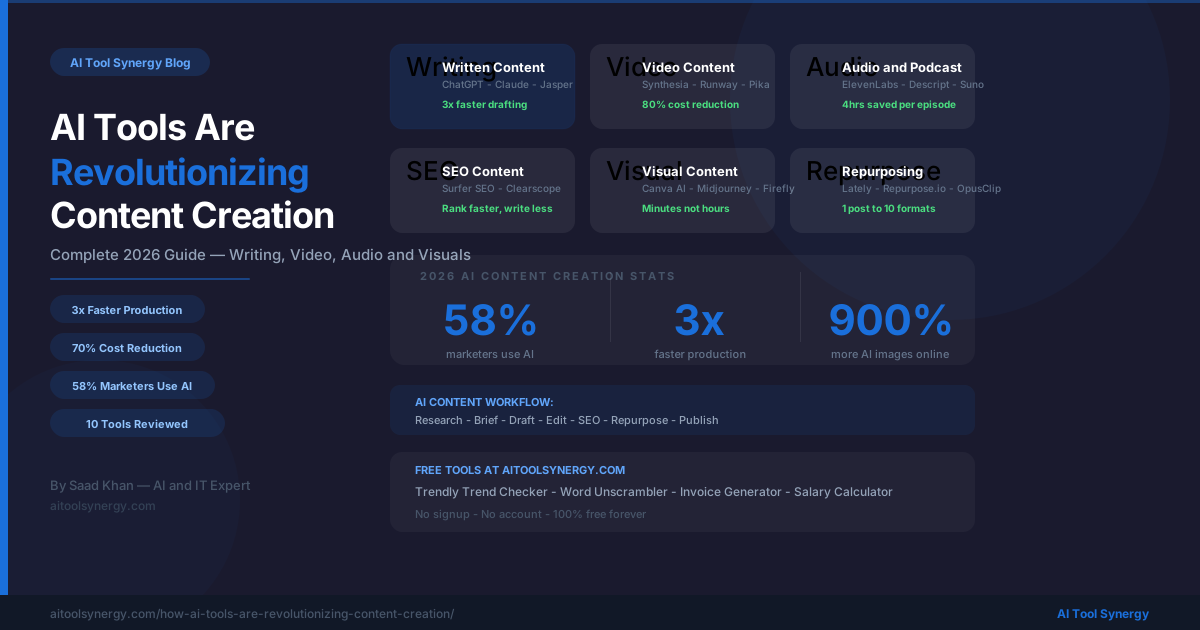
According to the Content Marketing Institute’s 2024 AI research, 58% of B2B marketers are now using AI tools in their content creation workflow — up from just 14% in 2022. The HubSpot State of Marketing report found that marketers using AI tools report producing three times more content in the same amount of time, with no significant reduction in quality as judged by their audiences.
This is not a marginal improvement — it is a fundamental shift in what’s possible for content creators and marketing teams of every size.
📊 The key shift: AI tools are not replacing human creativity in content creation — they are removing the bottlenecks that slow creative professionals down. The ideation, strategy, and authentic voice remain human. The research, drafting, formatting, and distribution are increasingly AI-assisted.
How AI Tools Are Revolutionizing Written Content Creation
1. AI Writing Assistants — From Blank Page to First Draft
The blank page problem is one of the most universal challenges in content creation. AI writing tools have essentially eliminated it. ChatGPT, Claude, and Gemini can generate a detailed first draft of any written content — blog posts, email newsletters, product descriptions, social media captions, press releases, case studies — in seconds.
The workflow that professional content creators are adopting in 2026 is consistent: use AI to generate a structured first draft, then apply human expertise to refine the argument, add original insights, verify facts, and inject authentic voice. This approach consistently produces better results faster than writing from scratch — and the AI-generated draft is usually 60-70% of the way to a publishable piece before human editing begins.
Specialized writing tools go further. Jasper offers templates optimized for specific content types — Facebook ads, Amazon product listings, LinkedIn posts. Copy.ai excels at marketing copy and brand voice consistency. Writesonic is particularly strong for SEO-optimized blog content. Each has strengths that make it more suitable than a general AI for specific content tasks.
2. AI SEO Content Tools — Ranking Faster with Less Effort
SEO content creation has been transformed by AI tools that combine keyword research, competitor analysis, and content generation in a single workflow. Surfer SEO analyzes the top-ranking pages for any keyword and generates content briefs with specific guidelines for word count, headings, semantic keywords, and structure — then its AI writer creates content optimized to those specifications.
Clearscope and MarketMuse take similar approaches, using AI to analyze content gaps and recommend exactly what topics and subtopics a piece needs to cover to rank competitively. For content teams managing large-scale SEO programs, these tools have made it possible to produce consistently high-quality, well-optimized content at a scale that was previously prohibitively labor-intensive.
For individual creators and small businesses, tools like our Trendly Keyword Trend Checker provide a free entry point into trend-based content research — showing you what keywords are gaining search interest before they become overly competitive.
3. AI Content Repurposing — One Piece, Many Formats
One of the most powerful applications of AI in content creation is repurposing — taking a single piece of content and transforming it into multiple formats automatically. A 2,000-word blog post can be transformed by AI tools into a Twitter thread, a LinkedIn carousel, an email newsletter, a short YouTube script, and five Instagram captions — in minutes rather than hours.
Repurpose.io and Lately.ai specialize in this workflow, connecting to your existing content library and automatically generating social media posts, clips, and variations from your long-form content. For content creators managing multiple channels, this multiplies the value of every piece of content produced.
How AI Tools Are Revolutionizing Video Content Creation
4. Text-to-Video — Creating Videos Without a Camera
The barrier to video content creation has fallen dramatically in 2026. Synthesia, HeyGen, and D-ID allow creators to produce professional talking-head videos simply by typing a script — AI avatars deliver the content in a chosen language, accent, and visual style. No camera, no studio, no presenter required.
For businesses creating product demos, explainer videos, e-learning content, or multilingual marketing videos — these tools have reduced video production costs by 70-80% compared to traditional production methods. Synthesia supports 140+ languages, making it possible to create localized video content for global markets at a fraction of the traditional cost.
5. AI Video Editing — Hours of Work in Minutes
Video editing is one of the most time-consuming creative tasks. AI tools are dramatically accelerating every stage of the editing process.
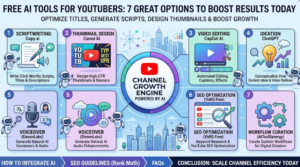
Descript allows creators to edit video by editing the transcript — delete words from the text and the corresponding video footage is automatically removed. It also removes filler words (“um”, “uh”, “like”) automatically and can clone your voice for seamless corrections. OpusClip analyzes long-form video content and automatically generates the best short clips optimized for TikTok, YouTube Shorts, and Instagram Reels — with captions, B-roll suggestions, and aspect ratio adjustments handled automatically.
For YouTube creators, VidIQ and TubeBuddy use AI to optimize titles, descriptions, tags, and thumbnails based on what’s performing in your niche — increasing organic reach without additional content production.
6. AI Thumbnail and Visual Creation for Video
YouTube thumbnails have an enormous impact on click-through rates — often more than the video title. Canva AI generates professional thumbnail designs from text prompts, while Midjourney creates custom background images and visual elements. Adobe Firefly’s Generative Fill can extend and enhance existing thumbnail compositions in seconds.
For creators producing high volumes of video content, AI thumbnail generation reduces the design time per video from 30-60 minutes to under 10 minutes — a significant productivity gain across a content calendar.
How AI Tools Are Revolutionizing Audio Content Creation
7. AI Podcast Tools — Recording to Published in Hours
Podcast production traditionally involves recording, editing, removing mistakes, adding music, writing show notes, and creating promotional clips — a process that often takes 4-6 hours for a single hour-long episode. AI tools have compressed this dramatically.
Adobe Podcast’s AI features enhance audio quality, remove background noise, and even out volume levels automatically. Otter.ai generates transcripts and show notes from recordings. Descript handles editing, filler word removal, and clip creation. ElevenLabs can generate AI voiceovers for intro music or ad reads that sound indistinguishable from human recordings.
The combined effect of these tools is that a solo podcaster can now produce a polished, professional episode in 1-2 hours rather than a full day — making consistent, high-quality podcast production genuinely manageable alongside a full-time job or business.
8. AI Music Generation for Content Creators
Royalty-free background music used to mean either expensive licensing or generic stock tracks that everyone recognizes. Suno and Udio generate original, professional-quality music tracks from text descriptions — specify the genre, mood, tempo, and instrumentation and get a unique track in seconds. Every track is original and royalty-free for the creator’s use.
For YouTube creators, podcast producers, and video marketers who need consistent background music that matches their brand, AI music generation has eliminated a significant cost and administrative burden.
AI Content Creation Tools — Complete Comparison 2026
| Tool | Content Type | Free Tier | Best For | Starting Price |
|---|---|---|---|---|
| ChatGPT / Claude | Written content | Yes | All written content types | Free / $20/month |
| Jasper | Marketing copy | No | Brand-consistent marketing | $49/month |
| Surfer SEO | SEO content | No | Ranking-optimized blog posts | $89/month |
| Synthesia | Video (avatar) | No | Corporate and training video | $22/month |
| Descript | Video and podcast | Yes (limited) | Editing by transcript | $24/month |
| OpusClip | Short video clips | Yes | Repurposing long-form video | $15/month |
| ElevenLabs | Audio/voice | Yes | Voiceovers and voice cloning | $5/month |
| Suno | Music generation | Yes | Background music creation | $10/month |
| Canva AI | Visual content | Yes (generous) | Social and marketing visuals | $15/month |
| Repurpose.io | Content repurposing | No | Multi-channel distribution | $25/month |
Building an AI-Powered Content Workflow in 2026
The most effective content creators in 2026 are not using AI tools in isolation — they are building integrated AI-powered content workflows where each tool feeds into the next. Here is an example workflow for a content creator producing weekly blog posts and social content:
- Research and trend identification — Use Trendly to identify rising keyword trends. Use ChatGPT to research the topic and identify content angles competitors have missed.
- Content brief and outline — Ask Claude or ChatGPT to create a detailed content outline with H2/H3 structure, key points per section, and suggested statistics to include.
- First draft generation — Use ChatGPT or Jasper to generate a complete first draft based on the outline. This takes under 2 minutes for a 1,500-word post.
- Human editing and expertise injection — Edit the draft to add your specific expertise, original examples, updated statistics, and authentic voice. This typically takes 20-40 minutes.
- SEO optimization — Use Surfer SEO or a free keyword tool to ensure the content covers the right semantic keywords and meets competitive length requirements.
- Repurposing — Use Lately.ai or manual prompting to generate 5-10 social media posts, a LinkedIn article summary, and an email newsletter excerpt from the finished blog post.
- Visual creation — Use Canva AI or Midjourney to create a featured image and social media graphics for the post.
This entire workflow — from research to a published post with social content — takes 2-3 hours in 2026. Without AI tools, the same output would take a full working day or more.
🛠️ Free Tools for Content Creators
These free tools from AI Tool Synergy are used daily by bloggers, marketers, and content creators:
- 📈 Trendly — Keyword Trend Checker — Find trending topics before they peak using Google Trends data. Free, no signup.
- 🧩 Word Unscrambler — Useful for wordplay, naming content series, and creative brainstorming.
- 🧾 Free Invoice Generator — For freelance content creators billing clients professionally.
- 💵 Salary to Hourly Calculator — Calculate your freelance content rate from your target annual income.
The Ethical Considerations of AI Content Creation
As AI tools become central to content creation workflows, several important ethical questions have emerged that every creator needs to consider.
Transparency and Disclosure
Should creators disclose when content is AI-assisted? Platforms and audiences are developing expectations around this. The FTC has issued guidance that AI-generated content used in advertising must be clearly identified. For editorial and journalistic content, disclosure practices are still evolving — but transparency builds trust with audiences who increasingly understand and accept AI assistance when it is acknowledged honestly.
Accuracy and Fact-Checking
AI writing tools can produce convincing but incorrect information — a phenomenon called “hallucination.” Any AI-generated content that includes statistics, dates, quotes, or factual claims must be verified against primary sources before publication. This is non-negotiable for responsible content creation. Building a fact-checking step into your AI content workflow protects your credibility and your audience.
Originality and Value
The greatest risk with AI content creation is producing high volumes of generic, low-value content that adds nothing to the existing conversation. Google’s helpful content guidelines explicitly target AI-generated content that lacks original insight or genuine value. The solution is using AI for efficiency while ensuring every piece of content reflects genuine expertise, original perspective, and real value for the reader.
❓ Frequently Asked Questions
How are AI tools revolutionizing content creation specifically?
AI tools are revolutionizing content creation by eliminating the most time-consuming parts of the production process — research, drafting, editing, formatting, and distribution. A blog post that took a skilled writer 4-6 hours to produce can now be completed in 1-2 hours with AI assistance. Video editing that took a full day can be completed in 2-3 hours. Podcast production that took 4-6 hours per episode can be done in under 2 hours. The cumulative effect is that content creators can produce 2-3 times more content in the same time while maintaining quality.
Will AI tools replace human content creators?
The evidence in 2026 strongly suggests AI tools augment rather than replace human content creators. AI is exceptionally good at generating volume, maintaining consistency, and handling mechanical production tasks. It struggles with genuine originality, emotional intelligence, cultural nuance, and building authentic audience relationships. The content creators who are thriving in 2026 are those who use AI tools to handle production while focusing their human creativity on strategy, voice, and genuine value creation.
Is AI-generated content penalized by Google?
Google does not penalize content simply because it was AI-assisted. What Google penalizes is low-quality, unhelpful content that provides no real value — regardless of how it was produced. AI-generated content that is accurate, original in perspective, genuinely helpful, and demonstrates expertise can rank well. AI-generated content that is generic, thin, or inaccurate will perform poorly — as it should. The key is using AI for efficiency while applying human expertise to ensure every piece is genuinely valuable.
What is the best AI tool for content creation beginners?
ChatGPT is the best starting point for content creation beginners — it is free, works through a simple chat interface, and can assist with every type of written content from blog posts to social media captions. For visual content, Canva AI is the most accessible free option. For keyword research and trend identification, our free Trendly tool provides Google Trends data without any signup or cost.
How do I maintain my authentic voice when using AI content tools?
Maintaining authentic voice with AI tools is about how you use them, not whether you use them. Use AI to generate a structural draft, then rewrite in your own voice — adjusting sentence rhythm, adding personal examples, and injecting your specific perspective. Develop a style guide that describes your voice characteristics and include it in your AI prompts. Always read AI-generated content aloud — your ear will immediately catch anything that doesn’t sound like you. The more specific your prompts are about tone and style, the closer the AI output will be to your natural voice.
Explore our full directory of AI content creation tools at AI Tool Synergy — every tool researched and curated by Saad Khan.