

ChatGPT vs Claude vs Gemini: Which to Use for Long Documents (2026)
Searching “ChatGPT vs Claude vs Gemini” usually turns up a spec sheet: which model has the biggest context window this month. That’s the wrong question if what you actually care about is getting good results out of a long document. All three vendors now offer context windows in the 1-million-token range, so the headline number that used to differentiate them has mostly converged. The real differences that matter for long-document work are elsewhere — how each model behaves as that window fills up, how it’s priced at scale, and which one actually holds up when the answer you need is buried on page 340, not page 1.
For the base numbers on any individual model’s context window and output cap, our ChatGPT Token Counter tool page already has the comparison table, and our ChatGPT token limit guide covers the context-window-vs-output-cap distinction in depth. This post won’t repeat those numbers — it’s about which model to actually reach for once you know a document is long enough to matter, and why “biggest context window” and “best for long documents” are not the same claim in the ChatGPT vs Claude vs Gemini comparison.
Check Your Document’s Token Count First
Before choosing a model for a long document, see exactly how many tokens it is with our free ChatGPT Token Counter — across ChatGPT, Claude, and Gemini limits.
Try the Free Token Counter →ChatGPT vs Claude vs Gemini: The Real Question Isn’t Just Token Limits
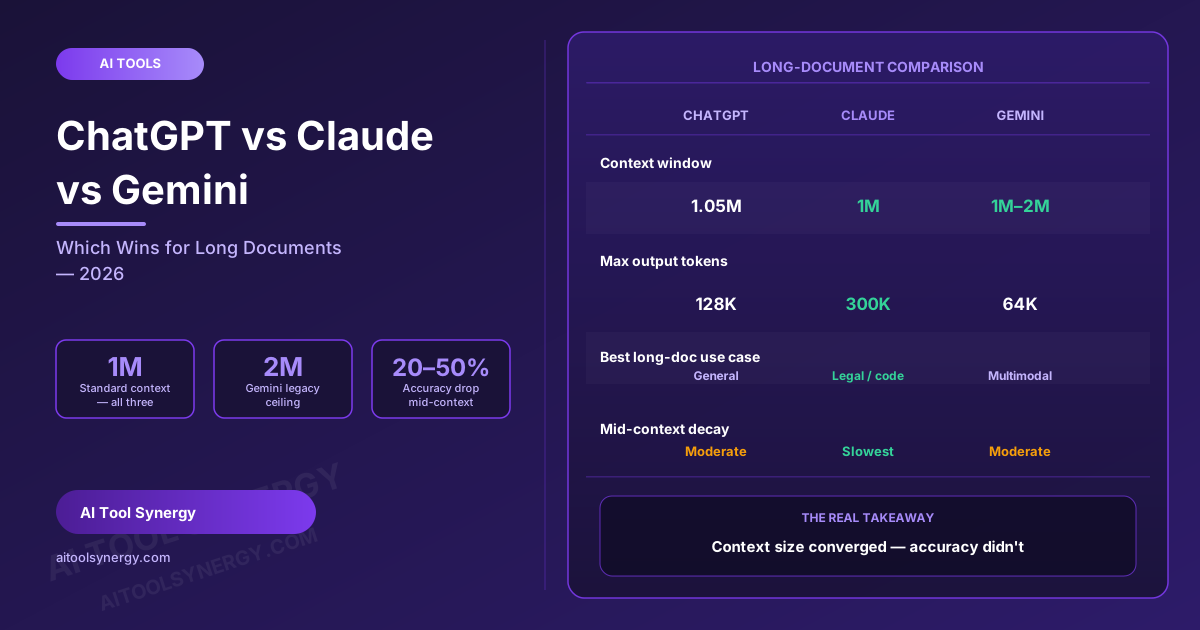
As of mid-2026, Claude’s Opus and Sonnet-tier models, OpenAI’s GPT-5.5, and Google’s Gemini 3 Pro and Flash all offer roughly 1 million tokens of input context at standard pricing, according to Anthropic’s official models documentation, with Gemini’s older 1.5 Pro model still available at up to 2 million tokens for enterprise workloads. That convergence means the ChatGPT vs Claude vs Gemini decision for long documents now hinges on three other factors: how gracefully each model handles information buried deep in that context, what the output cap looks like once you need a long response back, and how the pricing structure changes your cost at real document volumes.
Context Window Comparison: ChatGPT vs Claude vs Gemini
All three now sit at effectively the same order of magnitude for standard context. Claude’s Opus and Sonnet 4.6-generation models offer a 1 million token window at standard pricing with no surcharge; Gemini 3 Pro and Flash both ship with a 1 million token input window and up to 64,000 tokens of output, per Google’s official long-context documentation; and GPT-4.1 in the API sits just over 1.047 million tokens of context, though — as covered in our token limit guide — the practical window inside the ChatGPT app itself can be smaller than the API figure for the same model. In this comparison, ChatGPT vs Claude vs Gemini is no longer won or lost on the headline context number alone — run your own document through our free token counter to see exactly where it lands against each model’s window.
Why a Bigger Context Window Doesn’t Guarantee Better Long-Document Understanding
A model that accepts a million tokens doesn’t necessarily use all million tokens equally well. This is the part of the ChatGPT vs Claude vs Gemini comparison that spec sheets never show: independent research has repeatedly found that large language models exhibit a U-shaped attention pattern across long contexts, performing well when the relevant information sits near the start or end of the input, and measurably worse when it’s buried in the middle — even in models specifically built for long context.
The Research Behind Long-Document Accuracy: Lost in the Middle
The original “lost in the middle” research, along with follow-up studies through 2026, found accuracy drops of roughly 20 to 50% as document length grows from around 10,000 to 100,000 tokens, with the steepest drop-off when the needed answer sits in the center of a long context rather than at the edges. Later industry testing, including work referred to as “context rot” analysis, confirmed this pattern isn’t unique to any one vendor — it shows up across model families — but found that Claude models tend to decay more slowly than most competitors as context length increases, without being fully immune to the effect. For the ChatGPT vs Claude vs Gemini comparison specifically, this means the model that “wins” on a raw context window number isn’t automatically the one that will find the right clause in page 340 of a 400-page contract.
ChatGPT vs Claude vs Gemini for Legal and Contract Review
Legal and contract work is exactly the scenario where the lost-in-the-middle effect matters most, since the clause you need is rarely at the very start or end of the document. For this use case, the ChatGPT vs Claude vs Gemini decision tends to favor whichever model has demonstrated the flattest accuracy curve across long inputs in your own testing, rather than whichever has the largest advertised window. Practically, this means structuring the document with clear section markers and asking targeted questions about specific clauses tends to outperform a single “summarize this entire contract” prompt on any of the three models — a technique worth combining with the retrieval approach covered in our token reduction guide for developers.
ChatGPT vs Claude vs Gemini for Codebases and Technical Documentation
For loading an entire codebase into context, Gemini’s largest configurations extend furthest — Gemini 1.5 Pro’s legacy 2 million token ceiling can hold a genuinely large monorepo in one pass, while standard 1 million token windows on Claude, GPT-5.5, and Gemini 3 typically translate to roughly a 50,000-line project fitting comfortably. Claude has historically been favored heavily for agentic coding workflows specifically because of consistency across long sessions — independent testing in 2026 found newer Claude models preferred by developers a clear majority of the time over previous versions specifically for reading context accurately before modifying code, rather than duplicating logic or missing dependencies. In the ChatGPT vs Claude vs Gemini comparison for technical work, raw context size matters less than whether the model reliably tracks what it already read earlier in a long session — check your codebase’s token count against our free counter before choosing a model.
ChatGPT vs Claude vs Gemini for Research Papers and Academic PDFs
Loading multiple research papers into a single session is one of the most common long-document use cases, and this is where Gemini’s long-context design shows a genuine advantage: Google’s own documentation describes workflows where ten or more full research PDFs are loaded simultaneously without needing to chunk or re-prompt between documents. Claude and ChatGPT can both handle this volume at the token level too, but cross-document synthesis — comparing claims across five papers rather than summarizing each independently — is where the lost-in-the-middle effect becomes most visible across all three, making explicit citation instructions and structured output formats especially valuable regardless of which model you choose.
Claude’s Long-Document Strengths Compared to ChatGPT and Gemini
Beyond raw context size, Claude’s models support cached context reuse and, on Anthropic’s batch endpoint, output limits up to 300,000 tokens for very long generation tasks like full documentation sets or book-length content — a ceiling neither ChatGPT nor Gemini currently matches on their standard synchronous endpoints. Combined with comparatively graceful degradation on the lost-in-the-middle effect, this makes Claude a strong default choice in the ChatGPT vs Claude vs Gemini comparison specifically for workflows that need both a large input and a very long, coherent output in the same pass — full report generation from a large source set, for example.
Gemini’s 1M-Token Window vs ChatGPT and Claude in Practice
Gemini’s specific advantage is native multimodal long context — the same 1 million (or 2 million, on legacy Pro) token window accepts video, audio, and images alongside text, which matters if your “long document” is actually a mix of PDFs, scanned pages, and recorded meetings rather than pure text. Google’s own guidance for Gemini explicitly recommends providing all relevant information upfront rather than chunking, on the assumption that its context window is large enough to make retrieval-style filtering unnecessary for many tasks — a meaningfully different philosophy from the chunk-and-retrieve approach that tends to work better on ChatGPT and Claude for the same document sizes.
| Use case | Typically strongest choice | Why |
|---|---|---|
| Legal / contract review | Claude | Flattest accuracy decay on buried clauses |
| Large codebases | Claude or Gemini 1.5 Pro | Session consistency (Claude) or largest raw window (Gemini legacy) |
| Multi-document research | Gemini | Native multimodal ingestion, no chunking needed |
| Long-form generation | Claude | Up to 300K output tokens on batch endpoint |
Pricing ChatGPT vs Claude vs Gemini for Long-Document Workloads
At standard rates, OpenAI’s flagship models tend to price lower per token than Claude’s Opus tier, while Claude Sonnet sits in between GPT-5.4 and Gemini 3.1 Pro on direct vendor pricing. All three vendors now offer roughly 90% prompt caching discounts and 50% batch discounts, which matters enormously for long-document workloads specifically — re-analyzing the same 200-page document across multiple questions is exactly the repeated-prefix scenario caching was built for. We cover the mechanics of caching and batch discounts in detail in our OpenAI API cost calculator guide; the short version for this comparison is that the effective cost gap between ChatGPT vs Claude vs Gemini narrows substantially once caching is applied to a large, reused document.
Compare Token Counts Across Models
See exactly how your document tokenizes across ChatGPT, Claude, and Gemini before you commit to a model for a long-document workflow.
Check Token Counts Now →FAQ: ChatGPT vs Claude vs Gemini for Long Documents
Which AI has the highest token limit?
Gemini 1.5 Pro’s legacy configuration offers the largest ceiling at up to 2 million tokens, though Claude, GPT-5.5, and Gemini 3’s standard tiers all now offer roughly 1 million tokens at standard pricing.
What is the best AI model for long documents?
There isn’t a single answer — Claude tends to hold up best on documents where the needed information is buried deep in the middle, Gemini handles multimodal and multi-document ingestion most natively, and all three are viable once a document fits within the context window.
Is ChatGPT vs Claude vs Gemini really just about context window size?
No. Once all three vendors converged on roughly 1 million tokens, the more important differences became how accuracy holds up across that context, output caps, and pricing at real document volumes.
What is the “lost in the middle” problem?
It’s a well-documented pattern where LLMs answer questions correctly more often when the relevant information sits near the start or end of a long context, and less reliably when it’s positioned in the middle — even in long-context-optimized models.
Does Claude really perform better on long documents than ChatGPT and Gemini?
Independent testing has found Claude models tend to decay more slowly than many competitors as context length increases, though no current model is fully immune to the lost-in-the-middle effect.
Which model is best for loading an entire codebase?
Gemini 1.5 Pro’s legacy 2 million token window can hold the largest codebases in a single pass, while Claude is frequently preferred for session consistency across long, multi-turn coding work.
Can Gemini really handle 10 research papers at once?
Yes — Google’s documentation describes exactly this workflow, loading multiple full PDFs simultaneously without chunking, though cross-document synthesis quality still varies by task complexity.
Is Claude, ChatGPT, or Gemini cheapest for long-document workloads?
Pricing varies by tier, but all three now offer prompt caching (around 90% off) and batch discounts (around 50% off), which matter more for long-document cost than the base per-token rate alone.
Which model has the largest output limit for long-form generation?
Claude’s batch endpoint supports up to 300,000 output tokens for select models, higher than the standard output caps on ChatGPT and Gemini’s synchronous endpoints — check exact limits per model with our free token counter.
Related AI Tools Articles
ChatGPT vs Claude vs Gemini: Which to Use for Long Documents (2026)
Searching “ChatGPT vs Claude vs Gemini” usually turns up a spec sheet: which model has the biggest context window this month. That’s the wrong question if what you actually care about is getting good results out of a long document. All three vendors now offer context windows in the 1-million-token range, so the headline number that used to differentiate them has mostly converged. The real differences that matter for long-document work are elsewhere — how each model behaves as that window fills up, how it’s priced at scale, and which one actually holds up when the answer you need is buried on page 340, not page 1.
For the base numbers on any individual model’s context window and output cap, our ChatGPT Token Counter tool page already has the comparison table, and our ChatGPT token limit guide covers the context-window-vs-output-cap distinction in depth. This post won’t repeat those numbers — it’s about which model to actually reach for once you know a document is long enough to matter, and why “biggest context window” and “best for long documents” are not the same claim in the ChatGPT vs Claude vs Gemini comparison.
Check Your Document’s Token Count First
Before choosing a model for a long document, see exactly how many tokens it is with our free ChatGPT Token Counter — across ChatGPT, Claude, and Gemini limits.
Try the Free Token Counter →ChatGPT vs Claude vs Gemini: The Real Question Isn’t Just Token Limits
As of mid-2026, Claude’s Opus and Sonnet-tier models, OpenAI’s GPT-5.5, and Google’s Gemini 3 Pro and Flash all offer roughly 1 million tokens of input context at standard pricing, according to Anthropic’s official models documentation, with Gemini’s older 1.5 Pro model still available at up to 2 million tokens for enterprise workloads. That convergence means the ChatGPT vs Claude vs Gemini decision for long documents now hinges on three other factors: how gracefully each model handles information buried deep in that context, what the output cap looks like once you need a long response back, and how the pricing structure changes your cost at real document volumes.
Context Window Comparison: ChatGPT vs Claude vs Gemini
All three now sit at effectively the same order of magnitude for standard context. Claude’s Opus and Sonnet 4.6-generation models offer a 1 million token window at standard pricing with no surcharge; Gemini 3 Pro and Flash both ship with a 1 million token input window and up to 64,000 tokens of output, per Google’s official long-context documentation; and GPT-4.1 in the API sits just over 1.047 million tokens of context, though — as covered in our token limit guide — the practical window inside the ChatGPT app itself can be smaller than the API figure for the same model. In this comparison, ChatGPT vs Claude vs Gemini is no longer won or lost on the headline context number alone — run your own document through our free token counter to see exactly where it lands against each model’s window.
Why a Bigger Context Window Doesn’t Guarantee Better Long-Document Understanding
A model that accepts a million tokens doesn’t necessarily use all million tokens equally well. This is the part of the ChatGPT vs Claude vs Gemini comparison that spec sheets never show: independent research has repeatedly found that large language models exhibit a U-shaped attention pattern across long contexts, performing well when the relevant information sits near the start or end of the input, and measurably worse when it’s buried in the middle — even in models specifically built for long context.
The Research Behind Long-Document Accuracy: Lost in the Middle
The original “lost in the middle” research, along with follow-up studies through 2026, found accuracy drops of roughly 20 to 50% as document length grows from around 10,000 to 100,000 tokens, with the steepest drop-off when the needed answer sits in the center of a long context rather than at the edges. Later industry testing, including work referred to as “context rot” analysis, confirmed this pattern isn’t unique to any one vendor — it shows up across model families — but found that Claude models tend to decay more slowly than most competitors as context length increases, without being fully immune to the effect. For the ChatGPT vs Claude vs Gemini comparison specifically, this means the model that “wins” on a raw context window number isn’t automatically the one that will find the right clause in page 340 of a 400-page contract.
ChatGPT vs Claude vs Gemini for Legal and Contract Review
Legal and contract work is exactly the scenario where the lost-in-the-middle effect matters most, since the clause you need is rarely at the very start or end of the document. For this use case, the ChatGPT vs Claude vs Gemini decision tends to favor whichever model has demonstrated the flattest accuracy curve across long inputs in your own testing, rather than whichever has the largest advertised window. Practically, this means structuring the document with clear section markers and asking targeted questions about specific clauses tends to outperform a single “summarize this entire contract” prompt on any of the three models — a technique worth combining with the retrieval approach covered in our token reduction guide for developers.
ChatGPT vs Claude vs Gemini for Codebases and Technical Documentation
For loading an entire codebase into context, Gemini’s largest configurations extend furthest — Gemini 1.5 Pro’s legacy 2 million token ceiling can hold a genuinely large monorepo in one pass, while standard 1 million token windows on Claude, GPT-5.5, and Gemini 3 typically translate to roughly a 50,000-line project fitting comfortably. Claude has historically been favored heavily for agentic coding workflows specifically because of consistency across long sessions — independent testing in 2026 found newer Claude models preferred by developers a clear majority of the time over previous versions specifically for reading context accurately before modifying code, rather than duplicating logic or missing dependencies. In the ChatGPT vs Claude vs Gemini comparison for technical work, raw context size matters less than whether the model reliably tracks what it already read earlier in a long session — check your codebase’s token count against our free counter before choosing a model.
ChatGPT vs Claude vs Gemini for Research Papers and Academic PDFs
Loading multiple research papers into a single session is one of the most common long-document use cases, and this is where Gemini’s long-context design shows a genuine advantage: Google’s own documentation describes workflows where ten or more full research PDFs are loaded simultaneously without needing to chunk or re-prompt between documents. Claude and ChatGPT can both handle this volume at the token level too, but cross-document synthesis — comparing claims across five papers rather than summarizing each independently — is where the lost-in-the-middle effect becomes most visible across all three, making explicit citation instructions and structured output formats especially valuable regardless of which model you choose.
Claude’s Long-Document Strengths Compared to ChatGPT and Gemini
Beyond raw context size, Claude’s models support cached context reuse and, on Anthropic’s batch endpoint, output limits up to 300,000 tokens for very long generation tasks like full documentation sets or book-length content — a ceiling neither ChatGPT nor Gemini currently matches on their standard synchronous endpoints. Combined with comparatively graceful degradation on the lost-in-the-middle effect, this makes Claude a strong default choice in the ChatGPT vs Claude vs Gemini comparison specifically for workflows that need both a large input and a very long, coherent output in the same pass — full report generation from a large source set, for example.
Gemini’s 1M-Token Window vs ChatGPT and Claude in Practice
Gemini’s specific advantage is native multimodal long context — the same 1 million (or 2 million, on legacy Pro) token window accepts video, audio, and images alongside text, which matters if your “long document” is actually a mix of PDFs, scanned pages, and recorded meetings rather than pure text. Google’s own guidance for Gemini explicitly recommends providing all relevant information upfront rather than chunking, on the assumption that its context window is large enough to make retrieval-style filtering unnecessary for many tasks — a meaningfully different philosophy from the chunk-and-retrieve approach that tends to work better on ChatGPT and Claude for the same document sizes.
| Use case | Typically strongest choice | Why |
|---|---|---|
| Legal / contract review | Claude | Flattest accuracy decay on buried clauses |
| Large codebases | Claude or Gemini 1.5 Pro | Session consistency (Claude) or largest raw window (Gemini legacy) |
| Multi-document research | Gemini | Native multimodal ingestion, no chunking needed |
| Long-form generation | Claude | Up to 300K output tokens on batch endpoint |
Pricing ChatGPT vs Claude vs Gemini for Long-Document Workloads
At standard rates, OpenAI’s flagship models tend to price lower per token than Claude’s Opus tier, while Claude Sonnet sits in between GPT-5.4 and Gemini 3.1 Pro on direct vendor pricing. All three vendors now offer roughly 90% prompt caching discounts and 50% batch discounts, which matters enormously for long-document workloads specifically — re-analyzing the same 200-page document across multiple questions is exactly the repeated-prefix scenario caching was built for. We cover the mechanics of caching and batch discounts in detail in our OpenAI API cost calculator guide; the short version for this comparison is that the effective cost gap between ChatGPT vs Claude vs Gemini narrows substantially once caching is applied to a large, reused document.
Compare Token Counts Across Models
See exactly how your document tokenizes across ChatGPT, Claude, and Gemini before you commit to a model for a long-document workflow.
Check Token Counts Now →FAQ: ChatGPT vs Claude vs Gemini for Long Documents
Which AI has the highest token limit?
Gemini 1.5 Pro’s legacy configuration offers the largest ceiling at up to 2 million tokens, though Claude, GPT-5.5, and Gemini 3’s standard tiers all now offer roughly 1 million tokens at standard pricing.
What is the best AI model for long documents?
There isn’t a single answer — Claude tends to hold up best on documents where the needed information is buried deep in the middle, Gemini handles multimodal and multi-document ingestion most natively, and all three are viable once a document fits within the context window.
Is ChatGPT vs Claude vs Gemini really just about context window size?
No. Once all three vendors converged on roughly 1 million tokens, the more important differences became how accuracy holds up across that context, output caps, and pricing at real document volumes.
What is the “lost in the middle” problem?
It’s a well-documented pattern where LLMs answer questions correctly more often when the relevant information sits near the start or end of a long context, and less reliably when it’s positioned in the middle — even in long-context-optimized models.
Does Claude really perform better on long documents than ChatGPT and Gemini?
Independent testing has found Claude models tend to decay more slowly than many competitors as context length increases, though no current model is fully immune to the lost-in-the-middle effect.
Which model is best for loading an entire codebase?
Gemini 1.5 Pro’s legacy 2 million token window can hold the largest codebases in a single pass, while Claude is frequently preferred for session consistency across long, multi-turn coding work.
Can Gemini really handle 10 research papers at once?
Yes — Google’s documentation describes exactly this workflow, loading multiple full PDFs simultaneously without chunking, though cross-document synthesis quality still varies by task complexity.
Is Claude, ChatGPT, or Gemini cheapest for long-document workloads?
Pricing varies by tier, but all three now offer prompt caching (around 90% off) and batch discounts (around 50% off), which matter more for long-document cost than the base per-token rate alone.
Which model has the largest output limit for long-form generation?
Claude’s batch endpoint supports up to 300,000 output tokens for select models, higher than the standard output caps on ChatGPT and Gemini’s synchronous endpoints — check exact limits per model with our free token counter.








12 Responses
obviously like your website but you have to take a look at the spelling
on several of your posts. Several of them are rife with spelling problems and I find it very
bothersome to inform the truth nevertheless I will definitely
come again again.
Also visit my site … mcm998
Someone necessarily assist to make seriously articles I would state.
That is the very first time I frequented your web page and up to
now? I amazed with the research you made to make this actual publish amazing.
Magnificent task!
Feel free to surf to my website: تحميل 1xbet مصر
Paragraph writing is also a fun, if you know afterward you can write or
else it is complicated to write.
Here is my webpage … scam
My brother suggested I might like this website. He was once totally right.
This put up truly made my day. You cann’t imagine just how much time I had spent for this
information! Thanks!
Here is my web site :: kontol maut
This is really fascinating, You’re an overly professional blogger.
I have joined your rss feed and look forward to
searching for more of your fantastic post. Additionally, I’ve
shared your site in my social networks
Feel free to visit my homepage … 掃除機用フィルター
I’ve been exploring for a little bit for any high quality
articles or blog posts in this kind of area . Exploring in Yahoo I finally stumbled upon this site.
Reading this information So i am glad to express that I’ve an incredibly excellent uncanny feeling I
discovered exactly what I needed. I so much indubitably will make sure to do not forget this website and give it a look regularly.
Here is my web site vacuum filter
Great blog here! Also your web site loads up very fast!
What web host are you using? Can I get your affiliate link to your host?
I wish my website loaded up as fast as yours lol
Look into my site mcm998
Right here is the right website for anyone who wishes to understand this topic.
You know so much its almost tough to argue with you (not that I really would want to…HaHa).
You certainly put a new spin on a topic that’s been written about for
a long time. Excellent stuff, just excellent!
Here is my homepage Bahaya Sering Menahan Pipis
What’s up Dear, are you actually visiting this web site regularly, if so then you will definitely take fastidious knowledge.
Here is my web blog: bokep
Hey very cool website!! Guy .. Excellent .. Wonderful ..
I will bookmark your blog and take the feeds additionally?
I’m satisfied to seek out so many helpful information here within the post, we’d like develop extra strategies in this regard,
thank you for sharing. . . . . .
Here is my page … mcm168
You really make it seem so easy with your presentation but I find this
topic to be actually something that I think I would never understand.
It seems too complex and very broad for me.
I am looking forward for your next post, I will try
to get the hang of it!
My site – vacuum filter
Everyone loves it whenever people get together and share ideas.
Great blog, keep it up!
Here is my webpage; phisning website