


What Is TF-IDF in SEO? How It Works, Why It Matters, and How to Use It
TF-IDF stands for Term Frequency-Inverse Document Frequency. It is a mathematical formula that measures how important a specific word or phrase is to a document relative to a wider collection of documents. In SEO, TF-IDF is the conceptual engine behind how search engines evaluate whether a page genuinely covers a topic — rather than simply repeating a keyword many times.
Understanding what is TF-IDF in SEO helps you move beyond surface-level keyword density and think about content relevance the way search engines actually measure it. A page that uses the right terms at the right frequency, compared to competing pages, signals topical authority in a way that raw keyword repetition cannot.
This guide explains the TF-IDF formula, how TF-IDF SEO analysis works in practice, how it compares to keyword density, and how to use TF-IDF insights to improve your own content without over-complicating your workflow.
What Is TF-IDF in SEO — The Core Concept Explained
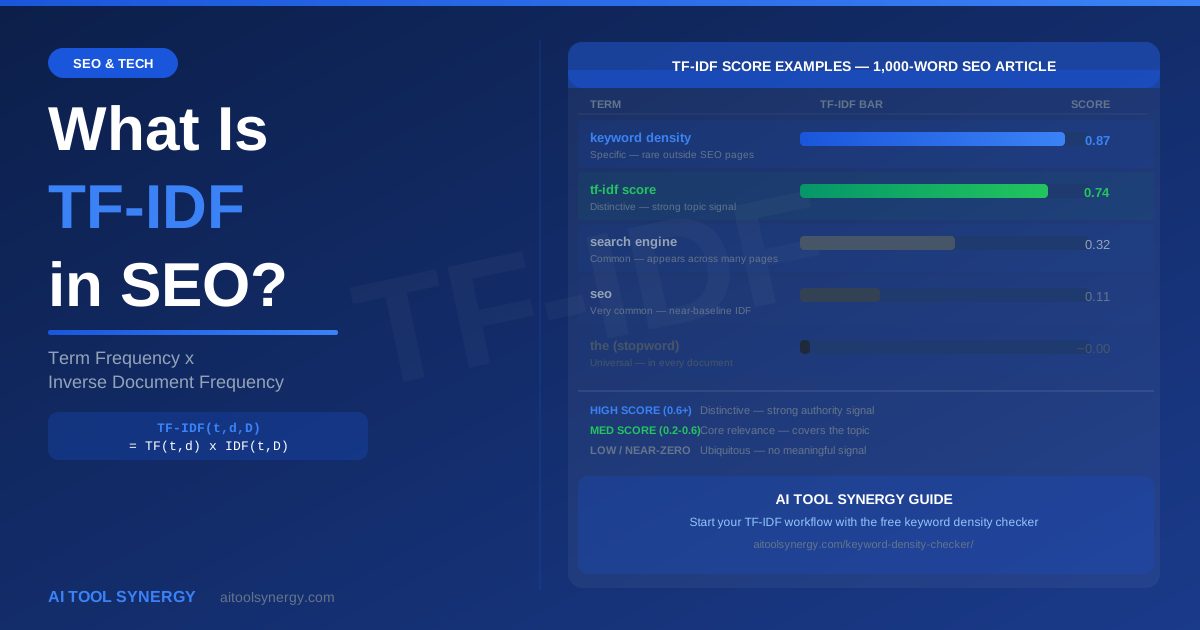
TF-IDF answers a deceptively simple question: does this word matter to this document, or does it appear everywhere? A word like “the” appears on every page on the internet, so its presence on your page tells a search engine nothing useful. A word like “keyword density” appearing eight times on a 1,000-word article about SEO — and rarely appearing on non-SEO pages — tells the search engine a great deal.
The formula breaks into two components that multiply together:
Term Frequency (TF) is simply how often a word appears in a document, usually expressed as a fraction of total words: TF = (occurrences of term t in document d) ÷ (total words in d). This is equivalent to keyword density expressed as a decimal.
Inverse Document Frequency (IDF) is the weight that penalises common words. IDF = log(N ÷ df), where N is the total number of documents in the corpus and df is the number of documents containing the term. A word that appears in every document gets a near-zero IDF. A niche term appearing in only a few documents gets a high IDF. Multiplied together, TF-IDF rewards terms that appear meaningfully within a page and rarely across the wider web.
The log function smooths the IDF score so that a term appearing in 5 of 1,000 documents is not massively overweighted compared to one appearing in 50 of 1,000. Without the log, raw frequency ratios produce extreme outliers that distort the scoring. The logarithm brings the scale to a workable range while preserving the relative signal.
The History of Term Frequency Weighting in Search Engines
TF-IDF was not invented for search engines. The foundational IDF weighting was developed by Karen Sparck Jones in 1972 as a tool for information retrieval in library science. Term frequency weighting was combined with IDF to create the TF-IDF formula as it is used today, and it became the mathematical backbone of early information retrieval systems throughout the 1980s and 1990s.
When commercial web search engines emerged in the mid-1990s, TF-IDF was one of the first ranking signals they adopted. Early Google used a version of TF-IDF combined with PageRank — the link-authority signal — to rank results. The Google founders’ original 1998 paper on their search architecture explicitly references term frequency and document frequency analysis as core ranking inputs.
Today, Google’s search ranking system uses a significantly more complex algorithm than raw TF-IDF, including neural ranking systems and large language model-based understanding. However, the foundational logic of TF-IDF — that a term’s importance depends on its frequency in a document relative to its frequency across the corpus — remains embedded in modern ranking systems through frameworks like BM25.
BM25 — The Modern Relevance Scoring System Behind Search Rankings
Raw TF-IDF has known weaknesses. It does not account for document length — a term appearing five times in a 200-word document should carry more weight than the same term appearing five times in a 5,000-word document. It also does not cap the benefit of additional repetitions, meaning a spammy page repeating a keyword 100 times would score higher than a page using it 10 times naturally.
BM25 (Best Match 25) is the refined version of TF-IDF that addresses both problems. It adds two parameters:
- k1 — controls how much additional TF score diminishes as repetitions increase. Beyond a certain frequency, extra repetitions add almost no score.
- b — controls document length normalisation, penalising unusually long documents where a term’s frequency is diluted by padding.
According to Elasticsearch’s BM25 documentation — whose search architecture mirrors the logic of modern web search — BM25 with default settings (k1=1.2, b=0.75) produces more accurate relevance scoring than raw TF-IDF across almost all document types. This is why understanding TF-IDF in SEO now means understanding BM25 — they are the same conceptual system with BM25 as the production-ready version.
BM25’s diminishing returns on repetition is exactly why keyword stuffing fails. Every additional repetition of a keyword beyond the natural frequency adds less ranking signal than the one before it — and eventually can trigger spam classifiers that overrule the relevance score entirely. Writing content where the keyword appears naturally, not obsessively, aligns with how BM25 actually scores relevance.
TF-IDF in SEO vs Keyword Density — Key Differences
Many SEOs use TF-IDF and keyword density interchangeably, but they measure different things. Understanding the distinction matters for how you use each metric:
- Measures frequency within one document only
- Formula: (count ÷ total words) × 100
- No comparison to external corpus
- Easy to calculate manually or with a tool
- Good for catching over-optimisation (stuffing)
- Target: 1–3% for most content types
- Measures frequency relative to a corpus of competing documents
- Formula: TF × log(N ÷ df)
- Requires comparison data (top-ranking pages)
- Requires a tool or manual calculation across multiple pages
- Good for identifying missing topically relevant terms
- Target: match or exceed competitor TF-IDF scores for key terms
For most content audits, checking keyword density with our free keyword density checker is the right first step — it gives you the TF component quickly and for free. TF-IDF analysis adds the IDF layer by pulling in competitor data, which requires either a dedicated tool or manual corpus building.
What Is TF-IDF in SEO — Video Explainer
How to Run a TF-IDF SEO Analysis — 5-Step Workflow
TF-IDF analysis for SEO means comparing the term frequencies in your content against the top-ranking pages for your target keyword. Here is a practical workflow that does not require expensive tools:
-
1Identify your target keyword and pull the top 10 ranking pagesSearch your target keyword in an incognito window and note the top 10 organic results. These are the pages Google considers most relevant — they form your TF-IDF corpus.
-
2Extract and analyse term frequencies for each competitor pageCopy the body text of each competitor page into our free keyword density checker. Note the top single-word and two-word phrase frequencies for each page. This gives you the TF component across your corpus.
-
3Identify terms that appear consistently across top-ranking pagesA term appearing in 8 of the 10 top results is a high-df term — common across the corpus, lower IDF. A term appearing in only 2 of the 10 results has a higher IDF and may be a more distinctive signal if your page uses it well.
-
4Audit your own page against the corpus patternsCheck your page for terms that appear consistently in competitor content but are missing from yours. These are topical gaps — terms that high-ranking pages treat as essential that your content has overlooked.
-
5Fill gaps naturally and recheck your keyword densityAdd missing terms into your content where they serve the reader — not as a keyword injection exercise. After editing, paste your updated content into the keyword density tool to confirm your primary keyword density has not been displaced and still sits at 1–3%.
TF-IDF SEO — What High and Low Scores Actually Mean for a Page
TF-IDF scores are not absolute — they only mean something relative to the corpus being compared. Here is how to interpret scores in practical SEO terms:
| TF-IDF Score Range | What It Means | SEO Implication |
|---|---|---|
| Near 0 | Term is either very rare in this document or appears in nearly every document in the corpus (stopwords, common verbs) | No meaningful signal — these terms are filtered out in relevance ranking |
| Low (0.01–0.2) | Term appears in this document but also across most competing pages — a baseline topical term | Necessary to include (confirms topic coverage) but not a differentiating signal |
| Medium (0.2–0.6) | Term appears meaningfully in this document and moderately across the corpus | Good relevance signal — these are the core topic terms to optimise around |
| High (0.6+) | Term appears significantly in this document but infrequently across competing pages — distinctive content | Strong topical authority signal for niche or long-tail terms — valuable for differentiation |
Topical Authority and Content Clusters — How Term Scoring Connects
The most useful way to think about TF-IDF in SEO is as a proxy for topical authority. A page that covers all the high-df terms (present in most competing pages) plus meaningful high-IDF terms (distinctive to deep coverage) is demonstrating that it covers the topic more completely than pages that only hit the surface-level high-frequency terms.
This is the connection between TF-IDF scoring and what Ahrefs describes as topical authority — the practice of building clusters of content that collectively cover a topic more deeply than any individual competitor page. A well-structured content cluster naturally produces higher average TF-IDF scores across its posts because the cluster vocabulary is consistently reinforced across multiple pages.
For this reason, TF-IDF analysis is most powerful when done at the cluster level, not just the individual page level. If your cluster of posts covers keyword density, keyword frequency, how to calculate keyword density, and keyword stuffing detection — as this site does — the combined vocabulary coverage signals topical authority across the subject in a way that a single page cannot.
What TF-IDF in SEO Cannot Tell You — Common Misconceptions
TF-IDF is a powerful signal but a limited one. These are the most common misconceptions about what TF-IDF analysis can and cannot do:
Google has never confirmed TF-IDF as a direct ranking signal and has stated that its modern systems go far beyond term frequency analysis. TF-IDF is a useful proxy for relevance — not a formula you can game by hitting a specific score. Optimising purely for TF-IDF without considering user intent, content quality, and E-E-A-T signals will not produce ranking improvements.
- TF-IDF does not measure content quality. A page could have perfect TF-IDF scores and still be poorly written, thin, or inaccurate. Quality signals are evaluated through different mechanisms (engagement, links, E-E-A-T).
- TF-IDF does not account for semantic understanding. Modern search engines use embedding-based models that understand meaning beyond term matching. Two documents covering the same concept using completely different vocabulary can both rank highly — TF-IDF alone would not predict this.
- TF-IDF scores vary by corpus. The same document will produce different TF-IDF scores depending on which competing documents you compare it against. There is no universal TF-IDF score for a piece of content.
- TF-IDF does not replace keyword research. TF-IDF analysis tells you how to use terms you have already identified — it does not tell you which terms have search volume or commercial value. Keyword research comes first.
Keyword Density vs TF-IDF — Which Metric to Track Day-to-Day
Given that TF-IDF requires a competitor corpus and a more complex workflow, the practical question for most content creators is: which metric should I actually track on a regular basis?
The answer depends on your goal:
| Goal | Use Keyword Density | Use TF-IDF Analysis |
|---|---|---|
| Check for keyword stuffing before publishing | Yes — quick density check, target 1-3% | Not needed |
| Audit existing page that is ranking on page 2 | Yes — confirm density is in range | Yes — identify topical gaps vs top 10 |
| Understand why a competitor outranks you | Partial — shows if they use the keyword more | Yes — reveals terms your content is missing |
| Write new content from scratch | Yes — check density during writing | Optional — useful for comprehensive topic mapping |
| Build a topic cluster for authority | Useful per page | Yes — critical for cluster-level term coverage |
For most day-to-day content work, starting with our free keyword density checker and checking your TF component is the fastest and most practical approach. Reserve full TF-IDF corpus analysis for content audits and competitive research where the added complexity is justified by the strategic need.
What Is TF-IDF in SEO — Key Takeaways
TF-IDF is the mathematical foundation that connects term frequency to topical relevance across a document corpus. Here is what to carry forward:
- TF-IDF scores a term’s importance by combining how often it appears in your document (TF) with how rarely it appears across competing documents (IDF)
- Modern search engines use BM25 — an evolved TF-IDF variant with diminishing returns on repetition and document-length normalisation
- Keyword density gives you the TF component quickly and is the right starting point for most content quality checks
- TF-IDF analysis adds the IDF layer by comparing your page against the top-ranking competitor corpus — most useful for audits and topic-cluster planning
- High TF-IDF scores come from covering a topic comprehensively with distinctive vocabulary, not from repeating one keyword aggressively
- TF-IDF is a relevance proxy, not a direct ranking factor — quality, E-E-A-T, and intent alignment remain the dominant signals