


OpenAI API Cost Calculator: Caching, Batch & Reasoning Token Costs Explained (2026)
Most people run one prompt through an OpenAI API cost calculator, multiply by their expected volume, and assume that’s their bill. In practice, that number is almost always wrong — sometimes by 2x, sometimes by 10x — because it ignores the mechanics that actually move your OpenAI API cost at scale: prompt caching, the Batch API, and hidden reasoning tokens on thinking models. If you just need the base per-1M-token rate for each model, our ChatGPT Token Counter already has that comparison table built in. This post covers what that flat rate table can’t: the discounts and hidden costs that decide what you actually pay.
If you haven’t already, it’s worth understanding the difference between a model’s token limit and its cost — the two aren’t the same thing, and we break that down fully in our ChatGPT token limit guide. And if you’re still fuzzy on what a token actually is before we get into pricing mechanics, our what is a token in ChatGPT guide covers the fundamentals first.
Run any prompt through our free tool to see its exact token count before you even start estimating cost — it takes the guesswork out of the first half of any OpenAI API cost calculator.
Know Your Token Count Before You Calculate Cost
Paste your prompt into our free ChatGPT Token Counter to see the exact token count and estimated API cost per model — instantly, with no signup.
Try the Free Token Counter →Same prompt, same model — the OpenAI API cost swings dramatically depending on whether you use caching, batching, or neither
What Is the OpenAI API Cost Calculator Really Calculating?
A basic OpenAI API cost calculator does one thing: multiply your token count by the model’s per-token rate. That’s a fine starting estimate, but it only reflects the “standard” price tier. It doesn’t account for the fact that OpenAI offers multiple discount mechanisms that most calculators — and most first-time API users — never factor in. Understanding those mechanisms is the difference between a cost estimate and your real OpenAI API cost.
OpenAI API Cost Per Token: The Basics
OpenAI bills input tokens (what you send) and output tokens (what the model generates) at different rates, with output typically priced three to four times higher than input. According to OpenAI’s official pricing documentation, rates are quoted per 1 million tokens and vary enormously by model — from a few cents to well over a hundred dollars per million tokens depending on capability tier. This base rate is exactly what our token counter tool’s comparison table already shows you, so we won’t repeat that table here — what matters for your real OpenAI API cost is everything below.
Prompt Caching: Cut Your OpenAI API Cost by Up to 90%
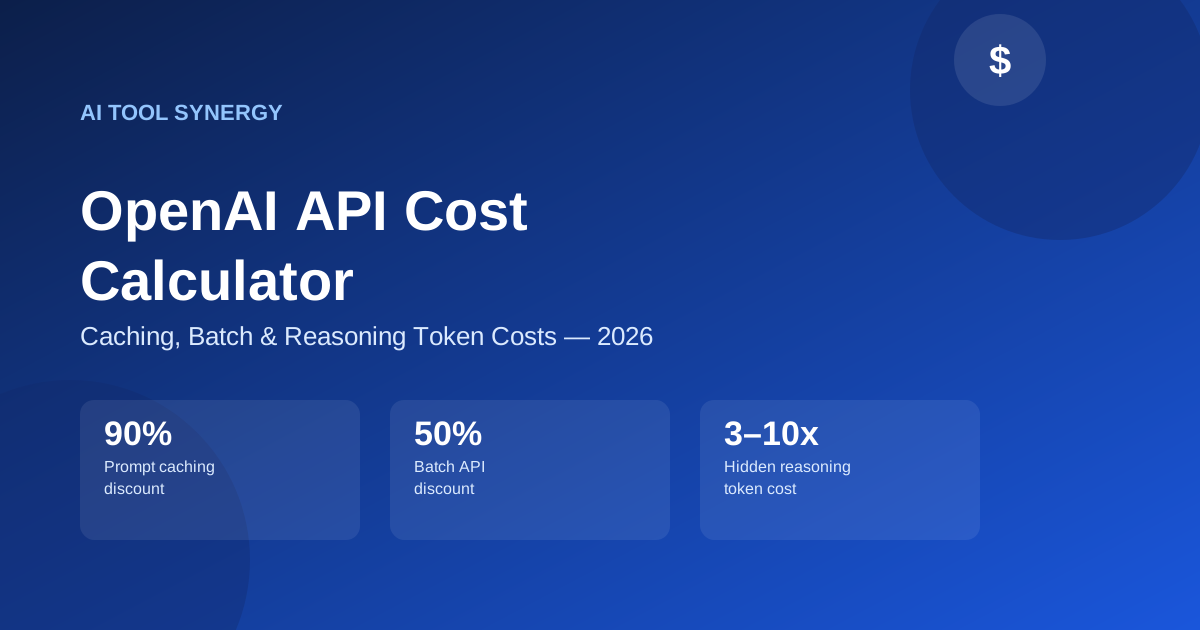
Prompt caching is the single biggest lever most developers leave on the table. When a request shares a stable prefix — a system prompt, a set of instructions, reference documents — with a previous request, OpenAI automatically caches that prefix and bills the repeated portion at a steep discount, commonly around 90% off the standard input rate. Caching triggers automatically once a shared prefix crosses roughly 1,024 tokens, with no extra configuration required on your end.
This matters enormously for OpenAI API cost at scale. A chatbot with a 2,000-token system prompt sent on every single request effectively pays full price for that prompt over and over — unless the request structure keeps that prefix stable and cacheable. Keeping instructions, reference material, and few-shot examples in a fixed, unchanging block at the start of your prompt is the single easiest way to lower your OpenAI API cost without changing which model you use. Other providers use a similar mechanism — Anthropic’s pricing documentation describes a comparable caching discount for Claude models, so the “keep your prefix stable” principle applies industry-wide, not just to OpenAI.
Batch API: Halve Your OpenAI API Cost for Async Work
For any workload that doesn’t need an instant reply — bulk content generation, embeddings, classification, evaluation runs, nightly report generation — OpenAI’s Batch API cuts both input and output token costs by 50% in exchange for asynchronous processing, typically completing within 24 hours. This is a flat discount on top of whatever model you’re using, and it stacks with the savings from prompt caching.
The catch is latency: Batch is not for real-time chat products. But for the large share of API workloads that genuinely don’t need a sub-second response, skipping the Batch API is one of the most common ways teams unknowingly double their OpenAI API cost for no benefit.
Hidden Reasoning Tokens: Why Thinking Models Cost More Than They Show
Reasoning models — OpenAI’s o-series and GPT “Thinking” modes — generate internal reasoning tokens before producing the visible answer you see. Those hidden tokens are billed at the same rate as output tokens, even though you never see them in the response. A request that emits a short, three-sentence visible answer can still consume three to ten times that amount in hidden reasoning tokens behind the scenes, meaning the true OpenAI API cost of a reasoning-model call is often far higher than the visible output would suggest.
This is worth checking before you commit to a reasoning model for a production workload: if your task doesn’t genuinely need multi-step chain-of-thought reasoning, a standard non-reasoning model at a fraction of the effective OpenAI API cost is usually the better choice. Independent cost breakdowns, including the rate-card analysis published by Calcis’s OpenAI pricing guide, confirm this pattern holds consistently across the o-series reasoning models.
How to Calculate Your Real OpenAI API Cost at Scale
To estimate your actual OpenAI API cost at any real volume, you need four numbers, not one: your input token count, your output token count, what share of your input is cacheable, and whether the workload can run through Batch. A rough formula looks like this — (uncached input tokens × input rate) + (cached input tokens × cached rate) + (output tokens × output rate) — then apply a 50% multiplier across the whole total if the workload qualifies for Batch. Skipping any one of these variables is why a naive OpenAI API cost calculator so often undershoots or overshoots the real monthly bill.
Estimate Your Prompt’s Token Count First
Before you can calculate OpenAI API cost accurately, you need an exact token count. Our free counter gives you that instantly for every major model.
Check Token Count & Estimated Cost →OpenAI API Cost by Model: Cheapest to Most Expensive
| Tier | Example use case | Relative OpenAI API cost |
|---|---|---|
| Nano / Mini models | Classification, tagging, simple extraction | Lowest — cents per 1,000 requests |
| Standard flagship (e.g. GPT-4o class) | General chat, content generation | Moderate |
| Frontier / large context models | Long-document analysis, complex agents | High |
| Reasoning / Thinking models | Multi-step logic, coding agents | Highest — hidden reasoning tokens included |
For exact current per-model rates, the tool page’s comparison table stays up to date with headline pricing — see the full breakdown on our ChatGPT Token Counter; this section is meant to show you the relative OpenAI API cost tier so you can pick a starting point before fine-tuning with a calculator. For a cross-provider view including Claude and Gemini pricing at the same volume, TECHSY’s multi-provider cost calculator is a useful second reference point.
Common OpenAI API Cost Mistakes That Inflate Your Bill
The same handful of mistakes show up in almost every OpenAI API cost audit. Sending a large, unstable system prompt that changes slightly on every request breaks caching eligibility entirely. Routing every request — including simple ones — through a frontier or reasoning model when a cheaper model would perform the task just as well. Running time-insensitive bulk jobs through the standard endpoint instead of Batch, quietly doubling the bill. And not tracking the usage field returned on every API response, which means cost surprises aren’t caught until the invoice arrives instead of in real time.
OpenAI API Cost vs ChatGPT Plan Cost: What’s the Difference
It’s easy to conflate these two, but they’re billed completely differently. A ChatGPT Plus or Pro subscription is a flat monthly fee covering a bundle of usage inside the consumer app — unrelated to per-token pricing. OpenAI API cost, by contrast, is metered per token, with no flat fee, and applies only to developers building on the API directly rather than using the ChatGPT interface. If you’re building a product or workflow that calls the API programmatically, your OpenAI API cost is calculated per request using the mechanics in this guide — a ChatGPT subscription doesn’t cover or offset that usage at all.
How to Lower Your OpenAI API Bill Without Sacrificing Quality
Start by matching model tier to task difficulty — most classification, extraction, and simple generation tasks don’t need a frontier model. Keep system prompts and reference material stable so prompt caching actually applies on repeat requests. Move any workload that can tolerate a delay onto the Batch API. Set explicit output limits so a model doesn’t generate longer replies than the task requires. And check reasoning-mode usage carefully, since it’s the single biggest lever for cost inflation on tasks that don’t strictly require chain-of-thought reasoning.
Calculate Your Prompt’s Token Count & Cost Now
Paste any prompt into our free ChatGPT Token Counter to see the token count and estimated cost across every major model before you send a single API request.
Open the Free Token Counter →FAQ About OpenAI API Cost Calculator
What is an OpenAI API cost calculator?
An OpenAI API cost calculator estimates how much a request or workload will cost by multiplying token counts by each model’s per-token rate, though most basic calculators don’t account for caching, batching, or reasoning-token overhead.
How much does the OpenAI API cost per token?
Rates vary widely by model — from a few cents to over a hundred dollars per million tokens — with output tokens typically priced three to four times higher than input tokens.
What is prompt caching and how does it lower OpenAI API cost?
Prompt caching automatically discounts the repeated portion of a prompt — such as a stable system message — by around 90%, as long as that shared prefix stays consistent across requests.
What is the OpenAI Batch API discount?
The Batch API offers a flat 50% discount on both input and output tokens for workloads that can tolerate asynchronous processing, typically completed within 24 hours.
Why do reasoning models cost more than their visible output suggests?
Reasoning models generate hidden internal reasoning tokens before the visible answer, and those tokens are billed at the output rate — often three to ten times the visible response length.
Is the OpenAI API free to use?
No. The OpenAI API is pay-as-you-go with no permanent free tier, though new accounts typically receive a small amount of trial usage credit.
Is the OpenAI API cheaper than a ChatGPT subscription?
It depends on usage volume. API cost is metered per token and can be cheaper for light or irregular use, while a ChatGPT subscription is a flat monthly fee that may cost less for heavy daily consumer use.
How can I estimate my OpenAI API cost before building a product?
Estimate your expected input and output tokens per request, multiply by monthly request volume, then apply caching and Batch discounts where applicable — our free token counter helps establish the token counts you need for this calculation.
Does the cheapest OpenAI model always mean the lowest total OpenAI API cost?
Not always. A cheaper model that requires more retries, longer prompts, or extra correction steps to get a usable result can end up costing more overall than a pricier model that gets the task right the first time.