


Keyword Stuffing Checker — How to Detect and Fix Over-Optimisation
A keyword stuffing checker is your first line of defence against one of the most damaging on-page SEO mistakes you can make before hitting publish. Keyword stuffing — the over-repetition of a target phrase to the point where it reads unnaturally — was a ranking tactic in early search. Today it is a direct violation of Google’s spam policies and one of the clearest ways to suppress your own rankings.
This guide covers everything you need to detect and fix keyword stuffing: how to use a free keyword stuffing checker to identify over-optimised content, the six types of stuffing Google penalises, real before-and-after examples, and eight specific techniques to fix over-optimisation without losing topical keyword signal. Whether your content has already been flagged or you want to ensure it never is, this is the complete workflow.
What Is Keyword Stuffing and Why Does a Stuffing Checker Matter?
Keyword stuffing is the deliberate over-repetition of a target keyword in content with intent to manipulate search engine rankings. It is explicitly listed in Google’s spam policies as a violation that can result in ranking suppression or a manual action against your site.
The reason a keyword stuffing checker is essential before publishing is that over-optimisation does not always feel obvious while writing. When you are deep in a topic, it is easy to repeat the same phrase in every paragraph without noticing. A density check makes the invisible visible — it shows the exact percentage at which each phrase appears and flags anything above the safe threshold before it ever reaches Google’s crawlers.
Keyword stuffing harms rankings in two ways simultaneously. First, it signals to Google that the page is trying to game rankings rather than serve readers — triggering algorithmic suppression through systems like Google Panda, which specifically targets over-optimised content. Second, it degrades the reading experience — content that repeats the same phrase every two sentences reads as unnatural, increasing bounce rate and reducing dwell time. Both effects compound to suppress rankings far more than any repetition ever helped.
Google defines keyword stuffing as “filling a page with keywords or numbers in an attempt to manipulate a site’s ranking in Google Search results.” This covers both visible body text repetition and hidden techniques such as white-on-white text, invisible div layers, and meta tag cramming.
How to Use a Keyword Stuffing Checker — 5-Step Detection Workflow
Using our free keyword stuffing checker takes under 60 seconds and gives you an instant, objective read on whether any keyword has crossed into over-optimisation territory. Here is the exact workflow:
Copy your full article body text
Copy the complete content — from the opening paragraph to the conclusion. Exclude page titles, navigation, and sidebar text. For published pages, use your browser’s Reader View to isolate the article body before copying.
Paste into the keyword stuffing checker and enable stopword removal
Open our free keyword stuffing checker, paste your content, and toggle stopword removal on. This filters meaningless words like “the”, “a”, and “is” so results focus entirely on meaningful keyword phrases.
Read the Density Health panel first
The color-coded health panel gives you an instant keyword stuffing assessment. Any keyword shown in red has exceeded 3% density — over-optimisation flag. Green means optimal 1-3%. Amber means under-optimised.
Check the 2-gram tab for your focus keyword specifically
Your focus keyword is almost always a two-word phrase. Switch to the 2-gram tab and find your primary keyword. Above 3% means keyword stuffing to fix. Below 0.5% means the topical signal is too weak. Optimal is 1-2% for most blog content.
Export results and proceed with your fix pass
Use the CSV export or copy-to-clipboard button to save results. This gives you a reference list of over-optimised phrases while editing — so you know exactly which terms to reduce and by how much before republishing.
Video Guide — What Over-Optimisation Looks Like to Google
Watch this short explainer from a Google perspective on what keyword stuffing looks like and how it triggers ranking suppression:
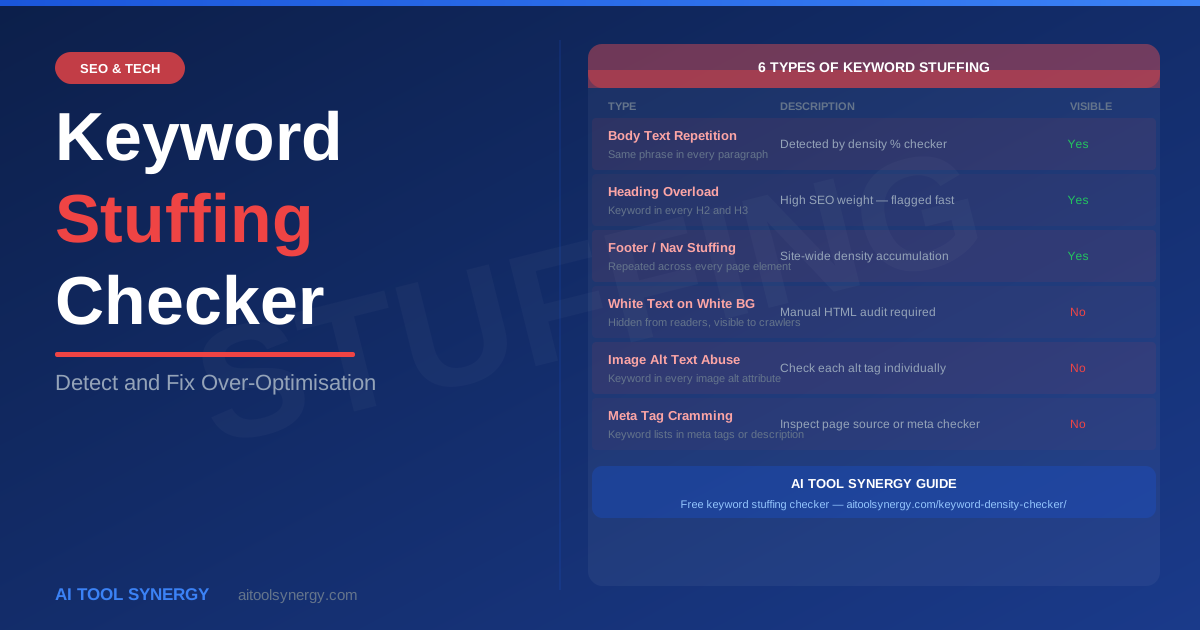
6 Types of Keyword Stuffing a Checker Detects
Not all keyword stuffing is identical. Google’s systems detect multiple patterns of over-optimisation — some visible to readers, some hidden in HTML. Understanding all six types helps you audit content more thoroughly than density percentage alone.
The most common form. The same keyword phrase appears in nearly every paragraph, often in awkwardly constructed sentences. A keyword stuffing checker catches this via the density percentage.
Stuffing the exact keyword phrase into every H2 and H3 on a page. Headings carry extra SEO weight, making repetition in them especially flagged by Google’s quality systems.
Repeating keywords in footer links, navigation menus, or sidebar text across every page of a site — each page accumulates the same repetition from shared page elements.
Hiding keyword lists in white-coloured text on a white background — visible to crawlers, invisible to readers. One of the oldest black-hat techniques, still actively penalised.
Using the same keyword phrase in the alt text of every image regardless of image content. Alt text is a legitimate SEO signal only when it accurately describes what the image shows.
Repeating the target keyword dozens of times in meta tags or stuffing the meta description with keyword lists. Google has deprecated the meta keywords tag and penalises obvious meta stuffing.
Our free keyword stuffing checker detects Types 1 and 2 directly — visible body text and heading repetition. Types 3-6 require a manual HTML audit. When body density is clean, conduct a visual scan of your HTML for hidden text layers and check image alt attributes individually.
Before and After — Real Over-Optimised Content Fixed
The fastest way to understand what keyword stuffing looks like in practice is real examples of stuffed content alongside the corrected version, with density percentages shown for each.
Example 1 — Blog paragraph (target: “keyword stuffing checker”)
“A keyword stuffing checker helps you detect keyword stuffing before publishing. Use our keyword stuffing checker to run a keyword stuffing check. The keyword stuffing checker will show you if keyword stuffing is present in your content.”
“A keyword stuffing checker helps you detect over-optimisation before publishing. Paste your content into the tool — any phrase above 3% density is flagged in red. Replace exact-match overuse with synonyms or related phrases to bring the percentage down.”
Example 2 — Product page (target: “free SEO tool”)
“Our free SEO tool is the best free SEO tool available. This free SEO tool gives you free SEO tool results instantly. Try our free SEO tool today — the most accurate free SEO tool for writers who need a free SEO tool.”
“Our free SEO tool gives instant keyword density results — no account needed, no word limit. Content writers and SEO specialists use it before every publish to confirm content is optimally calibrated for their target keyword.”
Example 3 — H2 headings (target: “keyword density”)
H2: What Is Keyword Density?
H2: How to Check Keyword Density
H2: Keyword Density Tools
H2: Keyword Density Best Practices
H2: Fix Your Keyword Density
H2: Keyword Density FAQ
Every single H2 contains the exact phrase.
H2: What Is Keyword Density?
H2: How to Check It With a Free Tool
H2: Reading Your Results
H2: Best Practices for On-Page SEO
H2: How to Fix Over-Optimisation
H2: Frequently Asked Questions
Keyword in 2 of 6 headings — natural and effective.
8 Proven Techniques to Fix Over-Optimised Content — After Your Keyword Stuffing Check
Once a keyword stuffing checker has identified which phrases are over-optimised, you need a concrete plan to reduce density without losing topical signal. These eight techniques cover every fix scenario you will encounter in practice:
Replace exact matches with semantic synonyms
The most effective keyword stuffing fix. If “keyword stuffing checker” appears 22 times in 800 words (2.75% — borderline), replace 8 occurrences with variations: “density analysis tool”, “over-optimisation detector”, “keyword frequency analyzer”. Topic remains clear; exact-match repetition drops to a healthy 1.75%.
Restructure sentences to make keywords implicit
Some sentences repeat the keyword because they were written with the keyword first and the meaning second. Rewrite these so the keyword is implied rather than stated: “Our keyword stuffing checker checks for keyword stuffing using a keyword density check” becomes “The tool scans your content and flags over-repeated phrases in red.”
Vary your H2 and H3 headings
Headings contribute disproportionately to keyword density on shorter pages because they occupy few words but carry extra weight. If five of seven H2s contain the same keyword phrase, rewrite three using related language. The signal in the remaining two headings is still clearly received.
Use pronouns and referential language
After introducing your topic keyword clearly in the first paragraph, subsequent references can use “the tool”, “it”, “this method”, or “this approach” rather than repeating the full keyword phrase. This is natural writing behaviour that removes keyword stuffing without removing topical clarity.
Expand the total word count with useful content
Keyword density is a percentage — if the keyword count stays the same but total word count increases, density falls automatically. Adding a genuinely useful FAQ section, worked example, or comparison table increases word count naturally while adding reader value. This is preferable to simply deleting keyword mentions.
Audit and clean image alt text
Check every image on the page. Alt text should describe the image accurately — not repeat your focus keyword. Replace keyword-stuffed alt text like “keyword stuffing checker keyword tool free” with descriptive text like “screenshot of density results showing 5.1% flagged in red.”
Remove keyword lists and hidden footer text
Some pages include lists of keyword variations in small text or matching background colour. These are detected by modern crawlers immediately. Delete them entirely. The same applies to keyword-stuffed footer sections and navigation elements that repeat the same phrase across every page of a site.
Re-run the keyword stuffing checker after every edit pass
After making changes, re-paste the updated content into our free keyword stuffing checker to confirm density has moved into the optimal range. Editing by feel is unreliable — a second density check takes 30 seconds and confirms the fix is complete before publishing.
Manual Detection vs a Free Checker — Which Is More Reliable
Attempting to detect keyword stuffing by reading your own content is unreliable. Familiarity blindness sets in after multiple editing passes — your brain skips repeated phrases automatically. What feels natural to you after three revisions may be showing 4.5% density to a search engine crawler.
A keyword stuffing checker eliminates this bias entirely. It does not read for meaning — it counts. It does not have familiarity with your content — it sees raw numbers. And it shows results in seconds rather than after another careful read that may miss the same phrases it missed before.
| Detection Method | Speed | Accuracy | All Phrase Types | Objective |
|---|---|---|---|---|
| Manual reading | Slow (10-20 min) | Low — familiarity blindness | No | No — subjective |
| Ctrl+F keyword count | Medium (2-5 min per keyword) | Accurate for one term only | No — one at a time | Yes |
| Keyword stuffing checker | Fast (under 30 seconds) | High — counts all phrases | Yes — 1/2/3-gram | Yes — pure data |
How Keyword Stuffing Affects Rankings — What to Know
The practical effect of keyword stuffing on rankings varies by severity. Mild over-optimisation — a keyword at 4-5% density — typically produces gradual ranking decline rather than a sudden drop. Severe stuffing — keywords at 8-10%+ or hidden keyword lists — can trigger immediate suppression.
Recovery timeline after fixing keyword stuffing ranges from 2-4 weeks for algorithmic suppression. Speed up the process by submitting the updated URL through Google Search Console’s URL Inspection tool and requesting reindexing. If a manual action was triggered, fix all over-optimisation across the site first, then submit a reconsideration request.
After fixing keyword stuffing and republishing, allow 2-4 weeks for Google to recrawl and reassess the page. Submit the URL through Google Search Console’s URL Inspection tool and request indexing to accelerate the recrawl timeline.
Setting the Right Density Targets After Running a Stuffing Check
Using an over-optimisation checker effectively means knowing what density targets you are aiming for before editing. These benchmarks apply when interpreting the checker results:
| Keyword Type | Safe Density Range | Over-Optimisation Threshold |
|---|---|---|
| Primary focus keyword (2-gram) | 1.0% to 2.0% | Above 3.0% — fix immediately |
| Secondary keyword phrases | 0.5% to 1.5% | Above 2.5% — reduce with synonyms |
| Brand name | 0.5% to 1.5% | Above 2.5% — vary with referential language |
| Long-tail 3-gram phrases | 0.3% to 0.8% | Above 1.5% — restructure headings |
Using a Keyword Stuffing Checker on AI-Generated Content — What to Watch For
— What to Watch ForAI writing tools — including ChatGPT, Claude, and Gemini — can produce keyword-stuffed content when given poorly structured prompts. The most common trigger is a prompt that repeats the target keyword or explicitly instructs the AI to “mention X as often as possible.” The result reads naturally at first glance but shows 4-6% density on a keyword stuffing checker.
Recommended workflow for AI content. As Search Engine Journal confirms, pre-publish density checks are especially critical for AI-assisted content: generate with a natural, intent-focused prompt. Then paste the output directly into our free keyword stuffing checker before any manual editing. Fix the flagged phrases first. Then proceed with your quality and accuracy editing pass. Running the stuffing check before manual editing is more efficient — once you have invested time editing AI content for tone and accuracy, familiarity blindness sets in and you will be less likely to catch the density issues on a second pass.
Keyword Stuffing Checker — Key Takeaways and Next Steps
Keyword stuffing is detectable, fixable, and entirely preventable with a 60-second pre-publish check. Here is what to remember and act on:
- Run a keyword stuffing check on every piece of content before publishing — it takes under 60 seconds with our free tool
- Any keyword above 3% density in the results is a red flag requiring a fix before the page goes live
- Six types of keyword stuffing exist: body repetition, heading overload, footer stuffing, hidden white text, alt text abuse, and meta tag cramming
- The most reliable fix is replacing exact-match overuse with semantic synonyms and referential language
- Expanding total word count naturally reduces density percentage without removing keyword signals
- AI-generated content is particularly prone to keyword over-repetition — always run it through the checker before publishing
- After fixing, re-run the keyword stuffing checker to confirm density is at 1-2%, then republish and request reindexing through Google Search Console
Frequently Asked Questions — Keyword Stuffing Checker
A keyword stuffing checker analyzes keyword density across all phrases in your content and flags any phrase exceeding a safe threshold. Our free keyword stuffing checker calculates density for every 1-gram, 2-gram, and 3-gram phrase, then color-codes results: green for optimal 1-3%, amber for low under 1%, and red for over-optimisation risk above 3%. Any red result requires a fix before publishing.
Most SEO professionals treat keyword density above 3% as the beginning of the keyword stuffing risk zone. Density between 3-5% is borderline — repetitive but sometimes acceptable in very short content. Density above 5% is clear over-optimisation that reads unnaturally and carries significant penalty risk. Our keyword stuffing checker flags anything above 3% in red. Staying below 3% for any primary keyword is the widely accepted safe practice for 2026.
Yes — keyword stuffing actively suppresses Google rankings. Google’s spam policies explicitly list it as a violation, and algorithmic systems including Google Panda continue to target over-optimised content. Consistent over-optimisation at 4-5% across multiple keywords can cause gradual ranking decline without a visible manual penalty. Running a keyword stuffing check before every publish is the simplest prevention strategy.
Fix keyword stuffing by replacing excess exact-match keyword occurrences with semantic synonyms, related phrases, and referential language such as “the tool”, “it”, or “this method”. Vary your H2 headings so not every one contains the exact keyword. Expand total word count with genuinely useful content — this reduces density percentage automatically. After editing, re-run the keyword stuffing checker to confirm the primary keyword is now showing 1-2% density. The topical signal remains strong at 1-2% — you do not need 5% density to rank.
Yes — our free keyword stuffing checker works on any text including AI-generated content from ChatGPT, Claude, or Gemini. Paste the AI output directly into the checker before manual editing and note which phrases are flagged in red. AI tools occasionally over-repeat target keywords, especially when the prompt mentioned the keyword multiple times. Fixing AI content keyword stuffing before your manual editing pass is more efficient than catching it afterwards.
Recovery from algorithmic keyword stuffing suppression typically takes 2-6 weeks. Ahrefs’ guide to Google penalties documents the recovery process in detail. after fixing and republishing the content. Submit the updated URL through Google Search Console’s URL Inspection tool and request indexing to speed up the recrawl. If a manual action was triggered rather than algorithmic suppression, fix all instances across the site and submit a reconsideration request through Search Console. Manual action recoveries typically take 2-4 weeks after the request is reviewed by Google.
Keyword repetition is a normal part of writing about any topic — every article about keyword stuffing will naturally mention “keyword stuffing” many times. The difference is density and intent. Natural repetition keeps density in the 1-2% range and flows naturally when read aloud. Keyword stuffing pushes density above 3-5% and creates sentences that feel forced because the keyword was inserted for search engines rather than readers. A keyword stuffing checker distinguishes between the two by measuring the percentage — not by judging intent.
Yes — published pages optimized before current best practices, or updated many times over the years, are frequent candidates for keyword stuffing. The highest priority pages to audit are those that recently dropped in ranking, pages written with an aggressive keyword-first approach, and any page with a history of repeated SEO edits adding keyword mentions. Copy the published body text into our keyword stuffing checker and check the results — fixing over-optimisation on existing pages can produce measurable ranking improvements within weeks.
Run a keyword stuffing check every time before publishing new content and after every significant update to an existing page. For new content it should be the final step before hitting publish — it takes under 60 seconds. For existing pages, include it as part of any quarterly content audit and run it specifically whenever you notice a ranking drop on a previously performing page. The check is fast enough to run on every piece of content as a routine pre-publish habit.