


Best Time to Drink Coffee for Energy — Cortisol, Chronotype & Cutoff Guide
Most people treat coffee timing as an afterthought — you wake up, the machine goes on, and the first cup happens before your eyes have fully adjusted to the light. It feels like the natural order of things. But that instinct is working directly against the science of how caffeine, cortisol, and your brain’s alertness systems actually interact.
Drinking coffee at the wrong time doesn’t just waste the caffeine — it accelerates tolerance, worsens the afternoon crash, and sets up a chain of events that can quietly degrade your sleep quality that same night. The best time to drink coffee for energy is a precise calculation involving your wake time, your chronotype, your caffeine half-life, and your target bedtime. This guide gives you all of it in one place, including a by-chronotype schedule and a cutoff time formula you can apply today.
Why the Best Time to Drink Coffee Matters More Than You Think
The question of when to drink coffee matters because caffeine doesn’t work in isolation — it interacts with two of your body’s most powerful natural systems: cortisol and adenosine. Drink it at the wrong point in either cycle and you get a fraction of the benefit. Drink it at the right point and the same dose delivers measurably more alertness with less crash, less tolerance buildup, and less sleep disruption that night.
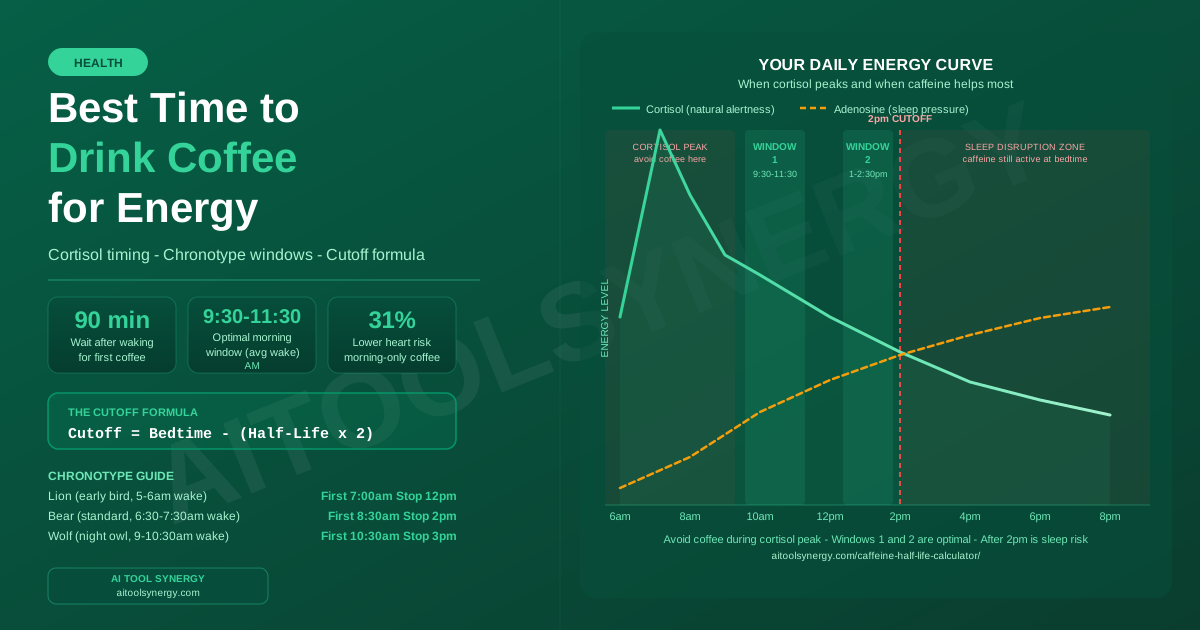
Research published in the European Heart Journal tracking over 40,000 adults found that people who restricted coffee to the morning hours (4am–noon) were 16% less likely to die from any cause and 31% less likely to die from heart disease than those who drank coffee throughout the day — a striking finding that points to timing as a real health variable, not just an energy optimisation trick.
The best time to drink coffee for energy is not simply “morning.” It’s a specific window within the morning — and the afternoon — that aligns caffeine’s effects with your body’s natural low points rather than its natural peaks. Getting this right doesn’t require willpower or a dramatic lifestyle change. It requires understanding two things: when your cortisol is high (don’t drink then), and when your adenosine has accumulated enough for caffeine to genuinely help (drink then).
The Cortisol Awakening Response — The Science Behind Coffee Timing
Within 30 to 45 minutes of waking, your body releases a surge of cortisol in a process called the Cortisol Awakening Response (CAR). This isn’t a stress response — it’s your body’s natural wake-up mechanism. Cortisol in the morning mobilises energy, sharpens focus, increases blood pressure slightly, and primes your immune system. It’s a genuinely powerful alertness signal, one of the strongest your body produces in a 24-hour period.
Here’s the problem: drinking coffee during your cortisol peak is like shouting into a microphone that’s already at full volume. Your adenosine receptors are already suppressed by cortisol’s alertness signalling. Caffeine blocking the same receptors adds very little incremental wakefulness — but it does two damaging things:
First, it accelerates caffeine tolerance. Your brain responds to repeated adenosine receptor blockade by creating more receptors. The more often you hit these receptors at peak cortisol times — when you don’t actually need the extra block — the faster your brain compensates and the more caffeine you need to achieve the same effect.
Second, it creates a harder crash later. When you add caffeine during a cortisol peak, you’re stacking two alertness signals. When both fade — cortisol declining naturally through the morning and caffeine wearing off in the early afternoon — the drop feels more abrupt. That’s the 2pm slump made worse by bad morning coffee timing, not an inevitable feature of caffeine itself.
The research consensus, summarised by neuroscientist Dr. Andrew Huberman of Stanford and clinically supported by the Cleveland Clinic, points to waiting 60–90 minutes after waking before your first cup. By that point, the cortisol awakening response has peaked and begun its natural decline. Adenosine has also had time to accumulate to a level where caffeine provides a genuine, meaningful boost rather than a redundant one.
Best Time to Drink Coffee for Energy — The Two Optimal Windows
Your body doesn’t run on a flat energy curve — it follows a wave pattern driven by cortisol and adenosine throughout the day. Cortisol peaks in the morning then gradually declines, with a secondary minor spike around noon. Adenosine accumulates continuously from the moment you wake. The best time to drink coffee for energy is specifically during the troughs between these natural peaks — where your body’s own alertness signal is lowest and caffeine can fill the gap most effectively.
For a person who wakes between 6am and 7:30am, the two science-aligned windows are:
What sits outside these windows is equally important. The hour immediately after waking (cortisol peak), the period after 2–3pm for most people, and the late evening are all suboptimal to actively harmful for coffee timing for energy. Caffeine consumed in these zones either wastes the dose or damages sleep architecture — often both.
Best Time to Drink Coffee by Chronotype — Morning Person vs Night Owl
The standard 9:30am–11:30am recommendation assumes you wake somewhere between 6am and 7:30am. But chronotype — your genetically influenced preference for sleep and wake timing — shifts the entire cortisol curve earlier or later. A true night owl who naturally wakes at 9am has a cortisol peak running from roughly 9:30am to 10:15am, not 7am to 7:45am. Drinking coffee at 9am based on the “standard” advice would put them squarely in their cortisol peak — the worst possible timing.
Use this framework to find your optimal coffee timing by chronotype:
The anchor rule for all chronotypes is the same: wait approximately 90 minutes after your natural wake time (not your alarm time — the time your body would wake without one) before your first coffee, and never push your last cup past the point where half-life math would leave more than 25% of caffeine active at your target bedtime. For the wolfchronotype, this means a seemingly early 3pm cutoff is actually already late given their later natural sleep time.
The Best Time to Drink Coffee Cutoff Formula — Protecting Your Sleep
Knowing the best time to drink coffee for energy is only half the equation. The other half is your afternoon coffee cutoff time — the latest point at which you can consume caffeine without measurably reducing your sleep quality that night. This is where caffeine’s half-life becomes the critical variable, and where most people get the calculation wrong.
With an average caffeine half-life of 5 hours, a 200mg dose (roughly two cups of coffee) consumed at 3pm still leaves approximately 50mg active at 8pm and around 25mg at 10pm. Research consistently shows that even 25–50mg of active caffeine at bedtime measurably reduces slow-wave (deep) sleep — the most physically restorative sleep stage — even in people who fall asleep without difficulty and report no subjective sleep problems.
The formula shifts significantly with age, genetics, and other factors that affect your personal caffeine half-life:
| Profile | Typical Half-Life | Cutoff for 10pm Bedtime | Cutoff for 11pm Bedtime |
|---|---|---|---|
| Fast metabolizer (under 35, non-smoker) | 2–4 hours | 2:00pm–6:00pm | 3:00pm–7:00pm |
| Average metabolizer (most adults) | 4–6 hours | 10:00am–2:00pm | 11:00am–3:00pm |
| Slow metabolizer (over 50, some genetics) | 6–9 hours | 4:00am–10:00am | 5:00am–11:00am |
| Oral contraceptive users | 7–10 hours | 2:00am–10:00am | 3:00am–11:00am |
| Pregnancy (3rd trimester) | Up to 14 hours | Morning only | Morning only |
To find your exact cutoff time based on your actual caffeine intake, metabolism type, and target sleep time, use our free Caffeine Half-Life Calculator — it runs the exponential decay math instantly and tells you exactly when caffeine in your system drops below the threshold that disrupts sleep.
What Happens If You Drink Coffee at the Wrong Time — The Real Costs
Understanding what poor coffee timing actually costs is more motivating than a generic “avoid it” warning. The consequences are specific, measurable, and cumulative.
Drinking coffee immediately on waking
Your cortisol awakening response is at its peak. Caffeine blocking adenosine receptors that aren’t fully loaded yet produces minimal additional alertness. You pay the tolerance cost — your brain creates more adenosine receptors to compensate — without getting the full energy benefit. Over weeks of this pattern, you need progressively more caffeine just to reach baseline function. You haven’t become more alert; you’ve rebuilt your floor higher while your ceiling stays the same.
Drinking coffee too late in the day
A 2013 study published in the Journal of Clinical Sleep Medicine found that caffeine consumed 6 hours before bed reduced total sleep time by a full hour — objective, polysomnography-measured sleep loss, not self-reported. Late coffee doesn’t primarily keep you awake; it compresses your deep sleep. You may fall asleep at your normal time, feel like you slept adequately, and still wake with the cognitive impairment and mood effects of insufficient restorative sleep because your slow-wave sleep was silently cut short.
Using coffee to replace sleep
This is where the real vicious cycle starts. Caffeine taken to compensate for poor sleep worsens the sleep it’s compensating for, which increases the next morning’s fatigue, which increases caffeine need, which further worsens sleep. Over time, baseline tiredness climbs while caffeine effectiveness declines. The result is someone drinking 4–5 cups a day not for energy but simply to feel normal — a state they haven’t experienced without caffeine in years.
Best Time to Drink Coffee for Energy — A Complete Daily Schedule
Pulling everything together: here is what an optimised daily coffee schedule looks like for the average bear chronotype (wake 7:00am, bedtime 11:00pm, average 5-hour half-life). Adjust all times by your chronotype offset — earlier for lions, later for wolves.
| Time | Action | Reason |
|---|---|---|
| 7:00am | Wake — water, light exposure, movement | Let cortisol awakening response do its job without caffeine interference |
| 8:30–9:30am | First coffee ☕ | Cortisol is declining, adenosine has built — caffeine is now genuinely useful |
| 11:00am–12:00pm | Second coffee (optional) ☕ | Still within the morning window; last chance for a dose that clears by 9pm |
| 1:00–2:00pm | Third coffee — afternoon dip window ☕ | Post-lunch adenosine dip; 5-hour half-life means this clears to 25% by 11pm |
| After 2:30pm | Switch to herbal tea or water | Any caffeine after this point will have 25%+ active at bedtime |
| 11:00pm | Sleep onset | Caffeine from your 2pm cut at approximately 6% remaining — negligible impact |
For those who struggle with the “no coffee before 9am” recommendation: the transition is uncomfortable for the first 3–5 days while your brain adjusts to relying on its own cortisol during the morning window. Most people find that after one week, the mid-morning coffee hits significantly harder and feels more effective than their old first-thing-in-the-morning cup — because it’s now hitting receptors that genuinely need blocking rather than pre-empting the body’s own alertness system.
How the Best Time to Drink Coffee Changes With Age
Age changes the optimal coffee timing in two distinct ways. First, caffeine half-life increases with age as liver enzyme (CYP1A2) activity declines — meaning the same cup stays in your system significantly longer in your 50s than in your 20s. A 5-hour half-life becomes a 7–8-hour half-life, which moves the safe afternoon cutoff progressively earlier with each decade.
Second, the cortisol awakening response itself shifts with age. Older adults tend to have an earlier natural cortisol peak, which means the “wait 90 minutes” rule can actually mean waiting for a period that arrives sooner in absolute clock time. A 65-year-old who naturally wakes at 6am and has a cortisol peak at 6:30am can have their first coffee by 7:30am — earlier than the standard recommendation suggests — but must enforce a much earlier afternoon cutoff, often by noon, to account for their extended half-life.
Our caffeine half-life calculator accounts for age group in its calculations — select “Senior (65+)” for age-adjusted clearance timing that factors in the slower metabolism typical of that demographic. The post on caffeine half-life by age covers the full decade-by-decade breakdown with clearance tables.
Morning Coffee and Cortisol — Common Myths Debunked
The cortisol-coffee timing topic has generated a fair amount of misinformation online. Here are the three most common myths and what the evidence actually says:
Myth 1: “You’ll get the jitters if you wait to drink coffee”
False. Jitteriness from coffee is primarily caused by drinking caffeine during a cortisol peak — when both signals are elevated simultaneously. Waiting for the cortisol peak to pass before drinking coffee typically reduces jitteriness, not increases it. Most people who switch to the 90-minute delay report smoother, more sustained alertness rather than the sharp spike-and-crash of immediate morning coffee.
Myth 2: “Drinking coffee first thing doesn’t affect sleep if you stop by 2pm”
Partially false. The cutoff time matters regardless of morning timing. But the pattern of when you first drink also matters because it shapes your tolerance trajectory. Consistent early-morning coffee at peak cortisol times accelerates tolerance, which means you tend to drink more total caffeine throughout the day — and some of that extra caffeine ends up later in the day where it can affect sleep.
Myth 3: “The 2pm coffee cutoff rule works for everyone”
False. The 2pm rule was derived assuming an average 5–6 hour half-life and a 10pm bedtime. For slow metabolizers, adults over 50, people on oral contraceptives, and anyone with a later bedtime, this cutoff is far too late. Conversely, for fast metabolizers with a 2–3 hour half-life and an early bedtime, 4pm or even 5pm may be perfectly safe. Personalised calculation using your actual half-life profile is the only accurate approach.
Practical Tips for Getting Your Best Time to Drink Coffee Routine Right
Shifting your best time to drink coffee routine takes a few days of adjustment. These strategies make the transition manageable:
Rehydrate before you caffeinate. Your first action after waking should be water — 400–500ml. You’ve been without fluids for 7–9 hours and mild dehydration independently contributes to morning fog. Drinking water first gives you something to do with the urge to “have something” while you wait for your 90-minute window, and hydration itself improves alertness without touching your cortisol or adenosine systems.
Get morning sunlight exposure. Light is the strongest input to your circadian clock. Ten to fifteen minutes of outdoor light within the first 30 minutes of waking strengthens your cortisol awakening response and accelerates adenosine clearance. This makes the 90-minute wait feel shorter because your body’s own alertness mechanisms are working harder in the meantime.
Move your alarm earlier, not your coffee. If your schedule requires you to be functional at 7am and you’ve been drinking coffee at 6:30am to manage it, the solution isn’t to compromise on timing — it’s to adjust your wake time earlier so that the 90-minute delay lands in a workable window. Waking at 5:45am means your first coffee at 7:15am, which clears the cortisol peak while still leaving a productive morning window.
Use our caffeine half-life calculator to verify your afternoon cutoff. Most people underestimate how much caffeine they’re consuming and overestimate how quickly it clears. Enter your actual drinks — including tea, energy drinks, or pre-workout if relevant — into the caffeine half-life calculator and check what’s actually in your system at bedtime. Many people discover their “harmless” 3pm coffee leaves 60–80mg of active caffeine at 11pm — equivalent to three-quarters of a cup of coffee taken right at sleep onset.
Track your sleep quality after adjusting your cutoff. The improvement in deep sleep from moving your last coffee one to two hours earlier is usually noticeable within 5–7 days. You may not fall asleep faster (caffeine’s effect on sleep onset is milder than its effect on sleep architecture), but you’ll likely notice feeling more genuinely rested in the morning — the marker of improved slow-wave sleep rather than just adequate total duration.
The Best Time to Drink Coffee for Energy — Summary
The science of coffee timing for energy comes down to three rules applied to your personal profile. First: wait 60–90 minutes after waking to let your cortisol awakening response peak and begin declining before you add caffeine to the system. Second: time afternoon coffee to land during the natural post-lunch adenosine dip — typically 1:00pm to 2:30pm for average chronotypes — and never later than Bedtime minus 10 hours (for an average half-life). Third: adjust both windows for your chronotype, age, and any factors that extend your half-life.
Everything else — the number of cups, the strength, the source — matters less than these timing anchors. The same 200mg of caffeine consumed at 9:30am delivers meaningfully more energy, less tolerance buildup, and less sleep damage than the same 200mg consumed at 7:00am or 4:00pm. Use the free caffeine half-life calculator to pin down your personal cutoff time and stop guessing.
Frequently Asked Questions
Best Time to Drink Coffee for Energy — Cortisol, Chronotype & Cutoff Guide
Most people treat coffee timing as an afterthought — you wake up, the machine goes on, and the first cup happens before your eyes have fully adjusted to the light. It feels like the natural order of things. But that instinct is working directly against the science of how caffeine, cortisol, and your brain’s alertness systems actually interact.
Drinking coffee at the wrong time doesn’t just waste the caffeine — it accelerates tolerance, worsens the afternoon crash, and sets up a chain of events that can quietly degrade your sleep quality that same night. The best time to drink coffee for energy is a precise calculation involving your wake time, your chronotype, your caffeine half-life, and your target bedtime. This guide gives you all of it in one place, including a by-chronotype schedule and a cutoff time formula you can apply today.
Why the Best Time to Drink Coffee Matters More Than You Think
The question of when to drink coffee matters because caffeine doesn’t work in isolation — it interacts with two of your body’s most powerful natural systems: cortisol and adenosine. Drink it at the wrong point in either cycle and you get a fraction of the benefit. Drink it at the right point and the same dose delivers measurably more alertness with less crash, less tolerance buildup, and less sleep disruption that night.
Research published in the European Heart Journal tracking over 40,000 adults found that people who restricted coffee to the morning hours (4am–noon) were 16% less likely to die from any cause and 31% less likely to die from heart disease than those who drank coffee throughout the day — a striking finding that points to timing as a real health variable, not just an energy optimisation trick.
The best time to drink coffee for energy is not simply “morning.” It’s a specific window within the morning — and the afternoon — that aligns caffeine’s effects with your body’s natural low points rather than its natural peaks. Getting this right doesn’t require willpower or a dramatic lifestyle change. It requires understanding two things: when your cortisol is high (don’t drink then), and when your adenosine has accumulated enough for caffeine to genuinely help (drink then).
The Cortisol Awakening Response — The Science Behind Coffee Timing
Within 30 to 45 minutes of waking, your body releases a surge of cortisol in a process called the Cortisol Awakening Response (CAR). This isn’t a stress response — it’s your body’s natural wake-up mechanism. Cortisol in the morning mobilises energy, sharpens focus, increases blood pressure slightly, and primes your immune system. It’s a genuinely powerful alertness signal, one of the strongest your body produces in a 24-hour period.
Here’s the problem: drinking coffee during your cortisol peak is like shouting into a microphone that’s already at full volume. Your adenosine receptors are already suppressed by cortisol’s alertness signalling. Caffeine blocking the same receptors adds very little incremental wakefulness — but it does two damaging things:
First, it accelerates caffeine tolerance. Your brain responds to repeated adenosine receptor blockade by creating more receptors. The more often you hit these receptors at peak cortisol times — when you don’t actually need the extra block — the faster your brain compensates and the more caffeine you need to achieve the same effect.
Second, it creates a harder crash later. When you add caffeine during a cortisol peak, you’re stacking two alertness signals. When both fade — cortisol declining naturally through the morning and caffeine wearing off in the early afternoon — the drop feels more abrupt. That’s the 2pm slump made worse by bad morning coffee timing, not an inevitable feature of caffeine itself.
The research consensus, summarised by neuroscientist Dr. Andrew Huberman of Stanford and clinically supported by the Cleveland Clinic, points to waiting 60–90 minutes after waking before your first cup. By that point, the cortisol awakening response has peaked and begun its natural decline. Adenosine has also had time to accumulate to a level where caffeine provides a genuine, meaningful boost rather than a redundant one.
Best Time to Drink Coffee for Energy — The Two Optimal Windows
Your body doesn’t run on a flat energy curve — it follows a wave pattern driven by cortisol and adenosine throughout the day. Cortisol peaks in the morning then gradually declines, with a secondary minor spike around noon. Adenosine accumulates continuously from the moment you wake. The best time to drink coffee for energy is specifically during the troughs between these natural peaks — where your body’s own alertness signal is lowest and caffeine can fill the gap most effectively.
For a person who wakes between 6am and 7:30am, the two science-aligned windows are:
What sits outside these windows is equally important. The hour immediately after waking (cortisol peak), the period after 2–3pm for most people, and the late evening are all suboptimal to actively harmful for coffee timing for energy. Caffeine consumed in these zones either wastes the dose or damages sleep architecture — often both.
Best Time to Drink Coffee by Chronotype — Morning Person vs Night Owl
The standard 9:30am–11:30am recommendation assumes you wake somewhere between 6am and 7:30am. But chronotype — your genetically influenced preference for sleep and wake timing — shifts the entire cortisol curve earlier or later. A true night owl who naturally wakes at 9am has a cortisol peak running from roughly 9:30am to 10:15am, not 7am to 7:45am. Drinking coffee at 9am based on the “standard” advice would put them squarely in their cortisol peak — the worst possible timing.
Use this framework to find your optimal coffee timing by chronotype:
The anchor rule for all chronotypes is the same: wait approximately 90 minutes after your natural wake time (not your alarm time — the time your body would wake without one) before your first coffee, and never push your last cup past the point where half-life math would leave more than 25% of caffeine active at your target bedtime. For the wolfchronotype, this means a seemingly early 3pm cutoff is actually already late given their later natural sleep time.
The Best Time to Drink Coffee Cutoff Formula — Protecting Your Sleep
Knowing the best time to drink coffee for energy is only half the equation. The other half is your afternoon coffee cutoff time — the latest point at which you can consume caffeine without measurably reducing your sleep quality that night. This is where caffeine’s half-life becomes the critical variable, and where most people get the calculation wrong.
With an average caffeine half-life of 5 hours, a 200mg dose (roughly two cups of coffee) consumed at 3pm still leaves approximately 50mg active at 8pm and around 25mg at 10pm. Research consistently shows that even 25–50mg of active caffeine at bedtime measurably reduces slow-wave (deep) sleep — the most physically restorative sleep stage — even in people who fall asleep without difficulty and report no subjective sleep problems.
The formula shifts significantly with age, genetics, and other factors that affect your personal caffeine half-life:
| Profile | Typical Half-Life | Cutoff for 10pm Bedtime | Cutoff for 11pm Bedtime |
|---|---|---|---|
| Fast metabolizer (under 35, non-smoker) | 2–4 hours | 2:00pm–6:00pm | 3:00pm–7:00pm |
| Average metabolizer (most adults) | 4–6 hours | 10:00am–2:00pm | 11:00am–3:00pm |
| Slow metabolizer (over 50, some genetics) | 6–9 hours | 4:00am–10:00am | 5:00am–11:00am |
| Oral contraceptive users | 7–10 hours | 2:00am–10:00am | 3:00am–11:00am |
| Pregnancy (3rd trimester) | Up to 14 hours | Morning only | Morning only |
To find your exact cutoff time based on your actual caffeine intake, metabolism type, and target sleep time, use our free Caffeine Half-Life Calculator — it runs the exponential decay math instantly and tells you exactly when caffeine in your system drops below the threshold that disrupts sleep.
What Happens If You Drink Coffee at the Wrong Time — The Real Costs
Understanding what poor coffee timing actually costs is more motivating than a generic “avoid it” warning. The consequences are specific, measurable, and cumulative.
Drinking coffee immediately on waking
Your cortisol awakening response is at its peak. Caffeine blocking adenosine receptors that aren’t fully loaded yet produces minimal additional alertness. You pay the tolerance cost — your brain creates more adenosine receptors to compensate — without getting the full energy benefit. Over weeks of this pattern, you need progressively more caffeine just to reach baseline function. You haven’t become more alert; you’ve rebuilt your floor higher while your ceiling stays the same.
Drinking coffee too late in the day
A 2013 study published in the Journal of Clinical Sleep Medicine found that caffeine consumed 6 hours before bed reduced total sleep time by a full hour — objective, polysomnography-measured sleep loss, not self-reported. Late coffee doesn’t primarily keep you awake; it compresses your deep sleep. You may fall asleep at your normal time, feel like you slept adequately, and still wake with the cognitive impairment and mood effects of insufficient restorative sleep because your slow-wave sleep was silently cut short.
Using coffee to replace sleep
This is where the real vicious cycle starts. Caffeine taken to compensate for poor sleep worsens the sleep it’s compensating for, which increases the next morning’s fatigue, which increases caffeine need, which further worsens sleep. Over time, baseline tiredness climbs while caffeine effectiveness declines. The result is someone drinking 4–5 cups a day not for energy but simply to feel normal — a state they haven’t experienced without caffeine in years.
Best Time to Drink Coffee for Energy — A Complete Daily Schedule
Pulling everything together: here is what an optimised daily coffee schedule looks like for the average bear chronotype (wake 7:00am, bedtime 11:00pm, average 5-hour half-life). Adjust all times by your chronotype offset — earlier for lions, later for wolves.
| Time | Action | Reason |
|---|---|---|
| 7:00am | Wake — water, light exposure, movement | Let cortisol awakening response do its job without caffeine interference |
| 8:30–9:30am | First coffee ☕ | Cortisol is declining, adenosine has built — caffeine is now genuinely useful |
| 11:00am–12:00pm | Second coffee (optional) ☕ | Still within the morning window; last chance for a dose that clears by 9pm |
| 1:00–2:00pm | Third coffee — afternoon dip window ☕ | Post-lunch adenosine dip; 5-hour half-life means this clears to 25% by 11pm |
| After 2:30pm | Switch to herbal tea or water | Any caffeine after this point will have 25%+ active at bedtime |
| 11:00pm | Sleep onset | Caffeine from your 2pm cut at approximately 6% remaining — negligible impact |
For those who struggle with the “no coffee before 9am” recommendation: the transition is uncomfortable for the first 3–5 days while your brain adjusts to relying on its own cortisol during the morning window. Most people find that after one week, the mid-morning coffee hits significantly harder and feels more effective than their old first-thing-in-the-morning cup — because it’s now hitting receptors that genuinely need blocking rather than pre-empting the body’s own alertness system.
How the Best Time to Drink Coffee Changes With Age
Age changes the optimal coffee timing in two distinct ways. First, caffeine half-life increases with age as liver enzyme (CYP1A2) activity declines — meaning the same cup stays in your system significantly longer in your 50s than in your 20s. A 5-hour half-life becomes a 7–8-hour half-life, which moves the safe afternoon cutoff progressively earlier with each decade.
Second, the cortisol awakening response itself shifts with age. Older adults tend to have an earlier natural cortisol peak, which means the “wait 90 minutes” rule can actually mean waiting for a period that arrives sooner in absolute clock time. A 65-year-old who naturally wakes at 6am and has a cortisol peak at 6:30am can have their first coffee by 7:30am — earlier than the standard recommendation suggests — but must enforce a much earlier afternoon cutoff, often by noon, to account for their extended half-life.
Our caffeine half-life calculator accounts for age group in its calculations — select “Senior (65+)” for age-adjusted clearance timing that factors in the slower metabolism typical of that demographic. The post on caffeine half-life by age covers the full decade-by-decade breakdown with clearance tables.
Morning Coffee and Cortisol — Common Myths Debunked
The cortisol-coffee timing topic has generated a fair amount of misinformation online. Here are the three most common myths and what the evidence actually says:
Myth 1: “You’ll get the jitters if you wait to drink coffee”
False. Jitteriness from coffee is primarily caused by drinking caffeine during a cortisol peak — when both signals are elevated simultaneously. Waiting for the cortisol peak to pass before drinking coffee typically reduces jitteriness, not increases it. Most people who switch to the 90-minute delay report smoother, more sustained alertness rather than the sharp spike-and-crash of immediate morning coffee.
Myth 2: “Drinking coffee first thing doesn’t affect sleep if you stop by 2pm”
Partially false. The cutoff time matters regardless of morning timing. But the pattern of when you first drink also matters because it shapes your tolerance trajectory. Consistent early-morning coffee at peak cortisol times accelerates tolerance, which means you tend to drink more total caffeine throughout the day — and some of that extra caffeine ends up later in the day where it can affect sleep.
Myth 3: “The 2pm coffee cutoff rule works for everyone”
False. The 2pm rule was derived assuming an average 5–6 hour half-life and a 10pm bedtime. For slow metabolizers, adults over 50, people on oral contraceptives, and anyone with a later bedtime, this cutoff is far too late. Conversely, for fast metabolizers with a 2–3 hour half-life and an early bedtime, 4pm or even 5pm may be perfectly safe. Personalised calculation using your actual half-life profile is the only accurate approach.
Practical Tips for Getting Your Best Time to Drink Coffee Routine Right
Shifting your best time to drink coffee routine takes a few days of adjustment. These strategies make the transition manageable:
Rehydrate before you caffeinate. Your first action after waking should be water — 400–500ml. You’ve been without fluids for 7–9 hours and mild dehydration independently contributes to morning fog. Drinking water first gives you something to do with the urge to “have something” while you wait for your 90-minute window, and hydration itself improves alertness without touching your cortisol or adenosine systems.
Get morning sunlight exposure. Light is the strongest input to your circadian clock. Ten to fifteen minutes of outdoor light within the first 30 minutes of waking strengthens your cortisol awakening response and accelerates adenosine clearance. This makes the 90-minute wait feel shorter because your body’s own alertness mechanisms are working harder in the meantime.
Move your alarm earlier, not your coffee. If your schedule requires you to be functional at 7am and you’ve been drinking coffee at 6:30am to manage it, the solution isn’t to compromise on timing — it’s to adjust your wake time earlier so that the 90-minute delay lands in a workable window. Waking at 5:45am means your first coffee at 7:15am, which clears the cortisol peak while still leaving a productive morning window.
Use our caffeine half-life calculator to verify your afternoon cutoff. Most people underestimate how much caffeine they’re consuming and overestimate how quickly it clears. Enter your actual drinks — including tea, energy drinks, or pre-workout if relevant — into the caffeine half-life calculator and check what’s actually in your system at bedtime. Many people discover their “harmless” 3pm coffee leaves 60–80mg of active caffeine at 11pm — equivalent to three-quarters of a cup of coffee taken right at sleep onset.
Track your sleep quality after adjusting your cutoff. The improvement in deep sleep from moving your last coffee one to two hours earlier is usually noticeable within 5–7 days. You may not fall asleep faster (caffeine’s effect on sleep onset is milder than its effect on sleep architecture), but you’ll likely notice feeling more genuinely rested in the morning — the marker of improved slow-wave sleep rather than just adequate total duration.
The Best Time to Drink Coffee for Energy — Summary
The science of coffee timing for energy comes down to three rules applied to your personal profile. First: wait 60–90 minutes after waking to let your cortisol awakening response peak and begin declining before you add caffeine to the system. Second: time afternoon coffee to land during the natural post-lunch adenosine dip — typically 1:00pm to 2:30pm for average chronotypes — and never later than Bedtime minus 10 hours (for an average half-life). Third: adjust both windows for your chronotype, age, and any factors that extend your half-life.
Everything else — the number of cups, the strength, the source — matters less than these timing anchors. The same 200mg of caffeine consumed at 9:30am delivers meaningfully more energy, less tolerance buildup, and less sleep damage than the same 200mg consumed at 7:00am or 4:00pm. Use the free caffeine half-life calculator to pin down your personal cutoff time and stop guessing.







2 Responses
[…] with the “slow metaboliser” setting to find your specific safe window. The guide on the best time to drink coffee for energy covers the optimal morning and cutoff windows in […]
[…] requires an earlier cutoff due to higher caffeine content. The full timing guide is covered in our best time to drink coffee for energy […]