


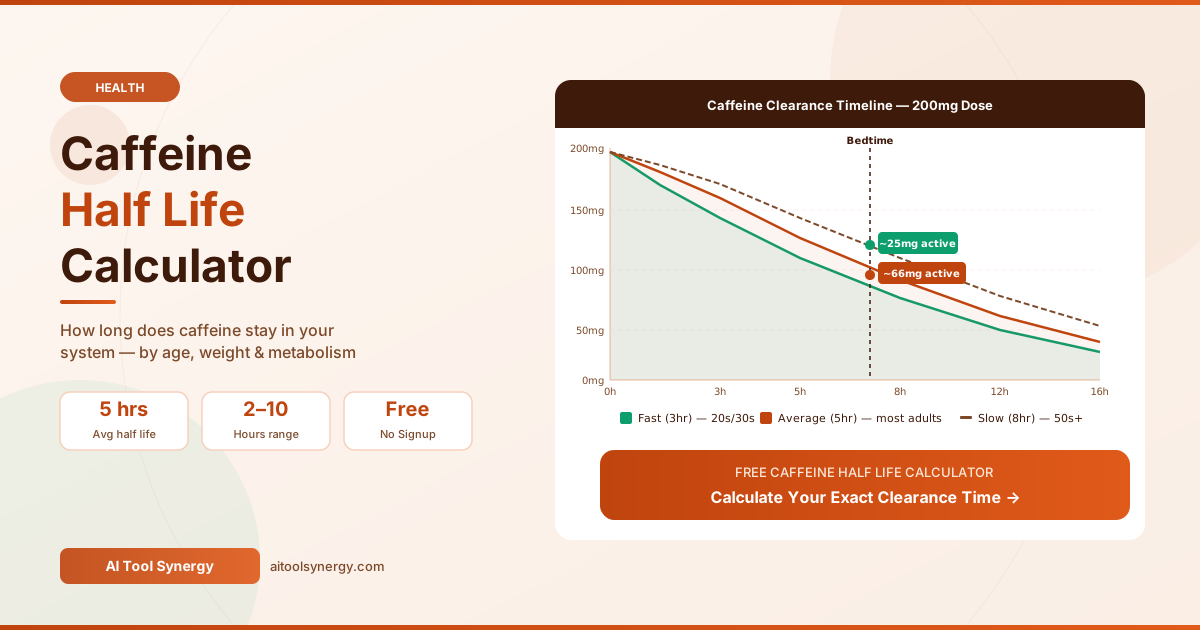
The caffeine half life calculator tells you exactly how much caffeine is still active in your body at any given time — and when it will finally clear your system completely. Whether you need to know your caffeine half life by age, understand why that 3pm coffee is still affecting you at midnight, or calculate the precise moment caffeine drops below the threshold that disrupts sleep — this guide covers everything the science knows, with clear visuals, tables, and our free caffeine calculator to do the maths for you.
What Is Caffeine Half Life? The Core Concept Explained
The caffeine half life is the time it takes your body to eliminate exactly 50% of the caffeine you consumed. It is the single most important number in understanding how long caffeine affects your body — more important than the total dose, and more important than when you feel the effects wearing off.
Here is why the half life concept matters more than most people realise: caffeine does not leave your body at a constant rate. It follows what pharmacologists call first-order kinetics — meaning it eliminates a fixed percentage of whatever is currently in your system with each passing hour, not a fixed amount. This is why calculating caffeine clearance requires a caffeine half life calculator rather than simple subtraction.
The key insight from the curve above: caffeine elimination is never linear. The same 5-hour half life that eliminates 100mg in the first 5 hours only eliminates 50mg in the next 5 hours, and only 25mg in the 5 hours after that. This exponential decay is why a caffeine half life calculator gives you so much more accurate information than simply estimating “it wears off in a few hours.”
The Caffeine Half Life Calculator Formula — How It Works
Every accurate caffeine half life calculator uses the same pharmacokinetic formula. Understanding the formula helps you interpret results correctly and manually estimate your caffeine levels when you do not have access to a calculator.
Breaking the formula down: Dose is the milligrams of caffeine you consumed. 0.5 represents the 50% elimination per half life. Hours ÷ Half Life tells the formula how many half life cycles have passed. The caret symbol (^) means “to the power of.” Put together, this is a standard exponential decay equation — the same mathematics used in radioactive decay, drug pharmacokinetics, and compound interest calculations.
Worked Example — Your 3pm Coffee at 11pm
You drink 200mg of caffeine (roughly 2 cups of drip coffee) at 3pm. Your estimated half life is 5 hours. You go to bed at 11pm — that is 8 hours after consumption. Here is what the caffeine half life calculator produces:
Calculate how many half lives have passed
8 hours elapsed ÷ 5 hour half life = 1.6 half life cycles
Apply the formula
200mg × (0.5 ^ 1.6) = 200mg × 0.330 = 66mg still active at 11pm
Interpret the result
66mg at bedtime is equivalent to drinking roughly two-thirds of a cup of coffee right before sleep. Not negligible — and enough to measurably reduce deep sleep and delay REM onset according to published sleep research.
Caffeine Half Life by Age — Complete Breakdown
The caffeine half life by age is one of the most practically useful things to understand from this entire guide. Age is one of the strongest predictors of how quickly your body processes caffeine — and most people significantly underestimate how much their caffeine metabolism slows as they get older.
The primary reason is the CYP1A2 liver enzyme — responsible for metabolising approximately 95% of dietary caffeine. This enzyme’s activity gradually declines with age, extending the half life year by year in a gradual drift that most people do not consciously notice until they start experiencing sleep problems that were not there a decade ago.
The practical implication: a 25-year-old and a 65-year-old drinking the same coffee at 3pm will have very different amounts of active caffeine at 11pm. The 25-year-old may have cleared 75–80% of it. The 65-year-old may still have 50–60% circulating — the equivalent of a full cup of coffee’s worth of stimulant in their system at bedtime.
| Age Group | Typical Half Life | Caffeine at 11pm (3pm 200mg dose) | Recommended Cutoff | Metabolizer Type |
|---|---|---|---|---|
| Teens (15–19) | 3–4 hours | ~25–35mg | Up to 5pm | Fast |
| 20s | 3–5 hours | ~30–50mg | 3pm–5pm | Fast–Average |
| 30s | 4–6 hours | ~50–80mg | 1pm–3pm | Average |
| 40s | 5–7 hours | ~65–100mg | Noon–2pm | Average–Slow |
| 50s | 6–8 hours | ~85–115mg | 11am–1pm | Slow |
| 60s | 7–9 hours | ~100–130mg | 10am–Noon | Slow |
| 70+ | 8–10+ hours | ~115–150mg | 9am–11am | Very Slow |
| Pregnancy (3rd trimester) | Up to 14 hours | ~170–185mg | Morning only | Extremely Slow |
Caffeine Calculator by Weight and Age — Does Body Size Matter?
A very common question when using a caffeine calculator by weight and age is whether heavier or lighter people process caffeine faster. The answer is more nuanced than most people expect — and it differs importantly between two separate effects: concentration and half life.
In practical terms: a person weighing 100kg drinking 200mg of caffeine will feel a weaker stimulant effect than a person weighing 60kg drinking the same dose — because the caffeine is distributed across a larger body volume. However, both people with the same age and genetic profile will eliminate that caffeine in roughly the same number of hours. The caffeine half life is primarily determined by liver enzyme activity, not body mass.
Where body composition does make a measurable difference is in muscle vs fat ratio. Caffeine distributes into lean tissue (muscle) more readily than into fat tissue. This means that at identical body weights, a person with higher muscle mass will have slightly lower peak caffeine concentration than someone with higher body fat — a minor effect compared to age and genetics, but real enough to note in a comprehensive caffeine calculator by weight and age.
How Long Does Caffeine Stay in Your System — Complete Timeline
Understanding how long caffeine stays in your system requires looking at the full clearance timeline — not just the half life. Many people mistakenly assume that once the half life has passed, caffeine is “gone.” In reality, it takes multiple half lives for caffeine to reach negligible levels.
| Hours After 200mg Dose | Fast (3hr half life) | Average (5hr half life) | Slow (8hr half life) |
|---|---|---|---|
| 1 hour | 159mg (79%) | 174mg (87%) | 183mg (92%) |
| 3 hours | 100mg (50%) ← ½ | 131mg (66%) | 153mg (77%) |
| 5 hours | 63mg (31%) | 100mg (50%) ← ½ | 129mg (65%) |
| 8 hours | 25mg (12%) | 66mg (33%) | 100mg (50%) ← ½ |
| 10 hours | 12mg (6%) | 50mg (25%) | 79mg (40%) |
| 15 hours | 2mg (1%) | 19mg (9%) | 42mg (21%) |
| 20 hours | <1mg (trace) | 6mg (3%) | 22mg (11%) |
| 25 hours | Cleared | 2mg (trace) | 12mg (6%) |
Factors That Change Your Caffeine Half Life Calculator Results
Your caffeine half life is not fixed. It shifts based on several biological and lifestyle factors — some temporary, some permanent. Understanding these variables helps you interpret caffeine calculator results for your specific situation rather than relying on population averages.
Smoking and Caffeine Half Life
Smoking is the single lifestyle factor that most dramatically speeds up caffeine metabolism. Compounds in tobacco smoke induce CYP1A2 enzyme activity, sometimes reducing the caffeine half life by as much as 50% compared to non-smokers. A non-smoker with a 5-hour half life may metabolise caffeine in as little as 2.5 hours while smoking. This is part of why smokers tend to drink significantly more coffee — the stimulant effect genuinely wears off faster. When smokers quit, caffeine suddenly feels much stronger because the same dose now stays in their system twice as long.
Oral Contraceptives and Caffeine
This is one of the most clinically significant and least-discussed interactions affecting the caffeine half life calculator. Research published in the European Journal of Clinical Pharmacology found that women taking combined oral contraceptives had caffeine half lives of 7.9 hours on average compared to 5.4 hours for non-users — an increase of approximately 46%. Women who recently started the pill and notice increased caffeine sensitivity or worse sleep after previously tolerating afternoon coffee well may be experiencing this pharmacological interaction.
Pregnancy
The caffeine half life during pregnancy increases progressively through each trimester — from roughly normal in the first trimester to approximately 10–11 hours in the second, and up to 14–18 hours in the third trimester. This is why the CDC recommends limiting caffeine to 200mg per day during pregnancy. At a 14-hour half life, a morning espresso still has roughly half its caffeine active at 9pm — making timing critical for pregnant women.
Caffeine Half Life by Drink Type — What You Are Actually Consuming
Accurately using any caffeine half life calculator requires knowing your actual caffeine intake — and most people significantly underestimate how much they consume. The variation across drink types and brands is enormous, and several common drinks contain more caffeine than most users realise.
Two important entries in this data deserve special attention. First, cold brew coffee is significantly higher in caffeine than most people assume — because it uses a higher coffee-to-water ratio and longer steep time. Some commercial cold brews contain 200–300mg per 12oz serving, making them comparable to energy drinks. Second, decaf is never truly zero caffeine. With 2–15mg per cup depending on the brand and preparation, multiple evening decafs can add up to a meaningful dose for sensitive individuals with slow metabolism.
How to Use the Caffeine Half Life Calculator for Your Specific Situation
Our free caffeine half life calculator at aitoolsynergy.com takes your individual inputs and produces a complete clearance timeline. Here is how to get the most accurate results from it:
How to determine your caffeine metabolism speed
You almost certainly do not know your CYP1A2 genotype without a DNA test. Use these proxy signals instead: Fast metabolizer — you can drink coffee after 5pm and sleep fine, you feel minimal jitteriness from caffeine, you are under 35 and a non-smoker. Average metabolizer — coffee after 2–3pm noticeably affects your sleep, you feel normal alertness effects. Slow metabolizer — you are very sensitive to caffeine, you are over 50, you are pregnant, or you take oral contraceptives.
Add up all sources consumed today
Most people forget to count tea, soft drinks, dark chocolate, pre-workout supplements, and some headache medications that contain caffeine. Use the drink table above to get an accurate total. If you had a double espresso (125mg) and a black tea (55mg), your total is 180mg — not 125mg.
What time do you want to sleep?
The calculator works backwards from your target bedtime to tell you the latest safe time to consume caffeine and have less than 25% remaining at sleep onset — the threshold below which most research shows minimal sleep architecture disruption.
What the results tell you
The calculator produces a timeline showing caffeine levels at each hour after consumption. Look for the point where your caffeine drops below 25mg — this is the threshold most pharmacologists consider functionally insignificant for sleep. For reference, 25mg is roughly equivalent to a quarter cup of coffee or one cup of green tea.
☕ Free Caffeine Half Life Calculator — No Signup
Enter your caffeine dose, time consumed, and metabolism type — get a complete clearance timeline instantly. Find your personal cutoff time in seconds.
Calculate My Caffeine Half Life →Caffeine Half Life vs Caffeine Duration of Effect — Not the Same Thing
One of the most common points of confusion is conflating the caffeine half life with the duration of caffeine’s noticeable effects. These are related but distinct concepts — and understanding the difference explains why many people believe caffeine has “worn off” hours before it has actually cleared their system.
You typically feel the peak alertness effect of caffeine 30–60 minutes after consumption. By 4–5 hours you may feel little or no stimulant effect — particularly if you have any caffeine tolerance. But as the caffeine half life calculator shows, at 5 hours you still have 50% of the caffeine in your bloodstream. Your brain has adapted to its presence through receptor downregulation (tolerance), so you no longer feel alert — but your adenosine receptors are still partially blocked, your deep sleep is still being suppressed, and your REM cycles are still being disrupted.
This is why so many regular caffeine users sincerely believe their sleep is unaffected by afternoon coffee — the subjective feeling of alertness has genuinely worn off, but the objective physiological effects on sleep architecture persist. Research cited by the Sleep Foundation confirms that sleep disruption from caffeine occurs even when subjects report no perceived stimulant effect. For everything that caffeine does to sleep stages specifically, read our detailed guide on how caffeine affects sleep.
Caffeine Half Life in Special Populations
Caffeine Half Life in Children and Adolescents
Children have a faster caffeine half life than adults — typically 2.5–4 hours — due to higher overall metabolic rates. However, caffeine sensitivity (the physiological response per mg) is higher in children, and the adenosine systems that caffeine disrupts are still developing during childhood and adolescence. Major health organisations including the American Academy of Pediatrics recommend no caffeine for children under 12 and strict limits for adolescents.
Caffeine Half Life in Athletes
Athletes frequently use caffeine as a legal performance enhancer — typically 3–6mg per kg of body weight consumed 30–60 minutes before training. The caffeine half life calculator is particularly useful for athletes to time both their performance dose and their final consumption to avoid disrupting the deep sleep that drives the muscle recovery and hormonal adaptation that training is designed to stimulate. Pre-workout supplements often contain 150–300mg of caffeine — even a single afternoon dose can significantly affect an athlete’s sleep quality if consumed too close to their target bedtime.
Caffeine Half Life and Anxiety Disorders
Individuals with generalised anxiety disorder (GAD) or panic disorder are frequently more sensitive to caffeine’s stimulant effects — not necessarily because of a different caffeine half life, but because adenosine receptor sensitivity and caffeine’s effect on cortisol and adrenaline amplify anxiety symptoms more intensely. For this population, even amounts that clear the system normally can produce disproportionate physiological arousal, making a conservative caffeine calculator cutoff especially important.
How to Reduce Caffeine Without the Withdrawal Crash
Once you understand your caffeine half life and how long caffeine actually stays in your system, many people want to reset their consumption patterns — but fear the withdrawal headaches and fatigue that come with sudden reduction.
Caffeine withdrawal symptoms — headaches, fatigue, irritability, difficulty concentrating — occur because your brain has upregulated adenosine receptor density in response to chronic caffeine blockade. When caffeine is suddenly removed, all those extra receptors flood with adenosine simultaneously, producing an exaggerated drowsiness and pain response. The headache is genuinely real, not psychological.
The solution is a gradual taper rather than cold turkey. Research suggests reducing caffeine intake by 10–25% every 1–2 weeks gives the brain time to downregulate receptor density gradually. For someone consuming 400mg daily (4 cups of coffee), a 12-week taper might look like: 400mg → 300mg → 225mg → 170mg → 130mg → 100mg — at which point the physiological dependency is largely resolved and further reduction or complete elimination causes minimal withdrawal.
Frequently Asked Questions
Final Thoughts
The caffeine half life calculator is not just a curiosity — it is one of the most practically useful health tools available to anyone who consumes caffeine regularly. Understanding that your 200mg afternoon coffee still has 50–100mg active in your bloodstream at bedtime — depending on your age and metabolizer type — fundamentally changes how you think about your daily caffeine habits.
The key takeaways: your caffeine half life by age increases significantly each decade, meaning strategies that worked at 25 may not work at 45. Body weight changes peak concentration but not elimination speed. Pregnancy and oral contraceptives can double your half life. And the fact that you stop feeling alert does not mean caffeine has cleared your system — your brain has simply adapted to its presence while your sleep architecture continues to be disrupted.
Use our free Caffeine Half Life Calculator to find your exact clearance timeline and cutoff time. And for the complete science of how caffeine disrupts every sleep stage — including REM disruption, adenosine mechanics, and the vicious dependency cycle — read our companion guide on how caffeine affects sleep.
✅ Free Caffeine Half Life Calculator — No Signup Ever
Enter your caffeine dose and metabolism type — get your complete clearance timeline and personal safe cutoff time instantly. 100% free forever.
Open Caffeine Calculator →






One Response
[…] clearance timing that factors in the slower metabolism typical of that demographic. The post on caffeine half-life by age covers the full decade-by-decade breakdown with clearance […]