


Why Am I So Sensitive to Caffeine? The Genetic and Biological Reasons Explained
You drink one cup of coffee and your heart races. Your colleague drinks three espressos after dinner and sleeps soundly. You wonder what is wrong with you — whether you are broken, anxious, or simply too weak for something 90% of adults consume without a second thought. The answer is none of those things. You are sensitive to caffeine because of your biology, and that biology is largely encoded in two specific genes you inherited before you were born.
Understanding why you are so sensitive to caffeine is one of the most practically useful pieces of health knowledge you can have. It explains your sleep problems, your jitters, your heart palpitations after a single cup, and why the standard advice to “just drink less coffee” misses the point — because even a small amount behaves differently in your body than it does in most people’s. This guide breaks down the exact biological mechanisms, shows you how to identify your sensitivity group without a DNA test, and gives you a practical caffeine limit matched to your profile.
Why Am I So Sensitive to Caffeine — The Short Answer
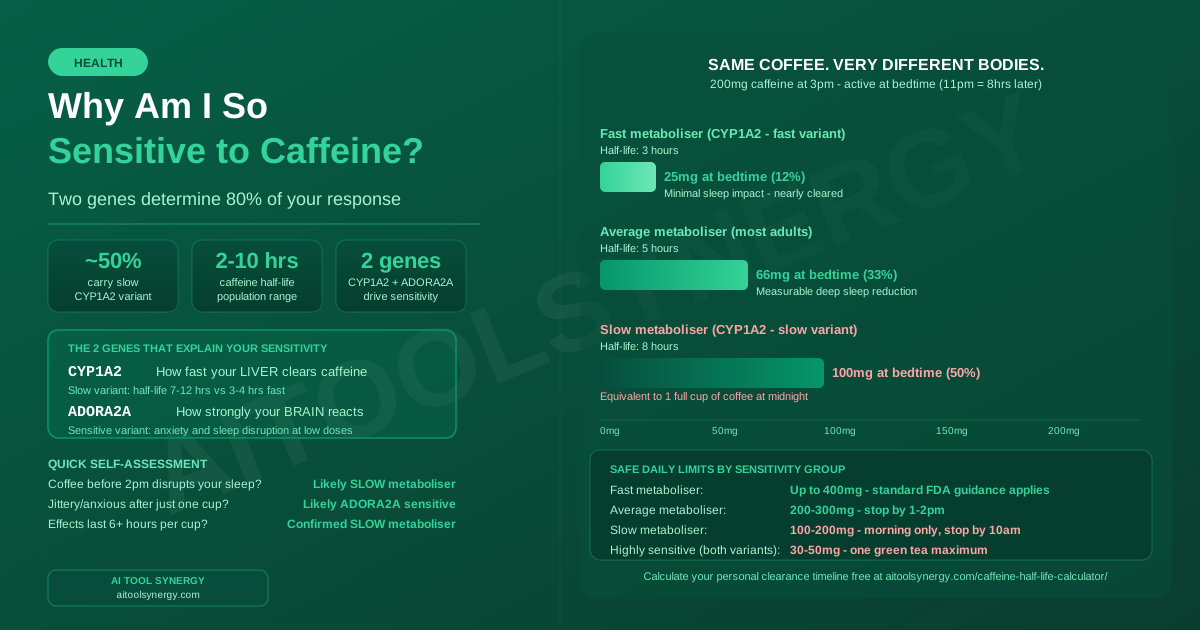
Caffeine sensitivity comes from two distinct but related biological mechanisms. The first is how fast your liver clears caffeine — determined primarily by the CYP1A2 gene. The second is how strongly your brain reacts to caffeine — determined primarily by the ADORA2A gene. You can be a slow metaboliser without having high receptor sensitivity, or vice versa. But when both work against you — when you clear caffeine slowly AND your adenosine receptors are highly reactive — you sit at the most sensitive end of the spectrum, and even small doses produce intense, prolonged effects.
Beyond genetics, caffeine sensitivity is also shaped by factors that can change throughout your life: age, hormonal medications, pregnancy, anxiety disorders, certain prescription drugs, and accumulated caffeine tolerance. This is why some people who handled coffee fine at 25 find themselves suddenly reactive to it at 45 without changing a single thing about their diet.
Why Am I So Sensitive to Caffeine — The Two Genes Responsible
Two genes account for the majority of individual variation in caffeine sensitivity. Both have been confirmed in large-scale genome-wide association studies and are well-established in the clinical pharmacology literature.
The interaction between these two genes is important. A study published in the journal Sleep confirmed that ADORA2A variants are a significant independent predictor of caffeine-induced sleep disruption, separate from metabolism speed. This means a fast metaboliser can still have high sensitivity if their ADORA2A variant makes their receptors highly reactive. The combination of slow CYP1A2 and sensitive ADORA2A — affecting roughly 10–15% of the population — produces the most pronounced caffeine sensitivity, where even a single morning coffee can cause pronounced anxiety and measurable sleep disruption that night.
Why Am I So Sensitive to Caffeine — The Three Sensitivity Groups Explained
Researchers and clinicians typically divide the population into three broad caffeine sensitivity groups based on the combination of metabolic speed and receptor reactivity. You almost certainly already know intuitively which group you belong to — the quiz below confirms it without a DNA test.
| Group | Half-Life | Population % | Safe Daily Limit | Afternoon Coffee |
|---|---|---|---|---|
| Low sensitivity (fast metaboliser) | 2–4 hours | ~40–50% | Up to 400mg | Generally safe to 4–5pm |
| Average sensitivity (moderate metaboliser) | 4–6 hours | ~30–40% | 200–300mg | Limit to before 2pm |
| High sensitivity (slow metaboliser or reactive receptor) | 6–12 hours | ~10–20% | 30–100mg | Morning only — before 11am |
These limits are general guidelines. The FDA’s 400mg daily guidance applies specifically to healthy adults with average sensitivity. For those who are sensitive to caffeine, this limit is far too high — the Cleveland Clinic notes that highly sensitive individuals may need to limit intake to 30–50mg per day, roughly equivalent to one cup of green tea.
How to Identify Caffeine Sensitivity Without a DNA Test
You do not need a DNA test to identify whether you are sensitive to caffeine. Your body has been running an experiment every time you consume caffeine for years. The following observable signals map reliably to your metaboliser type based on the pharmacokinetic self-assessment framework published by caffeine metabolism researchers.
If you answered “Slow” or “Sensitive” to three or more of these questions, you are almost certainly in the high-sensitivity group. Use the caffeine half-life calculator to model what your slow half-life means in practice — specifically how much caffeine is still active in your system at bedtime from each coffee you drink during the day.
Why Am I So Sensitive to Caffeine — Non-Genetic Reasons That Make It Worse
Even if your baseline genetic profile puts you in the average sensitivity group, several non-genetic factors can push your effective sensitivity significantly higher. These are particularly important because they explain why caffeine sensitivity often develops or worsens suddenly — when nothing in your apparent habits has changed.
Age
Liver enzyme activity declines measurably with each decade of life. As reported by UCLA Health, older adults clear caffeine from the body significantly more slowly than younger people — the same cup of coffee that cleared your system in 4 hours at 30 may take 7–8 hours at 55. This is one of the most common reasons people who “always tolerated coffee fine” suddenly find themselves lying awake after an afternoon espresso in their 50s. The coffee hasn’t changed. The body has.
Oral contraceptives
Hormonal contraceptives inhibit CYP1A2 enzyme activity, approximately doubling caffeine half-life in some women — from a typical 5 hours to around 8–10 hours. A woman who switches to the pill and suddenly finds her usual afternoon coffee keeping her awake at midnight is experiencing a real, documented pharmacological interaction. Her caffeine sensitivity has genuinely increased as a result of the medication, even though her genetics haven’t changed.
Pregnancy
Caffeine half-life extends progressively through each trimester of pregnancy — reaching up to 14–18 hours in the third trimester. This is why health authorities worldwide recommend limiting caffeine to 200mg per day during pregnancy. For a highly caffeine-sensitive pregnant woman, even this limit may produce prolonged effects.
Anxiety disorders
People with generalised anxiety disorder (GAD) or panic disorder show a heightened physiological response to caffeine not because of a different metabolic speed, but because caffeine’s stimulation of the sympathetic nervous system — increased heart rate, cortisol release, heightened alertness — amplifies pre-existing anxiety symptoms. As the Cleveland Clinic notes, having a pre-existing anxiety condition makes you significantly more likely to experience negative effects from caffeine even at moderate doses.
Certain medications
Several prescription medications slow caffeine metabolism by inhibiting CYP1A2 activity. These include some quinolone antibiotics (ciprofloxacin, norfloxacin), certain antidepressants (fluvoxamine), and bronchodilators. If you have recently started a new medication and noticed increased caffeine sensitivity, a pharmacological interaction is a real possibility worth discussing with your prescribing doctor.
Low habitual intake
People who rarely consume caffeine lack the receptor upregulation (tolerance) that regular consumers develop. A person who drinks one coffee per week will feel caffeine’s effects far more intensely than someone who drinks three per day, even with identical genetics. This is why the first coffee after a break feels so powerful — tolerance has been lost, and the brain’s adenosine system is fully reactive again.
Why Am I So Sensitive to Caffeine — What Happens in Your Body
When you are sensitive to caffeine, the same biological mechanisms that operate in everyone else are operating in you — just with a different intensity and duration. Caffeine enters your bloodstream within 15–45 minutes of consumption. It crosses the blood-brain barrier and binds to adenosine receptors, blocking the sleep-promoting signals adenosine would normally send. It also triggers adrenaline release, increases heart rate, and elevates cortisol.
In an average metaboliser, this cascade peaks at around 30–60 minutes and begins declining as the liver’s CYP1A2 enzymes clear caffeine from the blood. Within 5–6 hours, roughly half has been eliminated. By 10–12 hours, the vast majority has cleared and the body’s adenosine system returns to baseline.
In a sensitive caffeine metaboliser, this timeline stretches dramatically. The same biological cascade happens — but caffeine lingers. At the 8-hour mark (after a 3pm coffee, at 11pm), a slow metaboliser with a 7–8 hour half-life still has 50% of the original dose circulating in their bloodstream. That is 100mg of caffeine — the equivalent of a full cup of coffee — active in the brain at the moment they are trying to sleep. Their adenosine receptors are still partially blocked. Their adrenaline is still slightly elevated. Their deep sleep will be measurably reduced whether or not they feel the stimulant effect consciously.
Why Am I So Sensitive to Caffeine — Practical Limits by Sensitivity Group
The most actionable output of understanding your caffeine sensitivity is knowing your personal daily limit and optimal cutoff time. These differ significantly between groups and are far more personalised than the generic “400mg per day” advice most sources repeat.
| Sensitivity Profile | Max Daily Caffeine | Last Coffee Time (11pm bed) | Red Flag Signs to Watch |
|---|---|---|---|
| Fast metaboliser, low receptor sensitivity | Up to 400mg | Up to 5pm | Few — monitor if over 500mg/day |
| Average metaboliser, standard sensitivity | 200–300mg | By 1–2pm | Afternoon jitters, restless sleep |
| Slow metaboliser (CYP1A2 1F variant) | 100–200mg | By 10–11am | Sleep disruption, elevated heart rate |
| Sensitive receptor (ADORA2A T/T variant) | 50–100mg | Morning only | Anxiety, jitters, heart pounding after 1 cup |
| Slow metaboliser + sensitive receptor | 30–50mg | Before 9am only | All of the above at very low doses |
| Pregnancy (3rd trimester) | Max 200mg (any profile) | Morning only | Follow healthcare provider guidance |
To calculate what your specific caffeine intake means for your body in real time, our free caffeine half-life calculator lets you enter your drinks, weight, age group, and metaboliser type to see exactly how much caffeine is active in your system at any hour — including at your bedtime. It is particularly useful for sensitive individuals who want to experiment with shifting their cutoff time earlier and see the projected impact on their overnight caffeine levels.
Why Am I So Sensitive to Caffeine — How to Manage It Without Quitting Entirely
For most caffeine-sensitive people, complete elimination is not necessary and may not even be desirable — moderate caffeine consumption has documented cognitive and health benefits even for slow metabolisers. The goal is matched consumption: drinking an amount and at a time that produces benefit without triggering the adverse effects that make caffeine sensitivity so disruptive.
Reduce dose before you reduce frequency. If you drink two cups of coffee and feel jittery, try one cup of the same strength before dropping to zero. A single standard coffee (95mg) is a very different physiological experience to a double espresso or large cold brew (150–300mg). Sensitive individuals often discover they can tolerate moderate caffeine with no adverse effects — they were simply overdosing for their profile.
Switch to lower-caffeine sources for later in the day. Green tea contains 20–45mg per cup and includes L-theanine, an amino acid that moderates caffeine’s more anxiogenic effects. For caffeine-sensitive people who want the afternoon ritual without the sleep damage, green tea or matcha provides a meaningfully different physiological experience than an afternoon coffee even at equivalent caffeine doses.
Shift your cutoff time aggressively. For sensitive metabolisers, the standard “stop at 2pm” advice is dangerously late. With an 8-hour half-life, a 2pm coffee still has 50% — roughly 50–100mg depending on drink type — active at 10pm. Sensitive individuals typically need to stop by 10–11am to protect sleep quality. Use our caffeine half-life calculator with the “slow metaboliser” setting to find your specific safe window. The guide on the best time to drink coffee for energy covers the optimal morning and cutoff windows in detail.
Do not use caffeine to compensate for caffeine-disrupted sleep. This is the central trap for sensitive individuals. Poor sleep from late caffeine leads to morning fatigue, which leads to more caffeine, which worsens that night’s sleep, which deepens the next morning’s fatigue. If you suspect this cycle has established itself, a 2–3 day period of significantly reduced caffeine (expecting withdrawal headaches) will reset the baseline and reveal your true rested energy levels. Our detailed guide on how caffeine affects sleep covers the dependency cycle and exactly how to break it.
Understand that your caffeine sensitivity is not fixed. Non-genetic factors that increase sensitivity — age-related enzyme decline, oral contraceptives, certain medications — are real but manageable once identified. Removing the medication interaction, adjusting dose for age-related changes, or simply recognising that your 40s metabolism is different from your 20s metabolism allows you to recalibrate rather than simply suffering through unexplained symptoms. The detailed science of how different factors shift your half-life is covered in our caffeine half-life calculator guide.
Why Am I So Sensitive to Caffeine — Signs You Are in the High-Sensitivity Group
High caffeine sensitivity has a recognisable symptom pattern that distinguishes it from normal caffeine response at typical doses. If you experience several of the following after consuming what most people would consider a moderate amount — one or two standard cups — you are almost certainly in the high-sensitivity group:
Racing or pounding heartbeat (palpitations) after a single cup. Noticeable anxiety or feelings of nervousness that arrive 30–60 minutes after caffeine and persist for hours. Difficulty falling asleep even when your last coffee was in the morning. Feeling “wired but tired” — mentally alert but physically exhausted — in the hours after caffeine. Jitteriness or hand tremor after standard doses. Heightened sensitivity to sound or light following caffeine. Sleep that feels shallow or unrefreshing on days when you consumed caffeine, even small amounts. Significant energy crash 3–5 hours after caffeine — disproportionately severe compared to average. Headaches that begin within 12–16 hours of your last caffeine dose, suggesting physiological dependence even at low habitual intake.
Three or more of these signals consistently appearing at doses below 200mg per day indicates high caffeine sensitivity. At this point, reducing total daily intake to 50–100mg, restricting consumption to the morning hours, and switching to lower-intensity caffeine sources will typically resolve the symptoms within one to two weeks without requiring complete elimination.
Why Am I So Sensitive to Caffeine — Summary
Caffeine sensitivity is not a weakness, an anxiety problem, or an overreaction. It is a quantifiable difference in two well-studied biological systems: the CYP1A2 liver enzyme that determines how fast caffeine clears your blood, and the ADORA2A adenosine receptor that determines how powerfully your brain responds to caffeine’s presence. Approximately half the population carries a slow-metaboliser variant of CYP1A2. A smaller but significant group has highly reactive ADORA2A receptors. When both are present, even small doses produce intense, prolonged effects that standard caffeine advice completely fails to address.
Non-genetic factors — age, oral contraceptives, pregnancy, anxiety disorders, and certain medications — can push effective sensitivity significantly higher at any point in life, explaining why caffeine reactions often change without any change in consumption habits. The practical response is not elimination but recalibration: matching your dose, timing, and caffeine source to your actual biological profile rather than population averages.
Use the free caffeine half-life calculator to model your personal clearance timeline based on your sensitivity group and find the cutoff time that stops caffeine from damaging your sleep.







One Response
[…] Even those who are sensitive to caffeine can typically tolerate green tea until 3pm. See our caffeine sensitivity guide to identify your metaboliser […]