


If you’ve ever typed what is a good keyword density for SEO into Google hoping for one clean number, here’s the honest version: there isn’t a universal one — and chasing a fixed percentage can hurt more than it helps. This guide answers what is a good keyword density for SEO in 2026 using real ranking data, gives you the exact formula, shows you exactly where density tips into keyword stuffing, and includes a free checker so you can see your own number in seconds.
What Is a Good Keyword Density for SEO? Proven Benchmarks
Keyword density gets debated in SEO circles more than almost any other on-page metric — partly because it used to matter a lot, and partly because old advice never fully went away. This guide cuts through that noise with current data, a working formula, and the actual difference between healthy keyword usage and the kind that gets pages demoted.
What Is a Good Keyword Density for SEO? The Direct Answer
The short, useful answer to what is a good keyword density for SEO is: somewhere around 1–2% for your primary phrase, treated as a loose starting guideline rather than a number to hit exactly. That means for roughly every 100 words of body copy, your focus keyword or a close variant might naturally appear once or twice.
That range exists because it’s a comfortable, easy-to-remember starting point for writers — not because Google has ever published or confirmed it as a ranking input. So when people ask what is a good keyword density for SEO, they’re usually really asking a slightly different and more useful question: “how many times can I repeat my keyword before it reads unnatural or risks a penalty?” That’s the question this guide actually answers.
What Is a Good Keyword Density for SEO? What 1,536 Search Results Actually Show
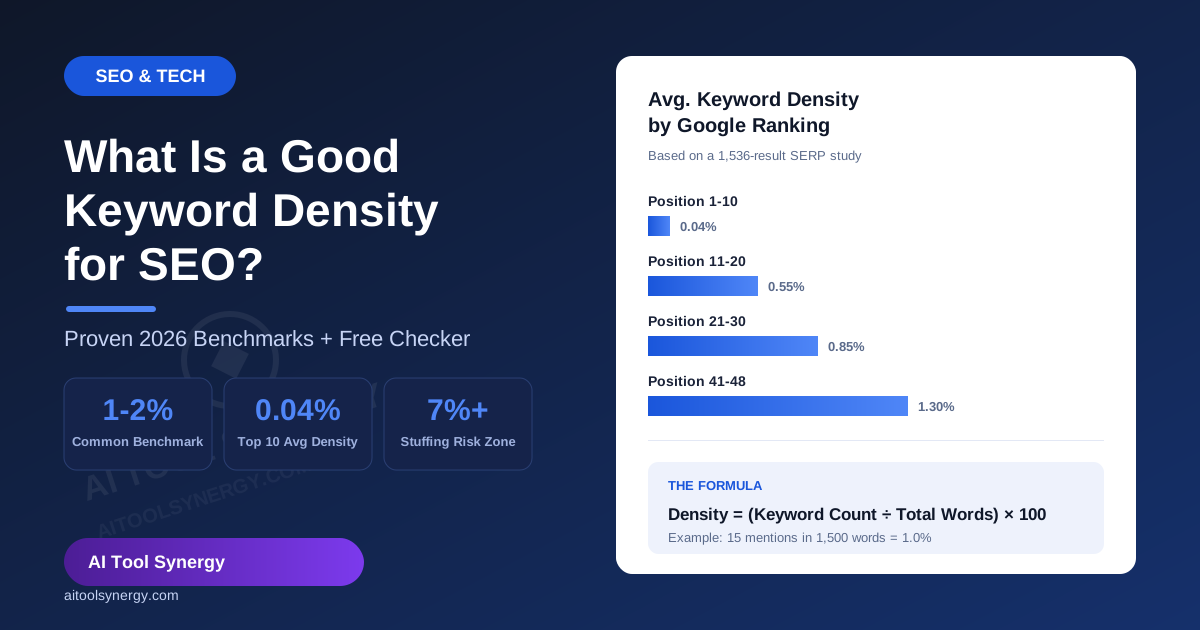
One of the more useful data points for answering what is a good keyword density for SEO comes from an independent analysis of 1,536 Google search results, which found no consistent correlation between keyword density and ranking position. More strikingly, pages sitting in the top 10 results averaged a keyword density of just 0.04% for their target term — far below the old “1–2%” rule of thumb most guides still repeat.
The same research found density tended to creep higher the further down the rankings you looked, with pages ranked 41–48 averaging noticeably more repetition than pages in positions 1–10. That doesn’t prove low density causes high rankings — it’s far more likely that naturally written, genuinely useful content simply doesn’t need much repetition to rank, while weaker content sometimes leans on repetition to compensate.
Average Keyword Density by Google Ranking Position
Source: independent study of 1,536 Google search results analyzing keyword density vs. ranking position.
The practical lesson here matters more than the exact numbers: lower keyword density is a characteristic of high-quality, naturally written content — it isn’t a lever you pull to rank higher on its own. Google’s algorithm weighs content quality, user experience, and backlinks far more heavily than how many times a phrase appears on the page.
The Keyword Density Formula — How to Calculate It Yourself
Before worrying about whether your number is “good,” it helps to know exactly how it’s calculated — understanding the formula is the first real step toward answering what is a good keyword density for SEO for your own page rather than relying on a tool’s verdict alone.
A few nuances most basic calculators miss: density should account for close variants and plurals of your phrase, not just the exact string. It should also be measured separately for exact-phrase matches versus the broader topic (your focus keyword plus its synonyms and related terms) — the second number tells you far more about topical relevance than the first.
What Is a Good Keyword Density for SEO by Content Type?
What is a good keyword density for SEO changes meaningfully depending on what kind of page you’re writing. A 3,000-word guide and a 200-word product page can’t reasonably use the same percentage and still read naturally.
| Content Type | Typical Length | Reasonable Density | Why |
|---|---|---|---|
| Blog post / guide | 1,500–3,000 words | 0.5–1.5% | Length naturally dilutes density even with frequent mentions |
| Product page | 150–400 words | 1–3% | Fewer total words means each mention carries more weight |
| Landing page | 300–800 words | 1–2% | Headline and CTA repetition counts toward the total |
| Category / listing page | 100–300 words | 1–2.5% | Thin pages are more sensitive to a stuffing perception |
Keyword Density vs. Keyword Stuffing — Where Google Draws the Line
This is the distinction that actually matters more than any percentage. According to Google’s own web search spam policies, keyword stuffing is the practice of filling a page with keywords or phrases in an attempt to manipulate rankings — typically appearing in lists, repeated unnaturally, or used out of normal context.
Google has been fairly direct that keyword stuffing is treated as a spam signal, not a ranking input — pages that lean on it can be demoted or, in serious cases, removed from results entirely. The safest practical rule: if you’d notice the repetition reading the page out loud to another person, a search engine will notice it too.
What Is a Good Keyword Density for SEO vs. TF-IDF and LSI Keywords?
Modern SEO tools increasingly answer what is a good keyword density for SEO with a more sophisticated lens than simple counting. TF-IDF (term frequency–inverse document frequency) weighs how often your keyword appears against how rare or common that term is across other ranking pages — giving a relative, competitive benchmark instead of a flat percentage. LSI keywords (related terms and synonyms) round out topical coverage so the page reads as comprehensive rather than repetitive.
| Metric | What It Measures | Still Useful in 2026? |
|---|---|---|
| Keyword density | Raw frequency vs. total word count | Basic sanity check only |
| TF-IDF | Frequency weighted against competing pages | Yes — used by many modern SEO tools |
| Topical / semantic coverage | Whether related concepts are present | The most important signal today |
In practice, this means a page that naturally discusses related terms — “keyword stuffing,” “TF-IDF,” “on-page SEO,” “keyword ratio checker” — tends to be read by Google as more topically complete than one that repeats a single exact phrase over and over, even at a “safe” density.
How to Check Your Keyword Density for Free in 3 Steps
Once you understand the formula and the line between healthy usage and stuffing, the fastest way to apply it is to check your actual content rather than estimating.
Paste your content into the checker
Drop your full blog post, product description, or page copy into our free Keyword Density Checker — no signup required.
Enter your focus keyword
Add the exact phrase you’re targeting. The tool will also surface your most repeated phrases automatically, even ones you didn’t realize you were overusing.
Read the percentage in context
Compare your result against the 1–2% guideline and the content-type benchmarks above — then judge by ear whether the repetition actually reads naturally.
🔍 Free Keyword Density Checker — No Signup
Paste your content, get an instant density breakdown for any keyword. 100% free forever.
Check My Keyword Density →What Is a Good Keyword Density for SEO in Titles, Headers and Meta Tags?
What is a good keyword density for SEO applies differently to high-weight page elements than it does to body copy. Your title tag, H1, and meta description carry disproportionate relevance signals compared to a single mention buried in paragraph four — which is exactly why placement matters more than raw repetition in these spots.
- Title tag: include the focus keyword once, ideally near the start
- Meta description: include it once, naturally, within the first sentence
- H1: include it once — this is your single strongest on-page signal
- H2s: a handful of your subheadings, not all of them, where it fits the actual content of that section
- URL slug: a short, hyphenated version of the keyword
For the full mechanics of each of these elements, see our guides on what meta tags actually do in SEO, what makes a good meta description, and how to structure an SEO-friendly URL.
What Is a Good Keyword Density for SEO? Common Mistakes That Hurt Rankings
- Treating 1–2% as a hard rule instead of a loose guideline — chasing an exact number almost always produces worse writing
- Repeating the exact phrase instead of mixing in natural variants, synonyms, and related terms
- Stuffing keywords into alt text, footers, or hidden elements — Google’s spam policies explicitly cover this and it’s easy to detect
- Ignoring related and semantic terms entirely in favor of one phrase repeated mechanically
- Forgetting that title, H1, and meta description carry more weight than body repetition, then over-compensating in the body instead
Frequently Asked Questions
What is a good keyword density for SEO?
A good keyword density for SEO is typically around 1–2% of total word count, though this is a loose guideline rather than a confirmed Google ranking factor. Research on actual top-ranking pages shows densities far lower than this — often well under 1% — suggesting natural writing matters more than hitting a specific number.
Does Google have an official recommended keyword density?
No. Google has never published an official keyword density target. The 1–2% benchmark comes from SEO practitioners as a general starting point, not from Google’s own documentation or spam policies.
What exactly counts as keyword stuffing?
According to Google’s spam policies, keyword stuffing means filling a page with keywords or phrases — often in lists or repeated unnaturally — specifically to try to manipulate rankings. It’s judged by whether the repetition reads naturally, not by crossing a fixed percentage.
Does keyword density still matter in 2026?
It matters far less than it did a decade ago. Modern search engines rely much more heavily on topical relevance, semantic coverage, and content quality than on raw keyword counts. Density is still a useful sanity check, but it’s no longer a meaningful ranking lever on its own.
How do I calculate keyword density manually?
Use the formula: (Keyword mentions ÷ Total word count) × 100. For example, a keyword appearing 15 times in a 1,500-word article gives a density of 1.0%. Our free keyword density checker does this instantly for any text.
Should I repeat the exact keyword or use variations?
A mix of both works best. Use the exact focus keyword where it fits naturally, but lean on synonyms, plurals, and related terms for the rest of your repetition. This keeps the writing natural while still signaling topical relevance.
What’s a safe keyword density for a short product page?
Short pages (150–400 words) can reasonably sit a little higher, around 1–3%, simply because each mention represents a larger share of the total word count. The same “does it read naturally” test still applies.
How do I check my keyword density for free?
Paste your content into a free tool like our Keyword Density Checker — enter your focus keyword and get an instant percentage breakdown with no signup required.
Final Thoughts on What Is a Good Keyword Density for SEO
The honest bottom line on what is a good keyword density for SEO in 2026: use 1–2% as a loose sanity check, not a target to hit. Real ranking data shows top-performing pages average far lower density than most guides claim, because naturally written, genuinely useful content rarely needs heavy repetition to signal what it’s about. Focus on covering your topic thoroughly with related terms, place your keyword carefully in your title and headers, and write for the person reading — the percentage will usually take care of itself.
Want a second opinion on your keyword strategy before you publish? Our Trendly Keyword Trend Checker shows real search interest over time, and our guide on what counts as a good Ahrefs Domain Rating covers the authority side of the ranking equation.
✅ Free Keyword Density Checker — No Signup Ever
Paste your content, get an instant, accurate density breakdown. 100% free forever.
Open Keyword Density Checker →






8 Responses
[…] What Is a Good Ahrefs Domain Rating Score? Benchmarks by Niche What Is a Good Domain Rating for a New Website? 7 Best Free Keyword Research Tools in 2026 What Is a Good Keyword Density for SEO? Proven Benchmarks […]
[…] For more on the SEO elements that work alongside your meta tags, see our guides on what every meta tag type actually does, what makes a meta description perform well, how to write SEO-friendly URLs, and ideal keyword density for body content. […]
[…] SEO & Tech What Is a Good Keyword Density for SEO? Benchmarks and Data SEO & Tech Free Keyword Research Tools — The Best Options Compared SEO & Tech What Are Meta Tags in SEO? A Complete Overview SEO & Tech How to Create SEO-Friendly URLs — Structure and Best Practices JJoshua […]
[…] SEO & Tech What Is a Good Keyword Density for SEO? Benchmarks and Data SEO & Tech How to Check Keyword Density of a Website — Competitor and Audit Guide SEO & Tech Free Keyword Research Tools — The Best Options Compared SEO & Tech What Are Meta Tags in SEO? A Complete Overview JJoshua […]
[…] SEO & Tech What Is a Good Keyword Density for SEO? Benchmarks and Data SEO & Tech How to Check Keyword Density of a Website — Competitor and Audit Guide SEO & Tech Keyword Frequency vs Keyword Density — What Is the Difference in SEO? SEO & Tech How to Create SEO-Friendly URLs — Structure and Best Practices JJoshua […]
[…] SEO & Tech What Is a Good Keyword Density for SEO? Benchmarks and Data SEO & Tech How to Check Keyword Density of a Website — Competitor and Audit Guide SEO & Tech Keyword Frequency vs Keyword Density — What Is the Difference in SEO? SEO & Tech How to Calculate Keyword Density — Step-by-Step Formula and Examples JJoshua […]
[…] SEO & Tech What Is a Good Keyword Density for SEO? Benchmarks and Data SEO & Tech How to Check Keyword Density of a Website — Competitor and Audit Guide SEO & Tech Keyword Frequency vs Keyword Density — What Is the Difference in SEO? SEO & Tech How to Calculate Keyword Density — Step-by-Step Formula and Examples SEO & Tech Keyword Stuffing Checker — How to Detect and Fix Over-Optimisation SEO & Tech How to Create SEO-Friendly URLs — Structure and Best Practices JJoshua […]
[…] in SEO? SEO & Tech How to Calculate Keyword Density — Step-by-Step Formula and Examples SEO & Tech What Is a Good Keyword Density for SEO? Benchmarks and Data SEO & Tech How to Check Keyword Density of a Website — Competitor and Audit Guide SEO […]