


Wondering what is a good domain rating for a new website? This guide gives you real benchmarks by site age and niche, a realistic timeline to reach DR 20, 30 and 50, the exact number of referring domains you need at each stage, and a free tool to check where you stand right now — no signup required.
What this covers: DR benchmarks by site age · benchmarks by niche · DR vs Domain Authority · how long to reach each DR target · how many backlinks you actually need · guest posting DR · does DR affect Google rankings.
What Is a Good Domain Rating for a New Website? 2026 Benchmarks by Age and Niche
If you just launched a website and checked your Domain Rating for the first time, you probably saw a number between 0 and 5. That number likely looked alarming — especially when you see established sites sitting at DR 60, 70, or 90. But here is what nobody tells you: what is a good domain rating for a new website is not what most guides claim it is.
DR 0 does not mean your site is broken, penalised, or irrelevant. It means your site is new. Every domain on the internet started at DR 0 — including Ahrefs, Moz, and Backlinko. The number itself tells you almost nothing in isolation. What matters is what is realistic for your site’s age, your specific niche, and your link-building activity. This guide answers all three.
What Is Domain Rating and Why It Matters for New Websites
Domain Rating (DR) is a metric created by Ahrefs to measure the overall strength of a website’s backlink profile on a logarithmic scale from 0 to 100. It is calculated based on how many unique domains link to your site and how authoritative those linking domains are.
DR does not measure content quality, traffic, or ranking ability directly. It measures one thing: the strength of your external backlink profile relative to every other website in Ahrefs’ index. It was created because Google’s original PageRank score — the metric that controlled how much link authority a page carried — became hidden from public view in 2016. SEO tools like Ahrefs and Moz developed their own proxies to fill that gap and give site owners a measurable way to track link-building progress.
Important: DR is not a Google ranking factor. Google does not use Ahrefs’ Domain Rating in its algorithm. However, the underlying thing DR measures — high-quality backlinks from authoritative domains — is one of Google’s strongest ranking signals. The correlation between DR and rankings is real. The causation is indirect.
How Ahrefs Calculates Your Domain Rating Score
The DR calculation is logarithmic and relative — which is the most important thing to understand about it. Moving from DR 0 to DR 10 requires far fewer backlinks than moving from DR 50 to DR 60. This is why new websites feel stuck at low numbers even when they are actively building links — each additional point requires exponentially more effort at higher levels.
Ahrefs uses three main factors in the calculation:
- Number of unique referring domains — how many different websites link to yours. One domain counts once regardless of how many individual pages link from it.
- DR of those linking domains — a link from a DR 80 site moves your score far more than ten links from DR 10 sites. Quality beats quantity every time in the DR algorithm.
- Link dilution from outbound links — if a DR 70 site links to 5,000 other domains, the authority it passes to you per link is proportionally reduced. A DR 30 site linking to only five other domains passes more concentrated authority than a DR 70 directory linking to thousands.
Why DR moves in jumps: Because the scale is logarithmic, each point at the higher end requires exponentially more backlinks. Going from DR 5 to DR 15 might take 20 quality referring domains. Going from DR 55 to DR 65 might take 500. This is why new websites feel stuck at low DR numbers even when they are actively building links.
Domain Rating vs Domain Authority — Clear the Confusion
The terms Domain Rating and Domain Authority are frequently confused — and Google sometimes ranks them interchangeably in search results. They are not the same metric and should never be compared directly to each other.
| Factor | Domain Rating (DR) | Domain Authority (DA) |
|---|---|---|
| Created by | Ahrefs | Moz |
| Scale | 0 to 100 | 0 to 100 |
| What it measures | Backlink profile strength | Predicted ranking ability |
| Calculation | Referring domains + their DR | Backlinks + linking root domains |
| Update frequency | Live / near real-time | Monthly batches |
| Free to check | Yes — via free tools | Limited free checks |
| Used by | Most SEO professionals | Moz platform users |
Common mistake: Comparing your DR to a competitor’s DA. They are different tools with different scoring methodologies. A site with DR 30 and DA 40 is not necessarily stronger or weaker — they are just measured differently. Always compare DR to DR or DA to DA.
Most SEO professionals default to checking DR because Ahrefs’ backlink index is widely considered the more accurate and comprehensive database. Moz’s own documentation on Domain Authority confirms the two metrics use entirely different calculation methodologies — reinforcing why comparing them directly gives no useful data. Use our free Domain Rating Checker to get instant DR data for any domain without needing an Ahrefs account.
What Is a Good Domain Rating for a New Website by Site Age?
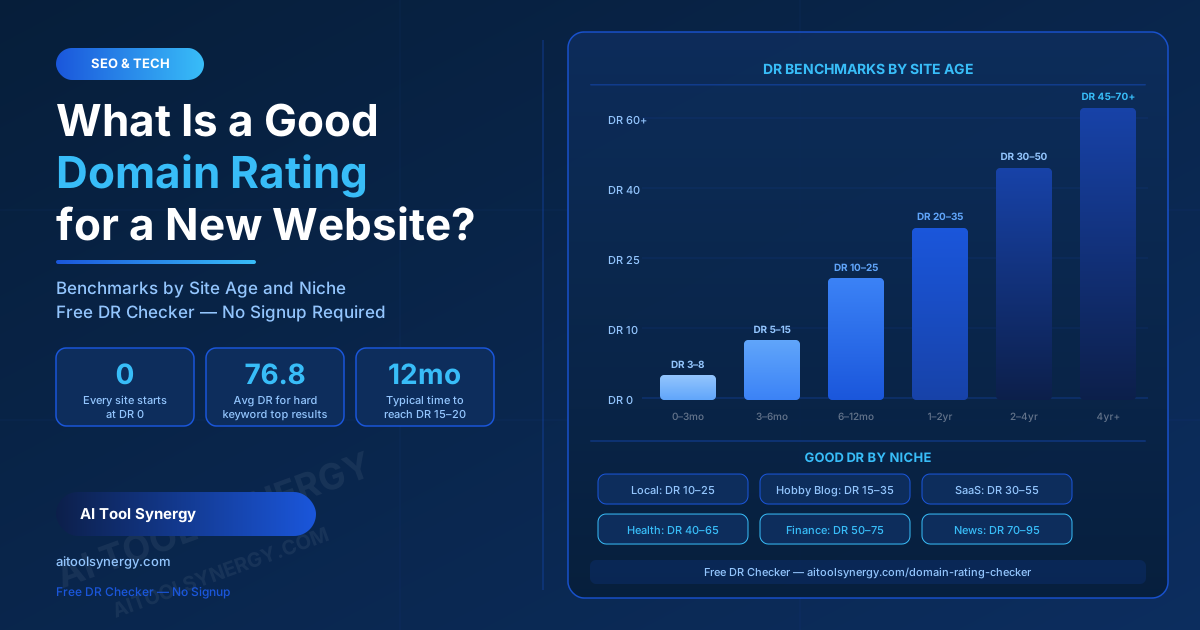
The most practical way to answer what is a good domain rating for a new website is to compare your DR against your site’s actual age — not against an arbitrary universal number. Here is a realistic breakdown based on consistent, moderate link-building effort versus no active outreach:
| Site Age | DR (No Link Building) | DR (Active Link Building) | Assessment |
|---|---|---|---|
| 0–3 months | DR 0–3 | DR 3–8 | Normal — site is new |
| 3–6 months | DR 1–5 | DR 5–15 | Expected — first links appearing |
| 6–12 months | DR 2–10 | DR 10–25 | Good — building momentum |
| 1–2 years | DR 5–15 | DR 20–35 | Solid — competitive in many niches |
| 2–4 years | DR 10–25 | DR 30–50 | Strong — can compete for most keywords |
| 4+ years | DR 20–40 | DR 45–70+ | Established authority |
A new website with DR 15 after 6 months of active link building is performing well. A new website with DR 2 after 6 months and no outreach is also completely normal — it simply means organic link acquisition hasn’t happened yet. The benchmark that actually matters for a good domain rating for a new website isn’t a specific number. It’s whether your DR is higher than the lowest-DR sites currently ranking for your target keywords. You don’t need DR 50 to rank — you need to outrank the weakest competitor on page one.
What Is a Good Domain Rating Score by Niche?
Site age is only half the picture. Industry matters enormously when judging what is a good domain rating for your specific situation. Niches with lower overall competition allow smaller sites to compete at much lower DR than niches dominated by major publishers and enterprise brands. A DR that would be excellent in one niche would be completely noncompetitive in another.
| Niche | Competitive DR Range | Notes |
|---|---|---|
| Local services | DR 10–25 | Low competition, geography limits rivals |
| Niche hobby blogs | DR 15–35 | Passionate audiences, moderate competition |
| SaaS / B2B tools | DR 30–55 | Active link-building culture in this space |
| Health and wellness | DR 40–65 | High competition, YMYL content scrutiny |
| Finance | DR 50–75 | Extremely competitive, dominated by major brands |
| News and media | DR 70–95 | Dominated by established publishers |
The smartest approach: Instead of relying on general niche tables, use our free DR checker to check the 5–10 sites actually ranking on page one for your target keywords. Their average DR is your real benchmark — not a generic industry number. If they average DR 25 and you are at DR 18, you know exactly how close you already are.
Average Domain Rating Ranges — What Each Score Can Actually Rank For
Understanding what is a good domain rating for a new website also means understanding what each DR range is realistically capable of ranking for. The referring domain estimates below are approximate — a single link from a DR 90 publication can move your score more than 30 links from DR 20 blogs.
| DR Range | What It Signals | Typical Referring Domains | Can Rank For |
|---|---|---|---|
| DR 0–5 | Brand new, minimal links | 0–5 unique domains | Very long-tail, near-zero competition |
| DR 5–15 | Early-stage authority | 5–30 unique domains | Long-tail keywords, niche topics |
| DR 15–30 | Growing authority | 30–100 unique domains | Medium competition keywords |
| DR 30–50 | Solid authority | 100–500 unique domains | Competitive industry keywords |
| DR 50–70 | High authority | 500–2,000 unique domains | Most keywords in most niches |
| DR 70+ | Major publication or brand | 2,000+ unique domains | Almost any keyword |
DR 0 to 10 — What a Good Domain Rating Looks Like and What to Do
DR 0 to 10 is where every new website starts. It is not a penalty, a problem, or a sign that your site is failing. It simply means Google and Ahrefs haven’t seen enough external validation yet. Here is exactly what to do at this stage to move a good domain rating for a new website from zero into double digits as efficiently as possible.
Submit to free legitimate directories
Submit your site to relevant industry directories, local business listings, and free tool aggregators. Each one is a unique referring domain. At DR 0 to 5, even modest links from DR 30+ directories move the needle meaningfully. Focus on directories in your niche — one targeted directory beats ten generic ones.
Create genuinely linkable assets
Pages that attract natural links include free tools, original data, comprehensive guides, and industry statistics. A free calculator or checker on your site gives other bloggers something worth referencing — which is exactly how our free Domain Rating Checker earns links passively from SEO content.
Guest post on sites with DR 20 or above
A single well-placed guest post on a DR 30 site can move a new website from DR 0 to DR 5 or 6 within one Ahrefs update cycle. Write one genuinely useful article per week on sites in your niche and include a natural link back to your most valuable resource page.
Get listed on Product Hunt, GitHub or niche aggregators
Tool sites benefit especially from listings on Product Hunt (DR 90+), GitHub, and niche tool directories. These are high-authority domains that pass real DR value even from a single listing link — and they often drive referral traffic alongside the DR boost.
Check Where Your DR Stands Right Now — Free
Instant Ahrefs DR data for any domain. No signup, no daily limit, 100% free forever. Check your site, your competitors, or any link prospect in seconds.
Check Domain Rating Free →How Long Does It Take to Reach a Good Domain Rating — DR 20, 30 and 50
One of the most common questions after learning what is a good domain rating for a new website is how long it realistically takes to get there. The timelines below assume active but realistic link-building — not aggressive paid link schemes — with consistent content publication.
| DR Target | Estimated Time (Active Outreach) | Referring Domains Needed | Key Milestone |
|---|---|---|---|
| DR 10 | 3–6 months | 10–20 quality domains | First guest posts secured |
| DR 20 | 6–12 months | 30–60 quality domains | Consistent content and outreach |
| DR 30 | 12–24 months | 80–150 quality domains | Linkable assets attracting organic links |
| DR 40 | 2–3 years | 200–400 quality domains | Topical authority and brand recognition |
| DR 50 | 3–5 years | 500–1,000 quality domains | Established publication in your niche |
Sites that rely solely on organic link acquisition with no active outreach typically take 2–3 times longer to hit these milestones. The fastest path is earning links from a small number of high-DR sites — two backlinks from DR 70 publications will move your score more than fifty backlinks from DR 5 blogs.
How Many Referring Domains Do You Actually Need?
The number of backlinks matters far less than the number of unique referring domains. Ten links from the same site count as one referring domain. Ten links from ten different sites move your DR significantly. Here is how it breaks down by DR movement:
| Moving From → To | New Referring Domains Needed | If Links Are DR 20–40 | If Links Are DR 50+ |
|---|---|---|---|
| DR 0 → DR 10 | 10–20 domains | 15–25 domains | 5–10 domains |
| DR 10 → DR 20 | 20–40 domains | 30–50 domains | 10–20 domains |
| DR 20 → DR 30 | 50–80 domains | 70–100 domains | 25–40 domains |
| DR 30 → DR 40 | 100–200 domains | 150–250 domains | 50–80 domains |
| DR 40 → DR 50 | 250–400 domains | 350–500 domains | 100–150 domains |
What Is a Good Domain Rating for Guest Posting?
If you’re researching domain rating specifically to evaluate guest posting opportunities, the benchmarks shift slightly. Understanding what is a good domain rating for guest posting works differently depending on whether you are the one pitching or the one accepting contributions.
- As a guest poster: target sites with a higher DR than your own. Even one accepted post on a DR 40 site can move a new website from DR 0 to DR 6 or 7 in a single Ahrefs update cycle. Use our free DR checker to verify a prospect’s authority before investing outreach time.
- As a site accepting guest posts: most established blogs set a minimum DR of 20–30 for contributors to maintain quality standards on both sides of the link exchange.
- Starting at DR 0: you can begin guest posting outreach immediately regardless of your current score. Site owners accept guest posts based on pitch quality and content value — not your DR. Starting outreach at DR 0 to 5 is actually the fastest way to build domain rating.
Guest posting strategy for new sites: Target sites with DR between 20 and 50 in your niche. Sites below DR 20 often pass too little authority to be worth the effort. Sites above DR 60 are typically very selective and reject new sites almost automatically. The DR 25–45 range is the sweet spot for early-stage link building.
Does Domain Rating Actually Affect Google Rankings?
This is the question most guides avoid answering directly. The short answer: DR does not directly affect Google rankings. Google does not use Ahrefs’ Domain Rating in its algorithm.
What Google uses is conceptually similar — the overall authority and trustworthiness of your backlink profile. DR is Ahrefs’ approximation of that same signal. A high DR generally correlates with strong rankings because both DR and Google’s internal scoring respond to the same underlying factor: high-quality backlinks from authoritative sources.
The practical reality: Sites with higher DR tend to rank better — not because Google reads the DR score, but because the same backlinks that raise your DR also raise your authority in Google’s eyes. DR is a proxy metric. Building real backlinks from real authoritative sites is what actually matters.
According to Backlinko’s analysis of 11.8 million Google search results, the number of domains linking to a page was the single factor most correlated with ranking position — which is exactly what DR measures. The correlation is real. The causation is indirect. And according to Google’s official guidance on links and SEO, external links from other sites remain one of the strongest signals for evaluating authority and relevance.
For a full guide on checking DR for free, reading your score correctly, benchmarking competitors, and tracking progress over time, see our complete guide on how to check Ahrefs Domain Rating for free.
Frequently Asked Questions About Domain Rating for New Websites
For a website under 6 months old, any DR between 0 and 10 is completely normal. Between 6 and 12 months, DR 5 to 20 is realistic with active link building. The number that actually matters is not a universal target — it is whether your DR is higher than the weakest competitors currently ranking for your target keywords. You don’t need a high DR; you need to outrank the lowest-authority page on page one of your specific keyword.
DR 20 within the first 12 months is a strong result that typically requires consistent guest posting and active link outreach. It is achievable and indicates you have secured roughly 30 to 60 quality referring domains. At DR 20 you can realistically compete for low to medium competition keywords in most niches — which is exactly the zone where new sites should be targeting their early traffic.
It varies significantly. Local service businesses are competitive at DR 10–25. Niche hobby blogs typically compete at DR 15–35. SaaS and B2B tool sites require DR 30–55. Health and wellness content needs DR 40–65 to compete. Finance is highly competitive at DR 50–75. News and media sites rarely rank well below DR 70. The best approach is checking the actual DR of sites ranking for your specific target keyword — that number is your real benchmark.
Domain Rating (DR) is Ahrefs’ metric. Domain Authority (DA) is Moz’s metric. Both run on a 0–100 scale and both approximate website backlink strength, but they use different calculation methodologies and different backlink databases. They are not interchangeable — comparing a site’s DR to another site’s DA gives you no useful information. Always compare DR to DR or DA to DA.
With consistent link building and content creation, reaching DR 30 typically takes 12 to 24 months. It requires approximately 80 to 150 unique referring domains of moderate quality. Sites that produce linkable assets — free tools, original research, comprehensive guides — tend to reach DR 30 faster because they attract natural links without requiring constant manual outreach.
No — Google does not use Ahrefs’ Domain Rating in its algorithm. However, the underlying factor DR measures — high-quality backlinks from authoritative domains — does directly influence Google rankings. Sites with higher DR tend to rank better because they have the same strong backlink profiles that Google also rewards. The correlation is genuine even though the causation is indirect.
The number that matters is unique referring domains — not total backlinks. One hundred backlinks from the same site count as one referring domain. Twenty backlinks from twenty different sites will move your DR significantly. To go from DR 0 to DR 10, focus on earning 10 to 20 unique referring domains from sites with DR above 20. Quality and diversity of domains matter more than raw link count.
No. DR 0 simply means Ahrefs has not yet found any external sites linking to your domain, or your site is so new that no links have been discovered yet. Every domain starts at DR 0. Google indexes and ranks pages based on content quality and relevance — a DR 0 page can appear in Google results and rank on page one for low-competition queries. DR 0 is a starting point, not a penalty.
As a guest poster, target sites with a DR higher than your own — ideally DR 25 to 50 for new sites. A single placement on a DR 40 site can move your domain from DR 0 to DR 6 or 7 in one update cycle. As a site accepting guest posts, most publishers set a minimum contributor DR of 20 to 30. You can start outreach at any DR — site owners make decisions based on pitch quality and content relevance, not your score.
Use our free Domain Rating Checker at aitoolsynergy.com/domain-rating-checker to get instant Ahrefs DR data for any domain. No signup, no daily limit, no credit card required. You can check your own site, any competitor’s site, or any potential link partner to assess their authority before pursuing a link from them.
Understanding what is a good domain rating for a new website comes down to three things: your site’s age, your specific niche, and how your DR compares to the weakest sites ranking for your exact target keywords — not a generic number you found in a blog post. Use the benchmarks in this guide as a starting reference, then check the actual DR of your real competitors to find the number that genuinely matters for your situation.
Check Any Domain’s DR Free — Real Ahrefs Data
No signup. No daily limit. Instant results. Check your site, your competitors, and any link prospect in seconds.
Open Free DR Checker →






10 Responses
[…] What Is a Good Domain Rating for a New Website? […]
[…] What Is Good Domain Rating For a new website? […]
[…] What Is a Good Domain Rating for a New Website? […]
[…] What Is a Good Domain Rating for a New Website? […]
[…] This timeline is a general guide, not a guarantee. A site with an aggressive, high-quality link-building strategy can outpace these numbers significantly, while a site that publishes content without any outreach may sit well below them even after years. For our own benchmark guide built specifically for new sites, see What Is a Good Domain Rating for a New Website? […]
[…] What Is a Good Domain Rating for a New Website? […]
[…] a complete breakdown of realistic benchmarks for new websites, see our guide on what is a good domain rating for a new website — it covers what scores to expect at 3, 6, and 12 months with different link-building […]
[…] Before starting any link building campaign, know your exact current DR so you can measure real progress. Use our free domain rating checker as your monthly baseline — it takes under 30 seconds and gives you the same real Ahrefs data a paid account would show. For a complete breakdown of what DR score to target at your current site age, see our guide on what is a good domain rating for a new website. […]
[…] To understand what DR score to target at your site’s current age and niche, see our guide on what is a good domain rating for a new website. For practical strategies to grow whichever score you are tracking, the how to increase domain […]
[…] For a full strategy to rebuild and grow DR after any drop, see our complete guide on how to increase domain rating. For benchmarking what score you should be targeting after recovery, see our guide on what is a good domain rating for a new website. […]