
Can AI Generate Handwriting? How It Works and How Realistic It Looks
Yes — can AI generate handwriting is one of the most common questions people ask before trying a handwriting tool for the first time, and the short answer is yes, AI can generate handwriting that looks convincingly human, though “AI” covers a few genuinely different techniques with very different results. Some tools use trained font systems with randomized variation, others use neural networks that learn actual pen-stroke movement. The realism gap between them is bigger than most people expect.
This guide explains exactly how AI generates handwriting, compares it honestly against real human handwriting, and clears up a related but separate question people often ask alongside it: whether ChatGPT can read or transcribe handwriting, which is the opposite direction entirely.
Can AI Generate Handwriting? The Short Answer
Can AI generate handwriting that’s actually convincing? Yes, and it’s been technically possible for over a decade. The first widely cited breakthrough came in 2014, when researcher Alex Graves published work demonstrating a recurrent neural network that could generate cursive handwriting stroke by stroke, learned directly from real handwriting samples rather than from a static font. You can still read the original research paper today, and it remains a foundational reference for how AI generates handwriting at the stroke level.
What’s changed since then isn’t really whether AI can generate handwriting — that question was settled years ago — but how accessible the technology has become. What used to require research-lab compute is now available free in a browser tab.
How Does AI Generate Handwriting? The Technology Explained
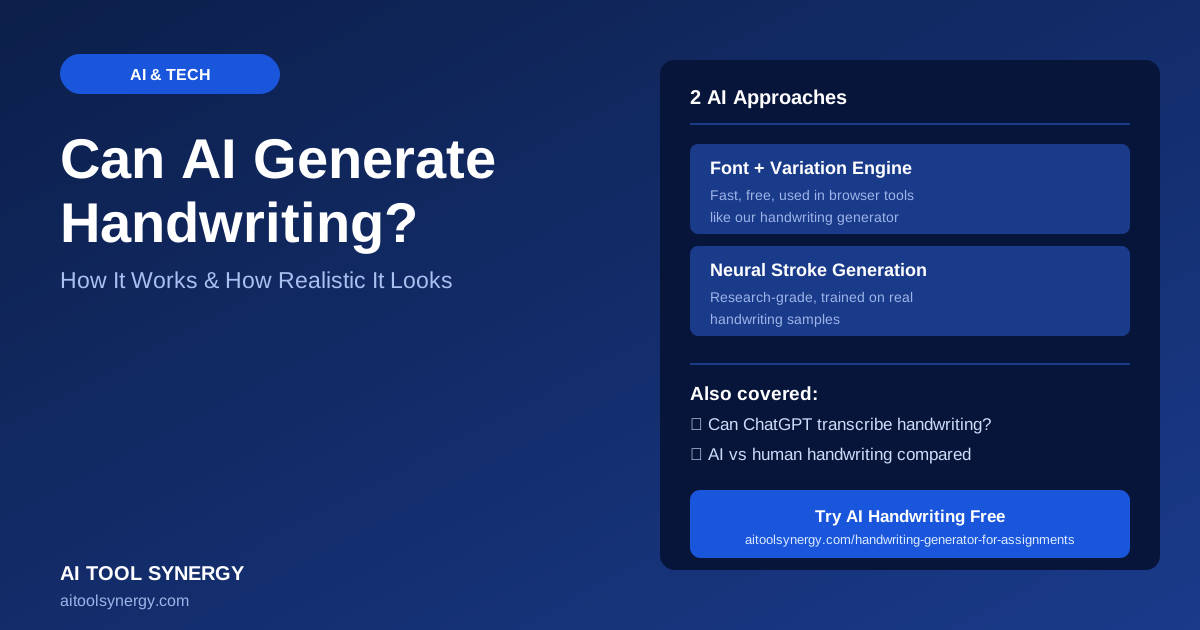
There isn’t one single way AI generates handwriting — there are two genuinely different approaches in common use, both of which fall under the broader umbrella of generative AI techniques, and knowing which one a tool uses tells you a lot about what kind of result to expect when you ask whether AI can generate handwriting that’s actually convincing.
The term “AI handwriting generator” gets applied loosely to both approaches below, even though they work in completely different ways under the hood. Neither is more “fake” than the other — they’re just solving the problem differently.
Font-Based vs Neural Stroke-Generation — Two Ways AI Generates Handwriting
The first and more common approach renders text using a handwriting-style font, then applies algorithmic variation — small randomized shifts in letter position, rotation, and spacing — so the output doesn’t look mechanically uniform. This is what our own free handwriting generator uses, and you can read the exact mechanics of how the variation engine works on the tool’s own page rather than us repeating it here.
The second, more computationally heavy approach uses a trained neural network — often a recurrent neural network or, more recently, a diffusion model — that generates the actual pen-stroke path character by character, the way Graves’ original research did. Open-source implementations like this handwriting-synthesis project on GitHub let developers experiment with stroke-level AI handwriting generation directly.
Does AI-Generated Handwriting Look Real?
Whether AI-generated handwriting looks real depends almost entirely on which of the two approaches above produced it, and how well the variation or model training was tuned. The question “can AI generate handwriting that’s truly convincing” really comes down to this variation setting more than anything else. Font-based AI handwriting with variation switched on — like the option built into our free generator — can look convincingly natural at normal reading distance, especially when the font itself was designed to mimic real pen strokes rather than a clean printed look. Neural stroke-generation models can look even more organic, since they’re not constrained to a fixed letterform at all — but they require far more computing power and aren’t available in free, instant browser tools the way font-based generators are.
In both cases, the single biggest factor in how real AI-generated handwriting looks is whether variation is present at all. Flat, unvaried text — regardless of which underlying technology produced it — is the fastest way to make AI handwriting look obviously artificial.
AI vs Human Handwriting — A Side-by-Side Comparison
- Instant — seconds to minutes
- Consistent quality every time
- Realism depends on variation settings
- No physical effort required
- Slower — minutes to hours
- Quality varies with fatigue, mood, speed
- Naturally authentic by definition
- Reflects an individual’s unique style
Can ChatGPT Generate or Transcribe Handwriting?
This is a different question from “can AI generate handwriting” in general, and it’s worth separating clearly. ChatGPT itself is a text-based language model — it doesn’t natively output an image of handwriting the way a dedicated handwriting generator does. However, newer multimodal versions of ChatGPT that can process images are able to read handwriting in a photo and transcribe it into typed text — the opposite direction from generating new handwriting. OpenAI’s own documentation on its multimodal capabilities covers what its vision-enabled models can and can’t reliably read from an image.
So: can ChatGPT transcribe handwriting? Within reasonable limits, often yes, for clearly written text. Can ChatGPT generate new handwriting images on its own? Not directly — for that, you still need a dedicated AI handwriting generator built specifically for rendering text onto a page, like ours.
Can AI Mimic Your Own Handwriting Style?
Can AI generate handwriting that mimics one specific person’s actual style? This is a related but more advanced question than whether AI can generate handwriting in general. Mimicking one specific person’s actual handwriting style requires a model trained specifically on samples of that person’s writing, which is a different (and more involved) task than generating generic, realistic-looking handwriting from a font. Some research projects and specialized tools can do this with enough training samples, but it isn’t something most free, instant browser-based handwriting generators offer — they generate convincing generic handwriting styles, not a forged copy of any specific individual’s handwriting.
How to Tell If Handwriting Was AI-Generated
A few tells can help identify AI-generated handwriting, though they’re getting harder to spot as the technology improves. Look for unnaturally perfect spacing between every word, identical letterforms repeated exactly across the page (a sign variation wasn’t used), an absence of natural pressure variation or ink pooling that real pens produce, and unusually consistent baseline alignment across every line. None of these are definitive on their own — well-tuned AI-generated handwriting with variation enabled can be genuinely difficult to distinguish from real handwriting at a glance.
There’s no widely available, reliable tool that can definitively detect AI-generated handwriting the way text-based AI detectors attempt to flag AI-written prose. Treat any claimed “handwriting AI detector” with skepticism.
Best Free AI Handwriting Generators to Try
If you want to see for yourself that AI can generate handwriting convincingly, free font-based AI handwriting generators are the most accessible starting point — no signup, no installation, results in under a minute. This is distinct from handwriting recognition, which reads existing handwriting rather than generating new handwriting from typed text. Our own free generator offers 19 handwriting fonts with a built-in variation engine, four paper styles, and both clean and scanned PNG downloads, making it a solid first stop if you’re exploring what AI-generated handwriting actually looks like in practice.
Common Misconceptions About AI and Handwriting
Now that the basics of can AI generate handwriting are settled, a few myths still circulate about exactly what that capability involves:
- “AI handwriting” always means a neural network.” Most free, instant tools actually use font-based rendering with algorithmic variation, not a trained stroke-generation model.
- AI-generated handwriting is always obviously fake. With variation enabled and a well-chosen font, it can be genuinely difficult to distinguish from real handwriting.
- ChatGPT can generate handwriting images directly. It can often transcribe (read) handwriting from a photo, but generating new handwriting images is a separate task handled by dedicated tools.
- AI can perfectly replicate anyone’s specific handwriting. That requires specialized training on an individual’s samples — far beyond what general-purpose handwriting generators do.