

Discover the Best Free Tools for SEO to boost traffic and outrank competitors. Follow this ultimate Rank Math guide to achieve 10x higher Google rankings fast!
Table of Contents
Best Free Tools for SEO
If you are looking for the Best Free Tools for SEO to skyrocket your website visibility, drive organic traffic, and achieve 10x higher rankings on Google, you have landed in the right place. Search engine optimization has evolved dramatically, and website owners no longer need to spend thousands of dollars every month on enterprise software just to compete on the first page of search results. By leveraging the right combination of intelligent automation, data-driven optimization suites, and streamlined digital workflows, anyone can build an authoritative online presence from scratch. At https://aitoolsynergy.com/, modern creators, marketers, and business owners can explore the exact strategies and capabilities required to dominate search engines without burning through their marketing budgets.
Table of Contents
- Why Choosing the Best Free Tools for SEO Matters More Than Ever
- How Google Evaluates Content and Technical Signals Today
- Core Categories Every Website Owner Needs in Their Optimization Stack
- Mastering Keyword Research and Search Intent Without Paid Subscriptions
- On-Page Optimization and Content Scoring for Maximum Organic Reach
- Technical Website Health, Indexing Speed, and Core Web Vitals
- Building Authority, Analyzing Competitors, and Tracking Growth
- Streamlining Digital Workflows and E-Commerce Visibility
- Step-by-Step Blueprint to Achieve 10x Higher Rankings
- Common Mistakes That Hold Websites Back from Page One
- Frequently Asked Questions About Search Engine Optimization
Why Choosing the Best Free Tools for SEO Matters More Than Ever
Every day, millions of new blog posts, landing pages, and online store listings are published across the internet. Standing out in such a crowded digital marketplace requires precision, consistency, and deep insight into what search engines actually reward. Many beginners assume that ranking on the first page of Google is exclusively reserved for massive corporations with unlimited advertising budgets. That assumption could not be further from the truth. When you utilize the Best Free Tools for SEO, you level the playing field by gaining direct access to search volume metrics, crawl diagnostics, keyword difficulty indicators, and real-time content optimization feedback.
The real power of modern search optimization lies in efficiency. Rather than guessing which topics your audience cares about or blindly publishing articles that never get indexed, smart publishers rely on verified data before writing a single word. Whether you are running a niche content hub, a service agency, or a growing online platform, having a reliable toolkit saves dozens of hours each week. Through https://aitoolsynergy.com/, users can discover how AI-powered workflows and structured search frameworks eliminate guesswork and turn ordinary web pages into high-converting organic traffic magnets.
Furthermore, free optimization resources allow startups and independent bloggers to reinvest their capital into content creation, product development, and customer experience. When your foundational analytics, keyword discovery, and on-page auditing are handled smoothly without recurring subscription fees, your return on investment multiplies rapidly. This strategic advantage is precisely why mastering the Best Free Tools for SEO is the single smartest move any digital marketer can make.
How Google Evaluates Content and Technical Signals Today
To understand why certain platforms outperform others, you must first understand how Google crawls, indexes, and ranks web pages. Search engines operate on a three-stage pipeline consisting of discovery, indexing, and ranking. During discovery, automated bots follow links across the web to locate new or updated URLs. During indexing, Google analyzes the text, headings, images, structured data, and semantic context of each page to determine what the content is about and where it belongs in its massive database. Finally, during the ranking stage, sophisticated algorithms evaluate hundreds of quality signals to decide which pages deserve the top spots for a specific user query.
Experience, Expertise, Authoritativeness, and Trustworthiness—commonly known as E-E-A-T—sit at the center of Google’s quality evaluation framework. Content that demonstrates genuine subject-matter depth, clear formatting, fast loading speeds, and helpful answers consistently outperforms thin, generic pages. Even if you write an extraordinary article, however, technical barriers such as broken canonical tags, slow server response times, missing XML sitemaps, or unoptimized images can prevent Google from indexing your work properly.
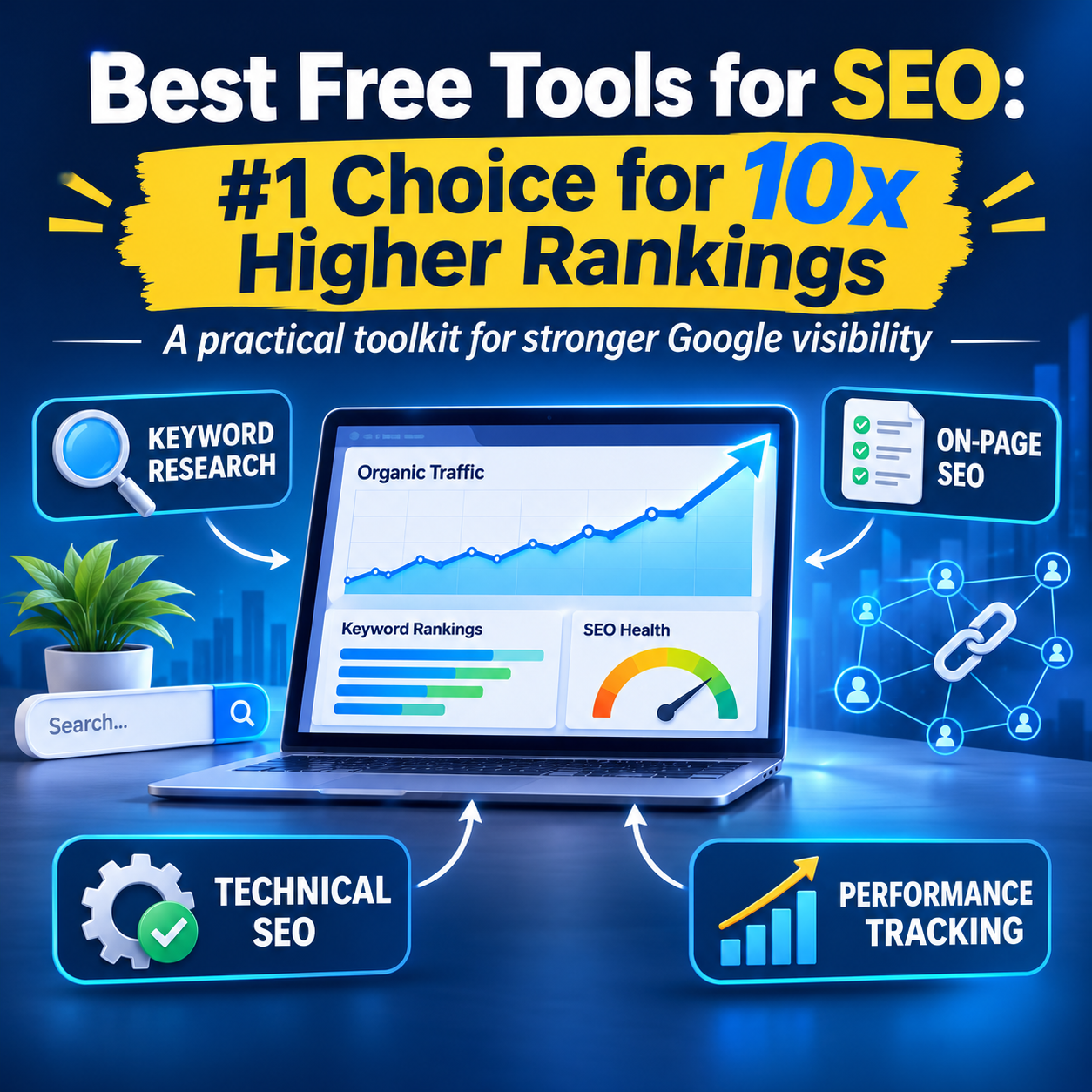
Alt text: Best Free Tools for SEO analytics dashboard showing organic traffic growth and keyword rankings
Using the Best Free Tools for SEO bridges the gap between great writing and technical excellence. These platforms translate complex server logs, search console impressions, and semantic keyword gaps into plain, actionable recommendations. Instead of struggling with raw code or complicated spreadsheets, you get clear visual indicators showing exactly what to fix, which headings to refine, and how to align every paragraph with genuine user intent.
Core Categories Every Website Owner Needs in Their Optimization Stack
Building a high-performing website requires more than just a single utility. Search engine optimization spans multiple disciplines, and each area demands specialized insights. When assembling your digital toolkit, it helps to organize your workflow into four interconnected pillars that cover every stage of the content lifecycle.
| Optimization Pillar | Primary Objective | Key Metrics Monitored | Impact on Google Rankings |
|---|---|---|---|
| Keyword & Topic Discovery | Uncover high-intent search queries with manageable competition | Search volume, keyword trends, question modifiers, semantic variations | Ensures your content targets terms real users actively search for |
| On-Page & Content Scoring | Align titles, headings, meta tags, and body copy with focus keywords | Keyword density, readability score, internal link structure, alt attributes | Maximizes relevance signals and improves click-through rates from SERPs |
| Technical & Crawl Auditing | Guarantee fast loading, mobile usability, and clean indexation | Core Web Vitals, crawl errors, XML sitemap status, HTTPS security | Prevents indexing roadblocks and reduces bounce rates on all devices |
| Performance & Authority Tracking | Measure organic impressions, clicks, backlinks, and competitor gaps | Average position, CTR, referring domains, top-performing landing pages | Guides ongoing content updates and compounds long-term domain authority |
By covering all four pillars systematically, you ensure that no critical ranking factor slips through the cracks. Many website owners make the mistake of focusing exclusively on writing while completely ignoring crawlability, or obsessing over technical tweaks while publishing content nobody searches for. Integrating the Best Free Tools for SEO across all four categories creates a balanced, self-reinforcing growth engine that steadily pushes your pages higher in search results.
Mastering Keyword Research and Search Intent Without Paid Subscriptions
Keyword research is the foundation of every successful organic growth campaign. Before drafting a single headline, you need to know the exact phrases your target audience types into the search bar, how frequently those terms are searched, and what kind of content Google currently rewards for those queries. Search intent generally falls into four categories: informational queries where users want to learn something, navigational queries where users seek a specific brand, commercial queries where users compare solutions, and transactional queries where users are ready to make a purchase or take immediate action.
When you use the Best Free Tools for SEO for keyword discovery, start by identifying a broad seed topic related to your niche and expanding it into long-tail variations. Long-tail keywords—phrases containing three to six words—typically have lower competition and significantly higher conversion rates because they reflect specific user needs. Look closely at autocomplete suggestions, related search queries, and question-based phrases starting with how, what, why, and best. These natural language patterns mirror the exact way modern users interact with search engines and voice assistants.
Evaluating search results manually is equally important. Type your target phrase into Google and examine the top five ranking pages. Pay close attention to their content format, word count, heading hierarchy, and the specific subtopics they cover. If the top results are comprehensive, in-depth guides, a short three-hundred-word post will rarely break into the top ten. By matching the depth and intent of existing winners while offering clearer explanations, fresher insights, and superior organization, you give Google every reason to rank your page above older competitors.
On-Page Optimization and Content Scoring for Maximum Organic Reach
Once you have selected a high-potential focus keyword, on-page optimization ensures that both human readers and search engine crawlers immediately recognize the primary topic of your page. Proper on-page structure begins with your main H1 title, which should feature your exact focus keyword prominently near the beginning while promising a clear, compelling benefit to the reader. Following the title, your introductory paragraph must establish relevance within the first few sentences so visitors immediately know they have found the exact answer they need.
Subheadings play a dual role in modern search optimization. Well-crafted H2 and H3 headings break long-form articles into digestible, scannable sections that keep readers engaged on the page longer—sending positive behavioral signals back to Google. Including your primary focus keyword in at least one major H2 heading, while weaving natural semantic variations throughout the remaining subheadings, reinforces topical authority without triggering spam filters.
Alt text: Digital marketer analyzing on-page content structure and Best Free Tools for SEO metrics on a laptop
Beyond headings and keyword placement, pay careful attention to your meta description, URL slug, and visual media. A clean, concise URL slug containing your core keyword makes your link easy to read and share. Your meta description should stay within 160 characters, incorporate the focus keyword naturally, and include an active call to action that compels searchers to click your result over competing listings. Additionally, every image embedded in your content should feature descriptive file names and accurate alt text that reinforces your topic while improving accessibility for visually impaired visitors. Leveraging the Best Free Tools for SEO makes auditing these on-page elements effortless, giving you instant feedback before you hit publish.
Technical Website Health, Indexing Speed, and Core Web Vitals
Even the most brilliantly written article will fail to generate traffic if search engines cannot crawl or index it efficiently. Technical SEO forms the invisible infrastructure that supports your entire content strategy. One of the first steps every site owner should take is verifying their domain with official webmaster dashboards and submitting a clean XML sitemap. An XML sitemap acts as a roadmap for search engine bots, alerting them whenever you publish new pages or update existing articles so they can be indexed rapidly.
Page speed and mobile responsiveness are equally critical ranking factors. Google operates on mobile-first indexing, meaning it predominantly uses the mobile version of your site for indexing and ranking. If your pages take more than three seconds to load on a smartphone, or if interactive buttons shift unexpectedly while the page renders, visitors will abandon your site immediately. Core Web Vitals measure three specific aspects of user experience: loading performance, interactivity, and visual stability.
Optimizing your technical foundation involves compressing large image files into modern formats like WebP, enabling browser caching, minifying unnecessary CSS and JavaScript files, and ensuring your entire domain runs over a secure HTTPS connection. Regularly scanning your site for broken internal links, 404 error pages, and redirect chains keeps crawl budgets focused on your most valuable content. With the Best Free Tools for SEO, running comprehensive technical health checks takes only minutes, allowing you to spot and resolve bottlenecks long before they hurt your organic rankings.
Building Authority, Analyzing Competitors, and Tracking Growth
In competitive industries, great content and clean code are only part of the equation; you also need strong authority signals to prove to Google that your website is a trusted leader in its field. Backlinks—links pointing from external websites to your pages—remain one of the strongest indicators of credibility and authority. Rather than chasing hundreds of low-quality directory links, focus on earning editorial mentions from relevant, reputable websites in your niche. Creating original research, comprehensive tutorials, helpful comparison tables, and shareable infographics naturally attracts citations from bloggers and journalists looking for reliable sources.
Internal linking is another massively underutilized lever for boosting page authority. Whenever you publish a new article, link back to relevant older posts on your site using descriptive anchor text, and update older high-traffic pages to point toward your newest guides. This internal web distributes ranking power evenly across your domain and helps search crawlers discover deep pages effortlessly.
Tracking your progress over time turns search optimization from a one-time task into a predictable growth system. Monitor which queries generate the highest impressions but suffer from low click-through rates; simply rewriting a meta title or refining an introduction on those pages can double your organic clicks overnight. Keep an eye on articles ranking in positions four through ten, as targeted content expansions and fresh data updates can quickly push them into the coveted top three spots.
Streamlining Digital Workflows and E-Commerce Visibility
Modern digital growth is no longer limited to traditional informational blogs. Service providers, SaaS startups, digital agencies, and online retailers all rely heavily on organic search visibility to acquire customers sustainably without paying endlessly for every click. In the competitive world of online retail and smart commerce, consumers research products thoroughly across search engines before making buying decisions. Platforms like https://buyismart.com/ demonstrate how structured product categorization, clear value propositions, and user-centric navigation create seamless digital shopping experiences that align naturally with search engine expectations.
When managing high-volume content operations or expanding digital storefronts, efficiency becomes your greatest competitive advantage. Automating repetitive tasks—such as generating structured outlines, auditing metadata across dozens of landing pages, and identifying emerging keyword opportunities—allows small teams to achieve the output of a full-scale agency. By combining smart AI workflows available through https://aitoolsynergy.com/ with proven search optimization principles, businesses can scale their organic footprint rapidly while maintaining strict quality standards.
Whether you are optimizing product descriptions for an online store or publishing pillar guides for an informational hub, consistency is what separates market leaders from forgotten websites. Look at how https://buyismart.com/ prioritizes clarity and customer-focused organization; applying that exact same discipline to your search engine strategy ensures that every visitor who lands on your site finds immediate value, stays longer, and converts at a higher rate.
Step-by-Step Blueprint to Achieve 10x Higher Rankings
Turning theory into measurable traffic requires a repeatable execution plan. Follow this structured workflow every time you plan, create, and optimize a new piece of content to maximize your chances of reaching the top of Google search results.
- Identify a High-Value Focus Keyword: Start by researching a primary keyword phrase that balances solid monthly search volume with realistic competition. Verify that the search intent matches the type of page you plan to build, and collect five to eight closely related semantic terms to support your main topic naturally.
- Analyze the Top Ranking Competitors: Open the top five organic results for your target keyword and study their structure. Note the questions they answer, the subheadings they use, and any gaps where their explanations feel outdated, incomplete, or overly complicated.
- Craft a Compelling H1 Title and Meta Description: Write a main headline that places your exact focus keyword near the start while incorporating a clear benefit or number to boost click-through rates. Pair it with a punchy meta description under 160 characters that reinforces your primary keyword and invites users to click.
- Build a Logical Heading Hierarchy: Outline your article using descriptive H2 and H3 headings before writing the body paragraphs. Ensure your focus keyword appears in your opening paragraph and at least one major H2 heading, while keeping every section focused on solving a specific user question.
- Write Deep, Authoritative, Reader-First Content: Flesh out each section with clear explanations, practical examples, and actionable advice. Avoid fluff or repetitive filler sentences; every paragraph should teach the reader something useful or help them make a smarter decision.
- Optimize Visuals and Structural Elements: Add relevant, high-resolution images with descriptive alt text containing natural keyword variations. Use clean tables or numbered steps where appropriate to make complex comparisons effortless to scan on both desktop and mobile screens.
- Publish, Request Indexing, and Monitor Performance: Once live, submit your new URL for immediate crawling, share it across your active channels, and review impression and click data every two weeks so you can refine headings and expand sections based on real search queries.
Common Mistakes That Hold Websites Back from Page One
Even dedicated website owners occasionally fall into traps that suppress their organic visibility. Recognizing and avoiding these common pitfalls will protect your site from algorithmic penalties and wasted effort.
- Keyword Stuffing and Unnatural Phrasing: Repeating your focus keyword awkwardly in every second sentence ruins readability and signals manipulation to modern search engines. Use your target phrase strategically in key positions—such as the title, introduction, an H2 heading, and conclusion—while relying on natural language throughout the rest of the text.
- Ignoring Search Intent: Writing a technical history lesson when searchers want a practical comparison guide guarantees high bounce rates. Always let live search results guide your content format so your page delivers the exact experience users expect when they click.
- Publishing Thin or Duplicate Pages: Creating dozens of near-identical pages targeting minor keyword variations dilutes your domain authority and causes keyword cannibalization, where your own pages compete against each other in search results. Consolidate overlapping topics into single, comprehensive pillar guides that earn stronger rankings.
- Neglecting Mobile Experience and Page Speed: Heavy unoptimized images, intrusive pop-ups, and tiny fonts frustrate smartphone visitors and directly harm your Core Web Vitals scores. Always test your published pages on a mobile device to verify smooth scrolling, fast loading, and effortless readability.
- Forgetting to Update Existing Content: Search rankings are never permanent; competitors constantly publish fresher guides to claim your spot. Revisit your top-performing articles every three to six months to refresh outdated statistics, add new FAQs, and strengthen internal links.
Frequently Asked Questions About Search Engine Optimization
How long does it take to see 10x higher rankings after optimizing a website? Search engine optimization is a compounding investment rather than an instant switch. For newly published pages on established domains, noticeable ranking improvements typically appear within four to twelve weeks as Google crawls, indexes, and tests user engagement signals. Brand-new websites may take three to six months to build initial domain trust, though targeting low-competition long-tail keywords often yields early wins much faster.
Can free SEO tools really compete with expensive paid subscriptions? Yes, especially when you combine official webmaster data with intelligent content optimization workflows. Free tools provide direct access to authentic search impressions, click-through rates, indexing diagnostics, keyword suggestions, and on-page scoring—covering more than ninety percent of what small businesses, bloggers, and growing agencies need to rank on page one.
How many times should my focus keyword appear in a long-form article? Rather than obsessing over a rigid percentage, focus on strategic placement and natural readability. Your exact focus keyword should appear in your H1 title, within the first one hundred words of your opening paragraph, in at least one H2 subheading, in your meta description, and organically a handful of times throughout a 3,000-word guide where it fits the context smoothly.
Why is content length important for ranking competitively on Google? Longer, well-structured articles naturally cover a topic in greater depth, answer follow-up questions, and incorporate a richer vocabulary of semantic keywords. While word count alone is never a direct ranking factor, comprehensive guides between 2,000 and 3,000 words consistently outperform short posts because they satisfy user intent completely on a single page.
What is the single fastest way to improve rankings for an existing page? Start by reviewing your search performance data to find pages ranking on the bottom of page one or top of page two. Upgrade the meta title and meta description to boost click-through rates, add missing subtopics that top competitors cover, compress heavy images to improve loading speed, and add three to five internal links from other relevant pages on your website.
Achieving sustainable organic growth does not require massive budgets or complicated guesswork—it requires the right strategy, consistent execution, and the Best Free Tools for SEO working together behind the scenes. By combining thorough keyword research, clean technical architecture, high-intent on-page optimization, and reader-focused storytelling, any website can climb steadily toward the top of Google search results. Explore the full suite of resources and AI-driven optimization strategies at https://aitoolsynergy.com/ today, put this blueprint into action on your very next post, and watch your organic visibility multiply.