


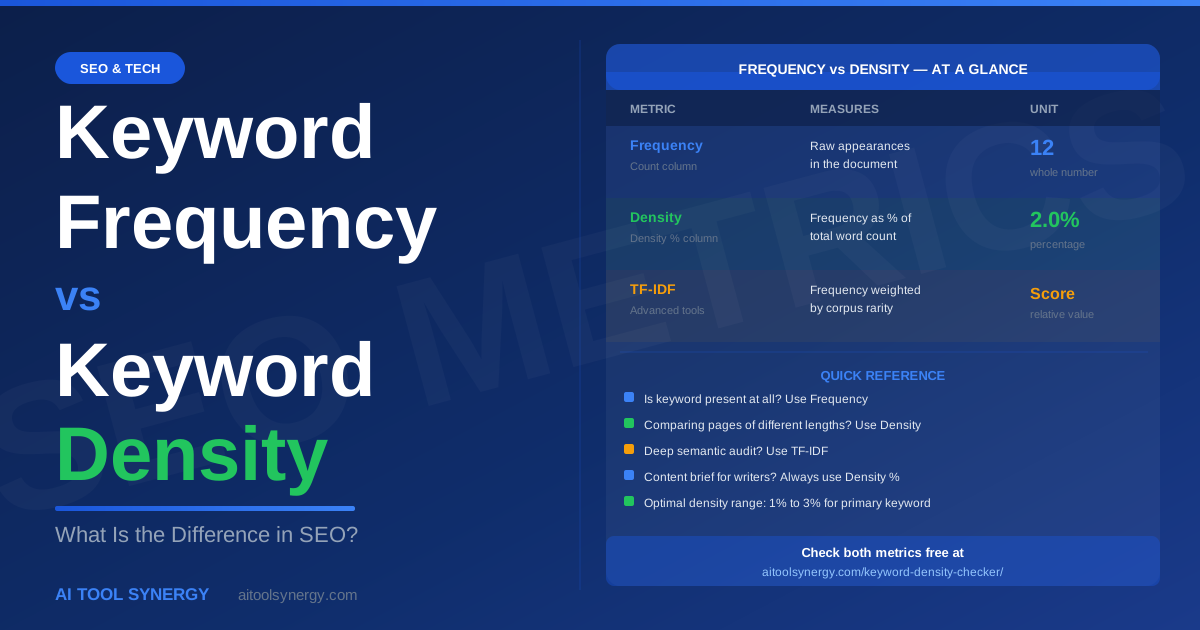
Keyword Frequency vs Keyword Density — What Is the Difference in SEO?
Open any keyword density checker tool and you will see two numbers side by side: a raw count and a percentage. Most people glance at the percentage and ignore the count. That is a mistake — because keyword frequency and keyword density measure different things, tell you different stories about your content, and should inform different decisions when optimising a page for search.
This post draws a clear line between keyword frequency vs keyword density: what each metric actually measures, when each one matters more than the other, how professional SEOs use both together, and why TF-IDF represents the logical evolution of both. If you have ever wondered why a tool shows you a “Count” column alongside a “Density %” column, this is the post that explains it.
What Is Keyword Frequency in SEO?
Keyword frequency is the raw count of how many times a specific word or phrase appears in a piece of content. It is the simplest possible measurement of keyword usage — no percentages, no ratios, just a whole number. If the word “SEO” appears 14 times in your article, the keyword frequency of “SEO” is 14.
Frequency was the original keyword metric used by early search engines in the 1990s and early 2000s. As Moz’s on-page SEO research documents, early algorithms relied heavily on term repetition as a primary relevance signal. The logic was direct: if a page mentions “best running shoes” twenty times, it is probably about best running shoes. The more times a term appeared, the stronger the signal. This is why early SEO involved stuffing keywords into content as often as possible — raw repetition moved rankings.
Today, keyword frequency still matters — but not in isolation. Google no longer rewards raw repetition. What frequency tells you now is whether a keyword appears at all and roughly how prominent it is within the content. A keyword with a frequency of zero is a clear signal the page probably does not cover that topic. A keyword with a very high frequency relative to the document length raises a flag for over-optimisation. The raw count is the starting point — keyword density converts it into something more meaningful.
Article: 600-word blog post about content marketing.
Keyword: “content marketing” appears 9 times.
Keyword frequency: 9 — this is the Count column in our tool.
By itself, 9 tells you nothing about whether that is too many or too few. You need the next step: density.
What Is Keyword Density and How Is It Different from Frequency?
Keyword density converts the raw frequency count into a percentage by comparing it to the total word count of the document. The formula is straightforward: divide the number of times the keyword appears by the total number of words, then multiply by 100.
Keyword density = (Keyword frequency ÷ Total word count) × 100
Using the example above: 9 occurrences ÷ 600 words × 100 = 1.5% keyword density
Now 9 has context. 1.5% sits in the optimal 1-3% range — the content is appropriately focused on “content marketing” without over-repeating it.
The critical difference between keyword frequency vs keyword density is that density accounts for the length of the document. This makes it a far more useful metric for comparison. Consider two pages:
Page A: keyword appears 8 times
Page B: keyword appears 8 times
Frequency alone says they are identical. But are they?
Page A: 8 times in 400 words = 2.0% — optimal
Page B: 8 times in 2,000 words = 0.4% — too low
Same frequency, completely different optimisation story.
This is exactly why our keyword density checker shows both columns — Count and Density — for every keyword phrase. The count tells you how often a term appears. The density percentage tells you whether that count is appropriate for the length of the content.
Keyword Frequency vs Keyword Density — A Side-by-Side Comparison
| Metric | What It Measures | Unit | When to Use It | Limitation |
|---|---|---|---|---|
| Keyword Frequency | Raw number of times a term appears in the document | Whole number (e.g. 12) | Checking if a keyword is present at all; comparing same-length documents | Meaningless without knowing total word count — 12 times in 300 words vs 12 times in 3,000 words are very different |
| Keyword Density | Frequency as a proportion of total word count | Percentage (e.g. 1.8%) | Comparing pages of different lengths; checking optimisation health; auditing competitor pages | Does not account for how rare or common the term is across the wider web — a 2% density for “the” means something very different from 2% for a specific long-tail phrase |
| TF-IDF Score | Frequency weighted by how rare the term is across all documents | Score (relative, tool-dependent) | Advanced semantic SEO; understanding which terms make your content uniquely relevant | Requires a large document corpus to calculate; not available in basic free tools |
Keyword frequency answers “how many times?” Keyword density answers “how much of the content?” TF-IDF answers “how uniquely relevant is this term to this document compared to everything else on the web?” Each question is more sophisticated than the last — but for day-to-day content optimisation, frequency and density together give you everything you need.
When Does Keyword Frequency Matter More Than Keyword Density?
There are specific situations where the raw keyword frequency count is the more useful number to look at, rather than the percentage:
Short content pieces under 300 words
On very short pages — product titles, meta descriptions, short landing page hero sections — density percentages become misleading. A keyword appearing twice in 100 words shows a 2.0% density, which looks optimal. But two occurrences in 100 words of marketing copy may genuinely feel repetitive and unnatural to a reader. Here, the raw count of 2 is more meaningful than the percentage.
Checking for keyword presence in specific sections
When you want to know whether your focus keyword appears in the first paragraph, in a specific subheading, or in the conclusion, you are thinking in terms of frequency — is it there or not, and how many times? Density is a document-level metric and cannot tell you where in the content the keyword is concentrated. Frequency, checked section by section, can.
Comparing two versions of the same document
If you are A/B testing two versions of the same page — same structure, roughly the same length — comparing raw keyword counts between drafts is faster and equally valid as comparing density percentages, since the denominator is roughly constant.
Identifying keyword cannibalization signals
When auditing a site for keyword cannibalization, checking which pages have the highest raw frequency of a target term helps identify the page that is most explicitly optimized around that keyword. This is a frequency-first analysis — you want to find the page with the strongest repetition of the term, then check density to confirm it is in a healthy range.
When Does Keyword Density Matter More Than Raw Frequency?
In most SEO scenarios, keyword density is the more actionable metric. Here is when the percentage clearly outperforms the raw count:
Comparing pages of different lengths
As the example above showed, the same raw frequency count means completely different things on a 400-word page vs a 2,000-word page. Whenever you are comparing content of different lengths — which is nearly always in SEO — keyword density is the right metric to use.
Auditing competitor pages
When you check keyword density on a competitor website using our free keyword density tool, you are almost certainly comparing pages of different lengths. The competitor’s article might be 1,800 words and yours might be 1,200 words. Density percentages make this a fair comparison regardless of length differences.
Setting content briefs for writers
Telling a writer “use this keyword 15 times” is a frequency instruction. Telling them “keep this keyword between 1% and 2%” is a density instruction. The density instruction automatically scales with the length of the content the writer produces — a 1,000-word article and a 2,500-word article will both hit the target naturally without the writer having to manually count. Density-based briefs are always more flexible and more scalable than frequency-based ones.
Checking for keyword stuffing risk
Keyword stuffing is inherently a density problem, not a frequency problem. A keyword appearing 30 times sounds alarming — but in a 5,000-word comprehensive guide, 30 occurrences produces only 0.6% density, which is under-optimized rather than stuffed. As Search Engine Journal explains in their keyword density guide, density is the only metric that can reliably identify genuine over-optimisation risk.
Use keyword frequency as your first check — is the keyword present at all and roughly how many times? Then immediately convert to density to put that count in context. Running both checks takes ten seconds in our free keyword frequency analyzer — the Count column gives you frequency, the Density % column gives you context, all in one view.
How a Keyword Frequency Checker Shows Both Metrics Together
A good keyword frequency checker does not force you to choose between raw counts and percentages — it shows you both simultaneously. This is exactly how our tool is designed. When you paste your content and run the analysis, every result row shows:
- Keyword / Phrase — the actual word or phrase detected
- Count — the raw keyword frequency (how many times it appears)
- Density % — the keyword density percentage (count relative to total word count)
- Status — a color-coded health indicator (green = optimal 1-3%, amber = low, red = over-optimized)
The three tabs — 1-word, 2-word, and 3-word phrases — let you see keyword frequency and density for individual words, two-word phrases, and long-tail three-word phrases separately. This is important because your focus keyword is almost always a multi-word phrase. The 2-gram tab is where you will find the keyword frequency and density for phrases like “keyword density”, “content audit”, or “on-page SEO” — the actual target phrases that map to real search queries.
Keyword Frequency vs Keyword Density — Which Should You Optimize For?
The practical answer: optimize for density, monitor with frequency.
Set your content targets in terms of density percentage — “my primary keyword should appear at 1.0-1.5% throughout this 1,800-word article.” This gives you a flexible, length-independent target. Then use the raw keyword count as a monitoring signal while writing — glancing at the count helps you notice if you have used a term several times in close succession (even if the overall density is within range).
Here is the decision framework most experienced SEOs use:
| Situation | Use Frequency | Use Density |
|---|---|---|
| Is my keyword present in this draft? | Yes — count tells you instantly | Not needed |
| Is my keyword over-used? | Partially — count gives a signal | Yes — density confirms the risk |
| Comparing my page to a competitor page | Only if same length | Always — normalizes for length |
| Writing a content brief for a writer | Avoid — too rigid | Yes — scales with article length |
| Checking where keyword clusters appear | Yes — section-by-section count | Not applicable |
| Site-wide content audit | Secondary check | Primary metric |
Keyword Ratio Checker — What Is Keyword Ratio and How Does It Differ?
Some tools and SEO discussions refer to a “keyword ratio” rather than keyword density. The terms are often used interchangeably, but there is a subtle distinction worth understanding.
Keyword density expresses frequency as a percentage of total word count: 12 appearances in 600 words = 2.0%.
Keyword ratio sometimes expresses the same relationship as a ratio rather than a percentage: 12 appearances in 600 words = 1:50 ratio (one keyword for every 50 words). This is mathematically identical to density — just expressed differently. Some older keyword ratio checker tools present the result this way.
More practically, “keyword ratio” in modern SEO discussions often refers to the balance between your primary keyword and related semantic terms — how much of your content is your exact-match keyword versus synonyms and LSI variations. A healthy keyword ratio in this sense means your content is not over-reliant on one exact phrase but distributes keyword signals across a natural range of related terms.
Our free keyword density analyzer helps you understand this ratio by showing frequency and density across all your 1-gram, 2-gram, and 3-gram phrases simultaneously. You can see at a glance whether one exact phrase is dominating the content or whether keyword signals are distributed naturally across related terms.
TF-IDF — The Evolution Beyond Keyword Frequency and Density
Understanding keyword frequency vs keyword density naturally leads to the next question: what comes after density? The answer is TF-IDF — Term Frequency-Inverse Document Frequency — a more sophisticated metric that accounts for how common or rare a term is across a large body of documents, not just within one page.
TF-IDF has two components:
- TF (Term Frequency) — essentially the same as keyword density: how often does this term appear in this document relative to its length?
- IDF (Inverse Document Frequency) — how rare is this term across all documents in a reference corpus? Terms that appear in almost every document (like “the” or “is”) get a very low IDF score. Terms that are specific and rare across documents get a high IDF score.
The TF-IDF score multiplies these two: a term that appears frequently in your document AND is relatively rare across the wider web gets a high TF-IDF score. This signals that the term is particularly meaningful and characteristic of your specific content.
Keyword density approach: “SEO tools” appears at 1.5% density — good, keep it.
TF-IDF approach: “SEO tools” appears at 1.5% density but appears on millions of web pages, so its IDF score is low. Meanwhile, “keyword frequency analyzer” appears at only 0.4% density but is a rare, specific phrase — its TF-IDF score is actually higher and more meaningful.
TF-IDF rewards specificity. Keyword density alone cannot distinguish between common and rare terms.
As Google’s documentation on how Search works describes, modern search algorithms use a range of signals to understand content relevance — going well beyond simple term counting. TF-IDF thinking is embedded in these systems, which is why content that covers a topic with specific, varied, and contextually relevant language tends to outperform content that simply repeats the same exact phrase at a target density percentage.
For most content creators and bloggers, TF-IDF tools are not a daily necessity. A solid keyword frequency and density check — using our free checker — catches the most impactful on-page optimisation issues without the complexity of TF-IDF scoring. But understanding that TF-IDF exists and why it matters gives you a more complete picture of how Google actually evaluates keyword signals.
Keyword Value Checker — What Does Keyword Value Mean in This Context?
Some searches for “keyword value checker” are looking for something different from frequency or density — they want to know the commercial or search value of a keyword (search volume, CPC, competition level). That is a keyword research function, covered by tools like Ahrefs Keywords Explorer or Google Keyword Planner.
But in the context of on-page optimisation — which is what keyword density tools are designed for — “keyword value” has a different meaning. It refers to how meaningful and relevant a keyword is to the content, which is closer to the TF-IDF concept above. A rare, specific phrase that appears consistently throughout your content has high keyword value in this sense, even if its raw frequency is lower than generic topic words.
When you run a keyword frequency analysis and see both the Count and Density columns, you are already getting a basic version of keyword value assessment — terms with healthy density in the optimal range (1-3%) and consistent frequency across sections are your high-value keyword signals. The 2-gram and 3-gram tabs reveal the specific multi-word phrases that carry the most topical value for your content.
Keyword Frequency vs Keyword Density — Key Takeaways
The distinction between keyword frequency and keyword density is straightforward but important. Here is what to remember:
- Keyword frequency is the raw count — how many times a term appears. Useful for quick presence checks and section-level analysis.
- Keyword density is the percentage — frequency relative to total word count. Use this for comparisons, content briefs, and over-optimisation checks.
- Both metrics appear together in every good keyword frequency checker — the Count and Density columns exist for a reason. Use both, not just one.
- Density is the more actionable metric in most SEO scenarios because it normalizes for document length.
- Frequency is more useful when checking specific sections or comparing same-length documents.
- TF-IDF is the next level — it adds document corpus context that neither frequency nor density alone can provide.
- For daily content work, a solid frequency and density check is sufficient. Save TF-IDF analysis for deep semantic SEO audits.
Run a free keyword frequency and density check on your content right now with our tool — see the Count and Density columns side by side, switch between 1-gram, 2-gram, and 3-gram tabs, and get color-coded health status for every phrase in your content.
Frequently Asked Questions — Keyword Frequency vs Keyword Density
Keyword frequency is the raw number of times a keyword appears in a document — for example, a keyword appearing 12 times has a frequency of 12. Keyword density converts that count into a percentage of the total word count — 12 occurrences in a 600-word article equals 2.0% keyword density. Frequency tells you how often. Density tells you how much of the content is that keyword relative to everything else. Both are shown together in a keyword density checker tool: the Count column shows frequency and the Density % column shows the percentage.
Keyword density is generally more useful for SEO because it accounts for the length of the content. A keyword appearing 10 times means something very different in a 300-word page versus a 3,000-word guide. Density normalizes this by showing you the percentage, which allows fair comparison between pages of different lengths. That said, raw keyword frequency is useful when checking whether a keyword appears in a specific section, or when comparing two versions of the same document at the same length.
Paste your content into a keyword frequency checker tool — our free keyword density checker shows keyword frequency (Count column) and density percentage (Density % column) for every word and phrase simultaneously. Enable stopword removal to filter out meaningless words like “the” and “and,” then switch between the 1-word, 2-word, and 3-word tabs to see frequency data for individual words and multi-word phrases. No signup required and there is no word count limit.
There is no universal ideal keyword frequency because it depends entirely on the length of the post. A better target is keyword density: aim for 1.0-1.5% for a primary keyword in a blog post. This means a 1,000-word post should mention the primary keyword approximately 10-15 times, while a 2,000-word post should mention it approximately 20-30 times. Use keyword density percentage as your target rather than a fixed frequency count so the goal scales naturally with whatever length the article reaches.
TF-IDF stands for Term Frequency-Inverse Document Frequency. Like keyword density, it measures how often a term appears in a document (Term Frequency). Unlike density, it also weighs that frequency against how common the term is across a large corpus of documents (Inverse Document Frequency). Terms that are frequent in your document but rare across the wider web get a high TF-IDF score, signaling high relevance and specificity. Basic keyword frequency and density analysis looks only at one document. TF-IDF adds a comparative dimension across many documents, making it more powerful but also more complex and requiring specialized tools to calculate.
Keyword ratio and keyword density are mathematically the same measurement expressed differently. Keyword density expresses frequency as a percentage — 12 appearances in 600 words equals 2.0% density. Keyword ratio expresses the same relationship as a ratio — 12 in 600 words equals a 1:50 ratio (one keyword for every 50 words). In modern SEO, “keyword ratio” sometimes also refers to the balance between exact-match keyword repetitions and semantic variations or LSI terms — a healthy ratio means not over-relying on one exact phrase but distributing keyword signals naturally across related terms.
No — high keyword frequency does not guarantee better rankings and can actively hurt them. Google’s algorithms, including systems like BERT and RankBrain, are designed to understand natural language and context rather than count keyword repetitions. Excessive keyword frequency that pushes density above 3-5% can trigger keyword stuffing detection, which suppresses rankings. The goal is sufficient frequency to clearly establish topical relevance — typically a density of 1-2% for the primary keyword — combined with natural use of related terms and synonyms rather than mechanical repetition of one exact phrase.
Yes — our free keyword density checker works on any text, including content copied from competitor pages. Open the competitor page, use your browser’s Reader View to isolate the article body text, copy it, and paste it into the tool. The results show both keyword frequency (Count column) and density percentage (Density % column) for every 1-gram, 2-gram, and 3-gram phrase on their page — revealing exactly which keywords their content is optimized around and at what frequency and density levels.
Check keyword frequency and density on every page before publishing and after every significant content update. When you add new sections, refresh statistics, or expand a page, the keyword balance can shift — new text may dilute the density of your primary keyword or accidentally over-represent a secondary term. A post-update density check takes under two minutes and prevents gradual optimisation drift on pages that were previously performing well. For a full site audit, run the check on your top-traffic pages quarterly.







3 Responses
[…] and Data SEO & Tech How to Check Keyword Density of a Website — Competitor and Audit Guide SEO & Tech Keyword Frequency vs Keyword Density — What Is the Difference in SEO? SEO & Tech How to Calculate Keyword Density — Step-by-Step Formula and Examples […]
[…] and Data SEO & Tech How to Check Keyword Density of a Website — Competitor and Audit Guide SEO & Tech Keyword Frequency vs Keyword Density — What Is the Difference in SEO? SEO & Tech How to Calculate Keyword Density — Step-by-Step Formula and Examples SEO & […]
[…] SEO & Tech Keyword Frequency vs Keyword Density — What Is the Difference in SEO? SEO & Tech How to Calculate Keyword Density — Step-by-Step Formula and Examples SEO & Tech What Is a Good Keyword Density for SEO? Benchmarks and Data SEO & Tech How to Check Keyword Density of a Website — 7-Step Audit SEO & Tech Keyword Stuffing Checker — How to Detect and Fix Over-Optimisation SEO & Tech On-Page SEO Keyword Placement — The 7 Locations That Drive Rankings JJoshua […]