

This guide clears up the confusion between Ahrefs Domain Rank vs Domain Rating once and for all. They sound similar, they appear on the same dashboard, and most people have no idea they measure completely different things. One is a score from 0 to 100 where higher is better. The other is a position number where lower is better. Getting them mixed up leads to misreading your own site’s authority and making poor link-building decisions.
What this covers: what Domain Rating is · what Ahrefs Rank is · the core difference explained simply · how AR is calculated from DR · why AR can drop without losing links · what a good AR looks like · how to check both free · when each metric is actually useful.
Ahrefs Domain Rank vs Domain Rating — What’s the Difference?
If you have ever opened Ahrefs and seen both a DR score and an AR number and wondered about the Ahrefs Domain Rank vs Domain Rating distinction on the same page, you might have wondered what the difference is. The confusion around Ahrefs Domain Rank vs Domain Rating is entirely understandable — both metrics use the word “domain,” both relate to backlinks, and both appear in the same interface. But they are measuring completely different things in completely different ways, and the most important difference is this: for Domain Rating, higher is better. For Ahrefs Rank, lower is better.
Understanding the Ahrefs Domain Rank vs Domain Rating difference correctly prevents real mistakes. Getting the distinction wrong leads to real mistakes — misreading your site’s authority, being confused when AR drops without any link changes, and not knowing which metric to report or track over time. This guide explains both clearly with a simple analogy that makes the difference immediately obvious.
Why Ahrefs Domain Rank vs Domain Rating Confuses So Many People
The confusion around Ahrefs Domain Rank vs Domain Rating starts with naming. “Domain Rating” sounds like a rating scale, and it is — 0 to 100. “Domain Rank” sounds like it might mean the same thing, just using a synonym. It doesn’t.
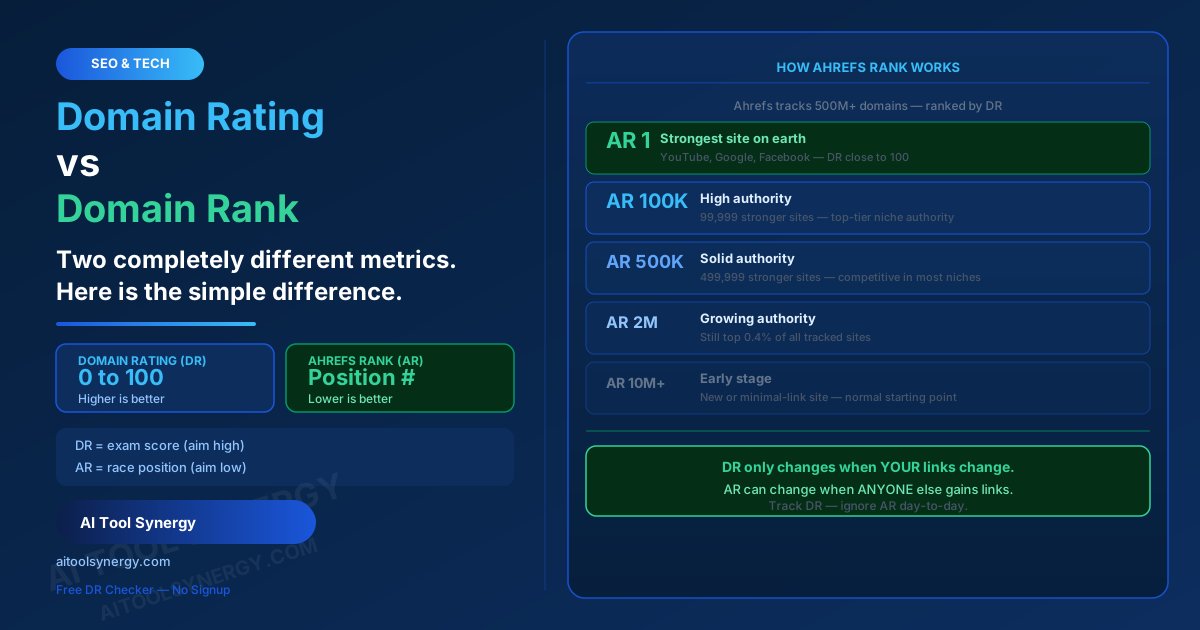
Ahrefs Rank (AR) is not a score — it is a position number. It ranks every website in Ahrefs’ database against every other website based on backlink strength. The site with the strongest backlink profile in the world gets AR 1. The second strongest gets AR 2. If your site has AR 350,000, there are 349,999 sites with stronger backlink profiles in the Ahrefs index. The smaller your AR number, the stronger your position.
The simplest way to remember the difference: Domain Rating (DR) is like your exam score — 85 out of 100 is great. Ahrefs Rank (AR) is like your position in a race — finishing 1st is better than finishing 10,000th. For DR, aim high. For AR, aim low.
What Is Ahrefs Domain Rating — The 0–100 Score
According to Ahrefs’ official Domain Rating documentation, Domain Rating (DR) measures the strength of a website’s entire backlink profile on a logarithmic scale from 0 to 100. It is calculated from three inputs: the number of unique domains linking to your site with dofollow links, the DR of those linking domains, and how many other sites each of those linking domains links to.
- DR 0–20: new or early-stage site with minimal external links
- DR 20–40: growing authority, competitive in low to medium niches
- DR 40–60: solid authority, competitive for most industry keywords
- DR 60–80: high authority, typically well-established publications
- DR 80+: major brands and publications with massive backlink profiles
DR is an absolute score on a fixed scale. It can only improve when you earn high-quality dofollow backlinks from new unique domains. It does not change because other websites changed their backlink profiles. It is a score, not a ranking. Use our free Domain Rating Checker to see your current DR and any competitor’s DR instantly — no account needed.
What Is Ahrefs Domain Rank and How Does It Differ From Domain Rating?
Ahrefs Rank (AR) — sometimes called Domain Rank — is a global ranking of every website in Ahrefs’ database ordered from strongest to weakest backlink profile. Unlike Domain Rating, which is a score, AR is a position number. It is directly derived from DR: the site with the highest DR gets AR 1, the second-highest gets AR 2, and so on down through hundreds of millions of tracked domains.
The sites that hold the top positions in Ahrefs Rank — AR 1, 2, and 3 — are consistently among the most linked-to properties on the internet, typically platforms like YouTube, Facebook, Google, and Wikipedia. These sites have accumulated backlinks from virtually every website on earth and hold DR scores approaching 100.
How to read your Ahrefs Rank number
Ahrefs Domain Rank vs Domain Rating — Key Differences at a Glance
The Ahrefs Domain Rank vs Domain Rating distinction comes down to four fundamental differences that determine how you read and use each metric.
The 0–100 authority score
- Higher is better (0 weak, 100 strongest)
- Fixed scale — does not depend on other sites
- Only changes when YOUR links change
- Measures absolute backlink strength
- Track monthly to measure link-building progress
The global position number
- Lower is better (AR 1 = strongest on earth)
- Relative — depends on all other sites in the index
- Can change even without any link changes
- Measures relative backlink strength position
- Less useful for regular tracking than DR
| Factor | Domain Rating (DR) | Ahrefs Rank (AR) |
|---|---|---|
| Type | Score (0–100) | Position number (1 = best) |
| Better direction | Higher is better | Lower is better |
| Scale | Fixed logarithmic scale | Relative to all other sites |
| Changes when | Your backlinks change | Anyone’s backlinks change |
| Stability | More stable | Can fluctuate without link changes |
| Best used for | Tracking your authority growth | Benchmarking global position |
| Free to check | Yes — via free tools | Shown alongside DR in Ahrefs |
How Ahrefs Domain Rank Is Calculated From Domain Rating
The relationship between Ahrefs Domain Rank vs Domain Rating is direct and straightforward: AR is simply a sorted list of all sites in Ahrefs’ database ordered by their DR score. According to a comprehensive breakdown of the Ahrefs ranking system and confirmed in Ahrefs’s own blog documentation on Domain Rating, the site with the highest DR in the database gets AR 1, the second-highest gets AR 2, and this continues down through hundreds of millions of tracked domains.
This means AR is entirely derived from DR — you cannot optimize for AR directly. If you want to improve your AR, you improve your DR. And because AR is a list ordered by DR, your AR position is also affected by everyone else’s DR. If thousands of sites improve their DR this month, your AR can drop even if your own DR stayed the same.
Important context: Ahrefs tracks over 500 million domains in its index. Most of these have very low DR scores. If your site has AR 2,000,000, that sounds large — but it places you in the top 0.4% of all sites Ahrefs tracks. An AR under 1,000,000 is already a strong global position for a growing website. An AR under 100,000 indicates genuinely high authority.
Why Your Ahrefs Domain Rank Can Drop Without Losing Backlinks
One of the most confusing aspects of the Ahrefs Domain Rank vs Domain Rating distinction is that AR can fall even when your own backlink profile hasn’t changed at all. This surprises many site owners who expect their rank to be stable as long as they haven’t lost links.
This is one reason why the Ahrefs Domain Rank vs Domain Rating distinction matters so much in practice. The explanation is simple: because AR is relative to all other sites in the Ahrefs database, any improvement made by other sites affects your position. If a competitor gains fifty high-quality backlinks this week and their DR rises from 32 to 38, they move ahead of you in the global ranking — and your AR number gets larger (meaning worse) even though you did nothing differently.
DR does not have this property. Your DR only changes when the links pointing to your own site change. This is one reason why DR is generally more useful for tracking your own site’s authority over time than AR is — DR measures what you have done, while AR measures where you stand relative to the entire web.
What this means practically: Track your DR monthly as your primary authority metric. Use AR as a rough global context indicator, not as a performance metric. If your AR dropped but your DR stayed flat, it simply means other sites gained ground — not that you lost anything. If your DR dropped alongside AR, investigate your referring domains as described in our guide on why Ahrefs domain rating drops.
Check Your Domain Rating Free — Instant Results
DR is the metric to track for your own site’s authority progress. Check yours now — real Ahrefs data, no account needed, no daily limit.
Check DR Free →What Is a Good Ahrefs Domain Rank Score?
Because AR is a relative position across 500+ million tracked domains, interpreting what a “good” AR means requires understanding the scale. Unlike DR — where 50 is solidly good and 70 is excellent — AR numbers are in the millions for most websites and need contextual interpretation.
| Ahrefs Rank Range | What it signals | Approximate DR equivalent |
|---|---|---|
| AR 1 – 1,000 | Global elite — major platforms and publications | DR 85–100 |
| AR 1,000 – 10,000 | Very high authority — established industry leaders | DR 70–85 |
| AR 10,000 – 100,000 | High authority — strong niche sites and brands | DR 55–70 |
| AR 100,000 – 1,000,000 | Solid authority — competitive in most niches | DR 35–55 |
| AR 1,000,000 – 5,000,000 | Growing authority — mid-stage sites | DR 15–35 |
| AR 5,000,000+ | Early stage — minimal external links yet | DR 0–15 |
For most growing blogs and small business websites, an AR under 1,000,000 is a meaningful milestone. For sites targeting competitive industry keywords, AR under 500,000 with DR above 30 is a solid competitive position. Because AR is so volatile compared to DR, focus your tracking on DR as your primary progress metric.
How to Check Your Ahrefs Domain Rank and Domain Rating Free
For the Ahrefs Domain Rank vs Domain Rating comparison, the checking methods differ significantly:
Checking Domain Rating (DR) — free for any site
Use our free Domain Rating Checker to see any website’s DR instantly. Enter any domain and get real Ahrefs DR data with no account, no daily limit, and no subscription. This works for your own site, any competitor, or any link prospect you want to evaluate. For a full guide on getting maximum value from DR checks, see our post on how to check Ahrefs Domain Rating for free.
Checking Ahrefs Rank (AR) — requires Ahrefs access
AR is displayed within Ahrefs Site Explorer and requires an Ahrefs account to see directly. It appears on the overview page for any domain alongside the DR score. Free Ahrefs Webmaster Tools shows AR for your own verified site. For competitor sites, a paid subscription is needed.
Practical note: Understanding the Ahrefs Domain Rank vs Domain Rating distinction helps here: for most SEO decisions, knowing the DR is sufficient. AR adds useful global context but is not needed for daily link-building, competitive analysis, or site monitoring tasks. If you only have access to free tools, DR alone gives you everything you need to evaluate sites and track your own authority progress.
Ahrefs Domain Rank vs Domain Rating — When Each Metric Is Useful
Understanding the Ahrefs Domain Rank vs Domain Rating distinction becomes most practical when you know which metric to reach for in each situation.
| Task | Use DR | Use AR |
|---|---|---|
| Tracking your own authority progress month over month | Yes | No — too volatile |
| Evaluating a site as a link building target | Yes | Optional context only |
| Benchmarking your site’s global position | Partial | Yes — global leaderboard |
| Explaining why a site’s authority seems low or high | Yes | No |
| Comparing your site to all sites on the internet | Difficult to interpret | Yes — gives clear position |
| Reporting to clients or stakeholders on SEO progress | Yes | Only for context |
| Checking if your DR dropped | Yes | No |
For growing your actual DR and understanding what score to aim for based on your niche and site age, see our guides on how to increase domain rating and what is a good domain rating for a new website. And for understanding how page-level authority (URL Rating) fits alongside DR and AR, see our guide on what is Ahrefs URL Rating.
All Three Core Ahrefs Metrics — DR, UR, and AR Explained Together
With the Ahrefs Domain Rank vs Domain Rating comparison fully laid out, it helps to see, it helps to see how all three of Ahrefs’ core backlink metrics fit together as a complete system.
| Metric | Measures | Scale | Better direction | Changes when |
|---|---|---|---|---|
| Domain Rating (DR) | Entire website backlink strength | 0–100 score | Higher is better | Your domain gains or loses links |
| URL Rating (UR) | Single page backlink strength | 0–100 score | Higher is better | That specific page gains or loses links or internal links |
| Ahrefs Rank (AR) | Global position by DR | Position number | Lower is better | Your DR or anyone else’s DR changes |
According to Google’s official guidance on links and SEO, the underlying factor all three metrics approximate — quality backlinks from authoritative external sources and a well-structured internal link network — remains one of the most important signals in determining how pages rank in search results. DR, UR, and AR are all different lenses on the same underlying reality: the strength of the links pointing at your site and its individual pages.
Check Your Domain Rating Now — Free
Monitor your DR as you build authority. Real Ahrefs data for any domain, no account required, no daily limit. The most useful free authority check available.
Check DR Free →Frequently Asked Questions About Ahrefs Domain Rank vs Domain Rating
Domain Rating (DR) is a score from 0 to 100 measuring your website’s backlink profile strength — higher is better. Ahrefs Rank (AR) is a position number showing where your site ranks among all sites in Ahrefs’ database by backlink strength — lower is better. AR 1 means the strongest site on the web. If your AR is 500,000, there are 499,999 sites with stronger backlink profiles. DR measures absolute strength; AR measures relative position.
Lower is better for Ahrefs Rank (AR). AR 1 is the strongest site in the world. AR 1,000 means 999 sites have stronger profiles than you. AR 1,000,000 means 999,999 sites are stronger. This is opposite to Domain Rating, where higher is better. The confusion between the two directions — higher for DR, lower for AR — is one of the most common mistakes when reading Ahrefs data.
Because Ahrefs Rank is relative — it shows your position among all sites in the Ahrefs index. When other sites gain backlinks and their DR rises, they move ahead of you in the global ranking and your AR number increases (gets worse) even if your own backlink profile stayed exactly the same. This is why AR can fluctuate significantly without any changes on your end. Domain Rating, by contrast, only changes when your own links change.
For most growing websites, AR under 1,000,000 is a meaningful milestone that reflects solid link-building progress. AR under 500,000 indicates genuinely competitive authority in most niches. AR under 100,000 is high authority territory. Since Ahrefs tracks over 500 million domains, an AR of 2,000,000 already places you in the top 0.4% of all tracked sites — the absolute number is less important than the context of your niche and competitors.
Track Domain Rating. DR is the more useful metric for monitoring your own SEO progress because it only changes when your actual backlink profile changes — making it a direct measure of the results of your link-building efforts. Ahrefs Rank fluctuates based on everyone else’s activity too, which makes it less reliable for measuring your own performance. Check DR monthly using our free DR checker to track authority growth over time.
Ahrefs Rank is simply a sorted list of all sites in Ahrefs’ database ordered by their Domain Rating score. The site with the highest DR gets AR 1, the second-highest gets AR 2, and so on. AR is entirely derived from DR — you cannot improve AR directly. Improving your DR automatically improves (lowers) your AR, because a higher DR moves you up in the global ranking.
AR is shown in Ahrefs Site Explorer alongside DR and typically requires an Ahrefs account to access. Free Ahrefs Webmaster Tools shows AR for your own verified site. For Domain Rating — which is the more useful metric to track — you can check any domain for free using our free Domain Rating Checker with no signup, no daily limit, and real Ahrefs data.
These are three different Ahrefs metrics: Domain Rating (DR) measures the overall website’s backlink strength on a 0–100 scale. URL Rating (UR) measures a single page’s backlink strength on a 0–100 scale. Ahrefs Rank (AR) is a global position number showing where your site ranks by DR among all sites in Ahrefs’ index. DR and UR are scores where higher is better. AR is a position number where lower is better. All three measure aspects of backlink authority but at different levels — domain, page, and global rank respectively.
When people ask about Ahrefs Domain Rank vs Domain Rating for the first time, the answer that sticks is this: DR is your score, AR is your position. The simplest full summary of Ahrefs Domain Rank vs Domain Rating: DR is your score, AR is your position. Both are useful, but for day-to-day SEO work, tracking DR gives you the clearest and most stable picture of your own authority progress. Check your DR monthly, build quality backlinks consistently, and your AR will improve as a natural consequence — without any separate effort needed. Use our free DR checker to establish your baseline and track it over time.