


This guide covers 8 proven strategies to increase domain rating in 2026 — from guest posting and digital PR to broken link building, competitor gap analysis, and linkable assets that earn backlinks on autopilot. Each strategy includes real implementation steps, realistic timelines, and what to prioritize based on your current DR level.
What this covers: referring domain diversity rule · guest posting correctly · linkable assets · digital PR and HARO · broken link building · Product Hunt and directories · competitor gap analysis · internal linking · reclaiming lost backlinks · realistic DR growth timelines.
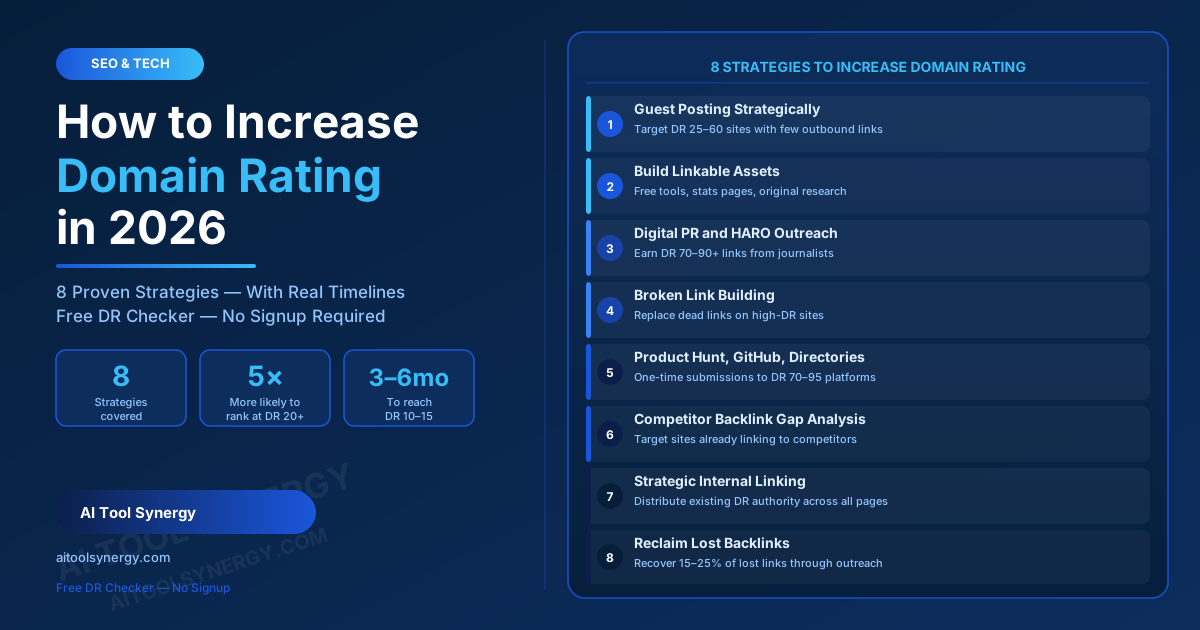
How to Increase Domain Rating — 8 Proven Strategies That Work in 2026
Domain Rating is a metric that only moves in one direction with consistent effort — upward. But the vast majority of site owners trying to increase domain rating make the same mistake: they focus on the wrong things, chase the wrong links, and then wonder why their score hasn’t moved after months of effort. According to Ahrefs’ own research on Domain Rating, DR is driven almost entirely by the number and quality of unique referring domains pointing to your site — not by raw backlink volume, social shares, on-page SEO, or content quality alone.
This guide breaks down the 8 strategies that have a proven track record of moving the DR needle — starting with the foundational rule that all 8 depend on. Use our free Domain Rating Checker to check your current score before you start, then track it monthly as you implement these strategies.
Why Most Approaches to Increase Domain Rating Fail — And What Works Instead
Most guides on how to increase domain rating give the same generic list: write great content, post on social media, optimize your site speed. All of these are good SEO practices — but none of them move DR directly. Domain Rating is a backlink metric. It measures exactly one thing: the quality and diversity of the external websites linking to your domain. Everything else is secondary.
The two most common reasons attempts to increase domain rating fail are getting links from the same sites repeatedly and chasing link volume from low-quality sources. One hundred backlinks from the same domain counts as exactly one referring domain in Ahrefs’ calculation. Meanwhile, one link from a DR 70 site with few outbound links can move a new site from DR 0 to DR 7 overnight. The approach matters far more than the volume.
What does NOT increase domain rating: publishing more content, improving page speed, fixing technical SEO, getting nofollow links, social media mentions, or earning more links from domains already linking to you. All of these improve your SEO — but none directly move your Ahrefs DR score.
The Core Rule: Increase Domain Rating With Referring Domain Diversity, Not Link Volume
Before any strategy, internalize this: the way to increase domain rating is to maximize the number of unique root domains linking to you with dofollow links — not the total number of backlinks. The Ahrefs algorithm gives diminishing returns for every additional link from the same domain. The second link from a site you already have a backlink from contributes almost nothing to your DR.
| Scenario | Referring Domains | DR Impact |
|---|---|---|
| 100 links from 1 DR 30 site | 1 unique domain | Minimal — same as 1 link from that site |
| 10 links from 10 different DR 30 sites | 10 unique domains | Significant — each domain adds new authority |
| 1 link from a DR 70 site linking to 50 domains | 1 unique domain | High — concentrated link equity from authority site |
| 5 links from 5 different DR 50+ sites | 5 unique domains | Very high — ideal combination |
With this in mind, every strategy below is designed to increase domain rating by adding new unique referring domains — not more links from existing ones. Target diversity first, quality second, volume last.
Strategy 1: Guest Posting — The Most Direct Way to Increase Domain Rating
Guest posting remains the most controllable and predictable strategy to increase domain rating when done correctly. The key word is correctly — because generic guest posts on low-quality sites with spam scores above 20 can actually hurt your profile more than help it after Ahrefs’ September 2025 algorithm recalibration, which increased the penalization of low-quality link networks.
How to guest post strategically to increase domain rating
Target sites in your niche with DR 25–60. Sites below DR 20 pass too little authority. Sites above DR 60 rarely accept pitches from new sites. Use our free DR checker to verify each prospect’s score before spending time on a pitch.
Check outbound link count. A DR 40 site that links to 200 other domains passes more authority per link than a DR 60 site that links to 20,000. A site with a lower DR but fewer outbound links is often the better target for increasing your domain rating.
Pitch genuinely useful content, not promotional articles. Editors reject promotional pitches almost universally. Your guest post should solve a specific problem for their audience — the link back to your site should feel natural within that context, not like the purpose of the post.
Aim for 1–2 quality guest posts per month. Consistency beats volume. Two placements per month on DR 30–50 sites will move your domain rating faster over 6 months than twenty rushed posts on low-quality sites.
Real result: According to Backlinko’s analysis of domain authority building strategies, a single guest post on a DR 40+ site with fewer than 200 outbound links can move a new domain from DR 0 to DR 5–7 within one Ahrefs update cycle (updates happen approximately every 15 minutes as Ahrefs recrawls the web).
Strategy 2: Build Linkable Assets — The Passive Way to Increase Domain Rating
Linkable assets are pages that attract backlinks naturally, without requiring you to constantly reach out and ask for them. This is the most scalable long-term approach to increase domain rating because the work is done once and the links accumulate over time. Our own free Domain Rating Checker is a linkable asset — SEO bloggers reference it when discussing DR because it gives their readers something genuinely useful.
The best linkable assets for increasing domain rating:
- Original data and statistics pages — Compile unique industry stats that bloggers and journalists need to cite. According to Backlinko’s analysis, stats pages earn 32% of their highest-quality backlinks despite making up only 16% of published content — the highest ROI of any content type for link building.
- Free tools and calculators — Any free tool that solves a real problem becomes a natural citation target. Tools attract links from tutorials, reviews, resource lists, and tool directories with zero additional outreach.
- Comprehensive definitive guides — A guide that covers a topic so completely that other bloggers prefer to link to it rather than write their own version. These take more effort to create but earn links for years.
- Original research and annual reports — Survey your audience, analyze your own data, and publish findings that others in your niche can cite. Even small-scale original research earns more links than syndicated content.
Quick win: If you already have a tool or calculator on your site, create a dedicated guide explaining how to use it and what the results mean. Then submit that guide to every tool directory and roundup post in your niche. This converts a single tool into multiple referring domains pointing at one page.
Strategy 3: Digital PR and HARO — Earn High-Authority Links at Scale
Digital PR is the strategy with the highest potential DR impact per effort — but also the one that requires the most patience and consistency. When a journalist at Forbes, Inc., or a major industry publication cites your site in an article, you earn a link from a DR 70–90 domain that can dramatically shift your score. A single placement like this can do more for your domain rating than fifty guest posts on average sites.
The most reliable source of journalist link opportunities in 2026 is Featured.com, which relaunched in April 2026 with the original HARO (Help a Reporter Out) format, sending journalist queries three times daily. Responding to relevant queries within six hours significantly improves the chance of earning a mention from publications with DR scores above 70.
How to use digital PR to increase domain rating
Sign up for Featured.com and set your topic categories to your niche. Respond to relevant queries with specific, data-driven answers — journalists want expert perspective, not promotional content. Short, direct responses win over long-winded ones.
Create a newsworthy data angle. Look at industry statistics that haven’t been widely reported, analyze your own tool or platform data, or take a contrarian position on a common belief in your niche. Original angles attract journalist interest without you having to wait for query opportunities.
Track published mentions and claim uncredited ones. After a journalist mentions your site without linking, send a polite follow-up noting the mention and asking if they’d add a link. Many will — and Converting unlinked mentions to links is one of the fastest link-building wins available without creating any new content.
Strategy 4: Broken Link Building on High-DR Sites
Broken link building is one of the most efficient ways to earn backlinks — and therefore one of the cleanest outreach strategies available — because you are solving a real problem for the site owner while earning the link. Every website has outbound links that eventually break as pages are removed or restructured. Finding these broken links and offering your content as a replacement gives you a genuine reason to reach out beyond a cold pitch.
The broken link building process — step by step
Find high-DR sites in your niche that cover topics related to your content. Use your browser’s “Check My Links” extension or any broken link checker to scan their resource pages and blog posts for broken external links.
Match broken links to content you already have — or create a piece specifically to fill the gap the broken link once served. The replacement must be genuinely relevant and useful, not just a loose keyword match.
Reach out with a helpful email. Alert the site owner to the broken link, mention the resource you have that could replace it, and keep the message brief. The key framing is helping them fix a broken resource — not asking for a link.
Best targets for broken link building: Resource pages (“useful tools for X”), “best of” lists that reference older tools or sites that have shut down, and educational guides that link to external statistics that have since gone offline. Sites with higher DR and fewer total links tend to be most responsive to outreach.
Track Your Domain Rating Progress — Free
Check your DR before you start, then again monthly to measure how each strategy is moving the needle. Real Ahrefs data, no signup, no limits.
Check Domain Rating Free →Strategy 5: Product Hunt, GitHub and Niche Directories — Quick DR Wins
For new sites trying to increase domain rating from DR 0 to their first meaningful milestone, free listings on high-authority platforms are the fastest available path. These are one-time submissions that earn dofollow backlinks from domains with DR scores in the 70–90+ range — the kind of links that typically require months of relationship building through other channels.
| Platform | Approx. DR | Best for | Link type |
|---|---|---|---|
| Product Hunt | DR 90+ | Tools, SaaS, apps | Dofollow profile link |
| GitHub | DR 95+ | Open source tools, code | Dofollow repo link |
| Crunchbase | DR 90+ | Startups, businesses | Dofollow company profile |
| G2 / Capterra | DR 85+ | SaaS tools | Dofollow listing |
| Niche directories | DR 20–60 | Any niche | Varies — check before submitting |
Important: Only submit to directories that are genuinely relevant to your niche and have real traffic. Submitting to hundreds of generic directories that Ahrefs categorizes as spam will add very little to your domain rating and can make your link profile look unnatural. Quality and relevance beat volume for directory links just as they do for all other backlinks.
Strategy 6: Competitor Backlink Gap Analysis to Increase Domain Rating Faster
Instead of guessing where to get backlinks, competitor gap analysis shows you exactly which sites are already linking to your competitors but not to you. These sites have already demonstrated willingness to link to content in your niche — making your outreach response rate dramatically higher than cold contact with strangers. This strategy can increase domain rating faster than any other because you are targeting proven opportunities rather than experimenting.
How to run competitor backlink gap analysis
Identify 3–5 direct competitors whose content is similar to yours and who have a higher DR. These are the sites Google is already ranking for your target keywords — the sites linking to them are already proven link sources.
Use Ahrefs’ free website authority checker to look at each competitor’s referring domains. Note the domains linking to multiple competitors — a site linking to three of your competitors but not to you is your highest-priority outreach target.
Build or identify your best existing content that would logically fit on those linking sites as a reference. Reach out explaining that you noticed they link to similar resources and that you have content covering a specific gap or newer angle they haven’t referenced yet.
Check the DR of each prospect using our free domain rating checker before spending time on outreach. Prioritize sites with DR 25–60 that link to three or fewer of your competitors — these are most likely to respond positively and pass meaningful authority when they do.
Strategy 7: Internal Linking — The Most Underused Strategy to Increase Domain Rating
Internal linking is the one way to increase domain rating impact without earning any new external links. While internal links don’t directly change your overall DR score (which depends on external referring domains), they have a significant impact on how the authority from those external links distributes across your site — boosting the URL Rating (UR) of individual pages and improving how well each page can rank for specific keywords.
A common pattern: a site earns strong backlinks to one or two pages — typically the homepage or a popular guide — while the rest of the site has almost no external links pointing at it. Strategic internal linking distributes the authority from those well-linked pages to other pages that need ranking support, making your existing DR work harder across more content.
- Link from your highest-authority pages to your new content — if your homepage has the most external backlinks, a link from it to a new blog post distributes link equity to that post immediately
- Use descriptive anchor text — internal links with keyword-relevant anchor text help Google understand the topical relationship between pages
- Build hub-and-spoke structures — create pillar pages that link out to related subtopic posts, and have all those posts link back to the pillar. This concentrates topical authority on your most important pages.
- Fix orphan pages — any page with zero internal links pointing to it receives no authority distribution from the rest of your site regardless of how many external backlinks your domain has
Strategy 8: Reclaim Lost Backlinks to Protect and Increase Domain Rating
Every site that is actively building links is also quietly losing them. Pages get deleted, sites restructure their URLs, editors remove links during content updates, and referring sites go offline entirely. Monitoring and reclaiming these lost backlinks is one of the most underutilized strategies to increase domain rating — or at minimum, to stop it from quietly declining despite your active link-building efforts.
After Ahrefs’ September 2025 algorithm update, which shifted how link equity is calculated, many sites saw DR drops specifically because they had been counting on links that Ahrefs reclassified as lower quality or discovered had been quietly removed. Regular link audits are no longer optional if you want consistent domain rating growth.
Backlink reclamation process
Check your referring domains monthly using our free DR checker to spot sudden drops. If DR falls while you haven’t changed anything, a key referring domain may have lost authority or removed your link.
Audit lost links from the past 90 days. Use Ahrefs’ Lost Backlinks report (available in the free version) to see which referring domains stopped linking to you. Identify the most valuable ones — DR 30+ domains — and investigate why the link disappeared.
Reach out to reclaim high-value lost links. If a page linking to you was deleted, ask whether the content moved to a new URL. If a site redesigned and removed external links in the process, reach out explaining the link existed previously and ask if they’d reinstate it. Recovery rates on reclamation outreach typically run 15–25% — significantly higher than cold outreach.
Find unlinked brand mentions. Search for your site name or tool name in quotation marks on Google. When you find a page that mentions you by name without linking, contact them and ask if they’d convert the mention to a link. These conversions are easy wins because the writer already chose to reference you.
Realistic Domain Rating Growth Timeline — What to Expect
These timelines assume consistent, active effort across multiple strategies simultaneously. According to Google’s official guidance on links and SEO, external backlinks from authoritative sites remain one of the strongest ranking signals — making consistent link building directly tied to the work that improves rankings over time. The two goals are the same goal.
Before starting any link building campaign, know your exact current DR so you can measure real progress. Use our free domain rating checker as your monthly baseline — it takes under 30 seconds and gives you the same real Ahrefs data a paid account would show. For a complete breakdown of what DR score to target at your current site age, see our guide on what is a good domain rating for a new website.
Check Your Current DR Before You Start — Free
Know exactly where you’re starting from. Real Ahrefs domain rating data for any website — no signup, no daily limit, instant results.
Open Free DR Checker →Frequently Asked Questions — How to Increase Domain Rating
With active link building, most new sites see their first DR movement within 4–8 weeks. Going from DR 0 to DR 10 typically takes 3–6 months of consistent effort. Reaching DR 20–30 usually takes 9–18 months. The logarithmic scale means each additional point gets progressively harder as DR increases — the jump from DR 50 to DR 60 requires far more new referring domains than the jump from DR 10 to DR 20.
The number that matters is unique referring domains — not total backlinks. To go from DR 0 to DR 10, focus on earning 10–20 unique referring domains with dofollow links, ideally from sites with DR above 20. Ten links from the same site count as one referring domain. Ten links from ten different sites move DR significantly. Always prioritize diversity over volume.
Not directly — Google doesn’t use Ahrefs’ Domain Rating in its algorithm. But the underlying activity that increases domain rating — earning high-quality dofollow backlinks from authoritative, relevant websites — is one of Google’s strongest ranking signals. Sites that successfully increase domain rating typically see ranking improvements too, because both outcomes come from the same source: genuine authority built through quality links.
The fastest way to increase domain rating from DR 0 is to get a dofollow link from one or two high-DR sites with few outbound links. A single placement on a DR 70 site that links to only 50 other domains can jump a new site from DR 0 to DR 8–12 in one Ahrefs update. For sites already at DR 15+, the fastest approach is competitor backlink gap analysis — targeting sites that already link to your competitors but not to you, where outreach response rates are much higher than cold contact.
No — nofollow links do not contribute to Ahrefs Domain Rating. Only dofollow backlinks from unique referring domains move DR. However, nofollow links from high-authority sites still drive referral traffic, build brand awareness, and create a natural-looking link profile. A backlink portfolio made entirely of dofollow links can look suspicious — some nofollow links from natural sources are expected in a healthy profile.
Yes — guest posting is the most direct method, but it isn’t the only one. Building linkable assets like free tools, original research, and comprehensive guides earns backlinks passively from other bloggers who want to cite them. Digital PR via journalist outreach can earn high-authority links from publications that would never accept a guest post pitch. Broken link building and directory submissions are also effective, especially for new sites building their first DR milestones.
Check your DR monthly using our free domain rating checker and record the number each time. Monthly tracking reveals genuine upward trends rather than individual data point fluctuations. Also track the number of unique referring domains pointing to your site — this is the input metric that directly drives DR, so growth in referring domains should precede and predict growth in DR score.
Use our free Domain Rating Checker at aitoolsynergy.com/domain-rating-checker. Enter your domain and get instant real Ahrefs DR data — no signup, no daily limit, no credit card. You can check your own site, any competitor, or any potential link partner. Checking takes under 30 seconds and uses the same data as a paid Ahrefs account.
Every one of the 8 strategies above works. The key to actually moving your domain rating is combining multiple strategies simultaneously rather than doing one thing and waiting. Guest post consistently, build at least one linkable asset, submit to quality directories, run competitor gap analysis every quarter, and reclaim lost links every 90 days. Do all of these together and your domain rating will compound upward month by month. For a detailed breakdown of realistic DR targets by site age and niche, see our complete guide on what is a good domain rating for a new website, and use our free DR checking guide to monitor your progress without needing a paid Ahrefs account.
Start With Your Baseline — Check Your DR Free
See your current Ahrefs Domain Rating instantly. Real data, no signup, unlimited checks. Use it before you start any link building campaign and monthly to track progress.
Check Domain Rating Free →





3 Responses
[…] rating for a new website. For practical strategies to grow whichever score you are tracking, the how to increase domain rating guide covers 8 proven methods with real […]
[…] reinstatement if the removal was accidental or if a redirect can be arranged. See our full guide on how to increase domain rating for detailed link reclamation […]
[…] Why this matters for Domain Rating too: As individual page UR rises through internal linking, pages become more competitive for their target keywords, which can attract more natural external backlinks — which in turn raises overall site DR. Internal linking improvements create a compounding cycle that benefits both UR and DR over time. For strategies to grow your overall site DR, see our guide on how to increase domain rating. […]