


If you opened Ahrefs and your domain rating dropped overnight, this guide explains exactly what happened. There are 7 specific reasons an Ahrefs domain rating drop occurs — and most of them have nothing to do with a Google penalty or anything you did wrong.
What this covers: the September 2025 Ahrefs algorithm update · 7 specific causes of a domain rating drop · how to tell which one hit you · 4-step diagnostic process · recovery actions for each cause · whether a DR drop affects your Google rankings.
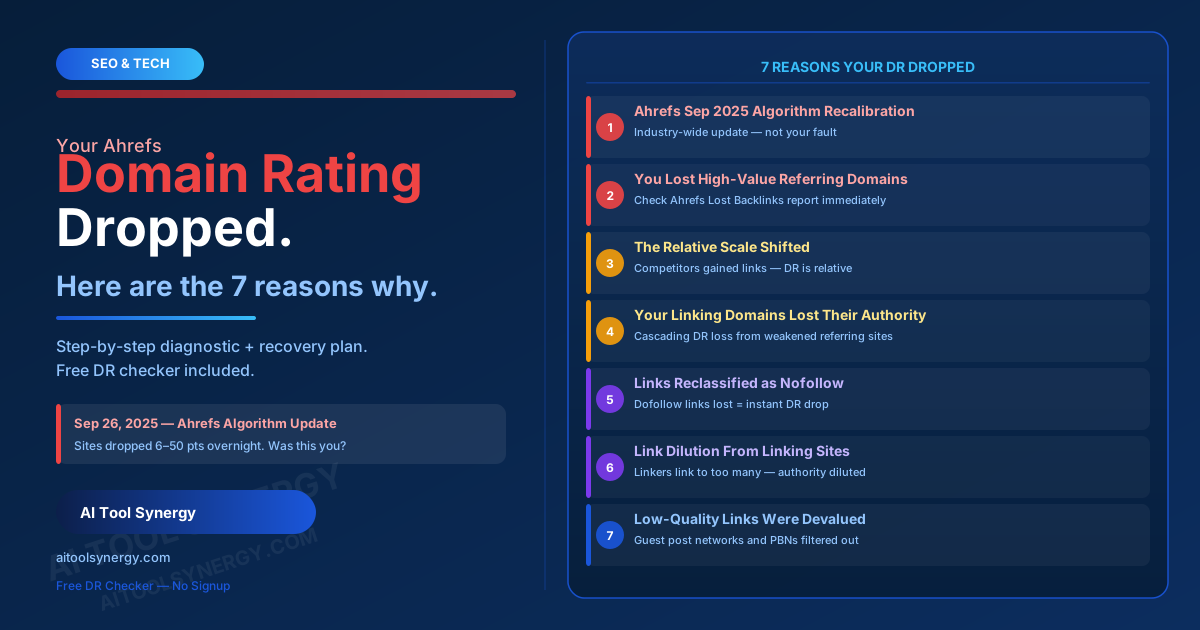
Why Did My Ahrefs Domain Rating Drop? 7 Reasons and How to Fix It
Few things cause more immediate panic in SEO than logging into Ahrefs and seeing your domain rating drop sharply overnight. One day your site sits at DR 45 — the next it shows DR 31. Before assuming your rankings are about to collapse, it is critical to understand what an Ahrefs domain rating drop actually means and what causes it. In most cases, a DR drop is not a sign that your site has been penalised by Google, that you’ve lost real search visibility, or that anything is fundamentally wrong with your SEO strategy.
DR is a third-party metric built entirely by Ahrefs — not by Google. According to Ahrefs’ own official guidance on Domain Rating drops, many DR decreases occur because of changes in the relative scoring system rather than changes to your actual backlink profile. This guide walks through all 7 reasons an Ahrefs domain rating drop can happen — starting with the most important event of 2025 — so you can identify exactly what caused yours and take the right action.
Why an Ahrefs Domain Rating Drop Is Often Not What It Looks Like
The most important thing to understand before diagnosing an Ahrefs domain rating drop is the distinction between a drop that signals a real problem and one that is simply a recalibration. Google does not use Ahrefs’ Domain Rating in its ranking algorithm. A DR drop does not automatically mean your search rankings will fall, your traffic will decline, or your site has been penalised in any way.
What a DR drop can affect is more indirect: how potential link partners perceive your site, how journalists evaluate your authority for outreach purposes, and how clients or teams interpret your site’s competitive position. These are real consequences, but they are very different from a Google penalty. Check your Google Search Console immediately when you notice any Ahrefs domain rating drop — if your impressions and clicks are stable, the drop is almost certainly an Ahrefs-side change rather than a real authority loss.
First step every time: Before investigating any specific cause, open Google Search Console and check your organic impressions and click trend for the same time period as the DR drop. If impressions and clicks are stable, your actual search visibility is unchanged. If they dropped simultaneously, investigate further as a potential real backlink loss rather than an Ahrefs recalibration.
The September 2025 Event That Caused the Largest Ahrefs Domain Rating Drop in Years
If your Ahrefs domain rating drop happened between September 26 and October 15, 2025 — or if you haven’t checked your score since then — this is very likely the cause. On September 26, 2025, Ahrefs rolled out a major algorithmic recalibration to how it calculates both Domain Rating (DR) and URL Rating (UR). According to Outrank Agency’s confirmed report and Stan Ventures’ direct confirmation from Ahrefs, the recalibration was intentional and industry-wide — not a glitch, and not a sign of any problem with individual sites.
The update made four key changes to how DR is calculated:
- Reduced influence of low-quality referring domains — sites with large numbers of low-quality guest post or PBN links saw the biggest drops
- Stricter link type differentiation — nofollow, UGC, and sponsored links were more strictly separated from dofollow links in the authority calculation
- Stronger spam filters — manipulative and inauthentic linking patterns were penalised in the DR model
- Score redistribution — the entire DR scale was recalibrated to reduce artificial inflation that had built up over time
Scale of the September 2025 event: Sites across industries saw Ahrefs domain rating drops of 6–50 points overnight. Sites with clean, high-quality backlink profiles from relevant, authoritative domains saw little change or even slight increases. Sites whose DR had been propped up by link networks, paid links, or low-relevance guest posts saw the steepest corrections.
If your site’s Google traffic remained stable through October 2025, the September event was almost certainly behind your domain rating drop — and it required no corrective action beyond continuing to build quality backlinks. Use our free Domain Rating Checker to see your current score and compare it against where you were before September 26, 2025.
Reason 1: The Relative Scale Shifted — Your Ahrefs Domain Rating Drop Without Losing Links
This is the most commonly overlooked cause of an Ahrefs domain rating drop: your score fell even though you didn’t lose a single backlink. How? Because DR is a relative metric, not an absolute one. Every DR score is calculated in comparison to every other site in Ahrefs’ database of hundreds of millions of domains.
When large numbers of other websites gain strong backlinks, the baseline of the entire DR scale shifts upward. Your site’s relative position drops even if your actual backlink profile stayed completely unchanged. Think of it like class rankings — if the top students all improve their grades while yours stays the same, your rank falls even though your score didn’t change.
How to identify this cause
Check your referring domain count in Ahrefs over the same time period as the DR drop. If your referring domain count stayed flat or grew while DR dropped, the relative scale shift is the likely cause. Check whether competitors in your niche also saw DR drops at the same time — if they did, it confirms an industry-wide or database-wide recalibration rather than a problem specific to your site.
Reason 2: Losing High-Value Referring Domains — When the Ahrefs Domain Rating Drop Is Real
This is the Ahrefs domain rating drop cause that warrants the most attention. If a high-DR site that was linking to you removed the link, deleted the page, or shut down entirely, the authority that link was passing to you disappears from your DR calculation immediately. Because Ahrefs updates DR approximately every 12 hours, a significant lost backlink can show up as a DR drop within the same day.
The impact is not proportional — losing one link from a DR 80 site with few outbound links can drop your DR more than losing twenty links from DR 20 sites. This is why it’s critical to check your Lost Backlinks report in Ahrefs before assuming a DR drop is external or algorithm-related.
How to identify and fix this cause
In Ahrefs, navigate to your site’s overview and check the Referring Domains report filtered to “Lost” over the relevant time period. Look for recently lost domains with DR above 30 — these are the links most likely to have caused the score change. For each lost link, investigate why it disappeared and contact the site to request reinstatement if the removal was accidental or if a redirect can be arranged. See our full guide on how to increase domain rating for detailed link reclamation strategies.
Reason 3: Your Linking Domains Lost Their Own Authority
DR operates through a chain of authority. When a DR 60 site links to you, it passes authority based on its own score. But if that site loses its own referring domains — and its DR drops from 60 to 35 — the authority it passes to you decreases proportionally. This creates a cascading effect where your DR fell without any action on your site by any action on your site or by the linking site removing your link, but simply by the linking site becoming weaker itself.
How to identify and fix this cause
In Ahrefs, check your top referring domains and note their current DR scores. If several of them show reduced DR compared to when you last checked, this cascading effect is likely contributing to the decline. The fix is long-term: diversify your backlink profile so that no single referring domain represents a significant portion of your total DR. Aim for at least 30–50 unique referring domains so that any one site’s DR movement has minimal impact on yours.
Reason 4: Links Were Reclassified From Dofollow to Nofollow
Only dofollow backlinks contribute to Ahrefs Domain Rating. Nofollow, UGC-tagged, and sponsored links pass zero DR value. If a site that was previously linking to you with a dofollow link updated their link attributes — converting it to nofollow, adding a rel="sponsored" attribute, or restructuring their CMS in a way that changed link types — the authority that link was passing to you disappears entirely without the link being removed.
This became a more significant cause of sudden DR falls after the September 2025 Ahrefs update, which applied stricter differentiation between link types. Links that were previously being counted as dofollow were in some cases reclassified, contributing to the industry-wide drops that month.
How to identify this cause
In Ahrefs, filter your Backlinks report to show nofollow links from your highest-authority referring domains. If a domain that previously showed as dofollow now shows as nofollow, that reclassification is contributing to your DR drop. Contact the site owner to understand the change — in some cases CMS updates cause unintentional attribute changes that can be reversed.
Check Your Current Domain Rating — Free
See your exact DR right now. Real Ahrefs data, no account needed, no daily limit. Compare against your score before and after any drop event to measure real change.
Check DR Free →Reason 5: Link Dilution — A Hidden Cause of Ahrefs Domain Rating Drop
A less obvious cause of an Ahrefs domain rating drop is link dilution. If a site linking to you significantly increases the number of other domains it links out to, the authority each of those links passes — including yours — gets diluted proportionally. A DR 50 site that links to 100 other domains passes considerably more authority per link than if it links to 5,000 other domains.
This can happen when a linking site adds a large resource directory, joins a link exchange network, or restructures their site to include footer links to many other websites. Your link from that domain still exists — but the value it passes to your DR decreases without any change on your end.
How to identify this cause
Check the “Linked Domains” count of your highest-authority referring domains in Ahrefs. If a key referring site has dramatically increased its outbound linking over the same period as your DR decline, link dilution may be a contributing factor. No immediate fix is available — the long-term solution is maintaining a diverse backlink profile where no single domain represents more than 5–10% of your total DR contribution.
Reason 6: Ahrefs Devalued Low-Quality Links in Your Profile
Ahrefs continuously refines how it evaluates link quality, and sites with backlink profiles built on low-quality tactics — guest post networks, private blog networks (PBNs), mass directory submissions, or paid links from irrelevant sites — are increasingly vulnerable to DR score reductions as the algorithm improves at detecting these patterns.
This is what the September 2025 update specifically targeted at a large scale. But similar smaller-scale adjustments happen continuously as Ahrefs updates its crawling technology and link assessment criteria. If your DR was built primarily on volume rather than quality, expect continued pressure on your score as Ahrefs’ detection improves.
How to fix this cause
Audit your backlink profile for links from sites with very low traffic, irrelevant niches, or clear link network patterns. Use Google Search Console to disavow genuinely toxic links that you cannot have removed manually. Then redirect your link building toward quality: use the strategies in our domain rating growth guide to replace devalued links with legitimate placements on real, editorially controlled websites.
Reason 7: Your Competitors Gained Links While You Stood Still
Because DR is a relative metric, standing still is effectively moving backward. If your entire niche is actively building backlinks while your own link acquisition has slowed or stopped, your DR can fall even without any of the other 6 causes being present. The Ahrefs database constantly recalibrates as new domains and links are added — a site that was at DR 35 six months ago needs more referring domain strength today to maintain that same score as the overall database grows stronger.
How to identify and fix this cause
Check whether 3–5 of your direct competitors’ DR scores have increased over the same period as your DR decline. If your score dropped while theirs rose, the relative scale shift caused by their link building is partially responsible for yours. The fix is consistent link acquisition — even 2–3 quality guest posts per month from DR 30+ sites will protect your relative position over time. Track progress monthly using our free DR checker to catch any future drops early.
How to Diagnose Your Ahrefs Domain Rating Drop in 4 Steps
Once you understand the 7 possible causes, use this diagnostic sequence to identify exactly what triggered your specific Ahrefs domain rating drop:
Check Google Search Console first. Go to your GSC Performance report and compare impressions and clicks for the period before and after the DR drop. If organic traffic is stable, your real-world SEO is unaffected. If traffic also dropped, prioritise investigating Reason 2 (lost referring domains) immediately.
Check your referring domain count. Use our free DR checker to monitor your current score, then check Ahrefs’ Referring Domains report for lost domains over the relevant period. If referring domain count dropped, Reason 2 or 4 is likely. If it stayed flat, look at Reasons 1, 3, or 7.
Check timing against the September 2025 event. Did the drop occur between September 26 and October 15, 2025? If yes, the Ahrefs algorithm recalibration is the primary cause, and no corrective action is needed unless your Google traffic also dropped. If the drop happened at a different time, focus on Reasons 2–7.
Check your top referring domains’ DR health. Look at the 10–15 sites sending you the most authoritative links. If several of them show lower DR than they had previously, Reason 3 (cascading authority loss) is contributing. Begin diversifying your backlink sources to reduce dependence on any single referring domain’s health.
For a full strategy to rebuild and grow DR after any drop, see our complete guide on how to increase domain rating. For benchmarking what score you should be targeting after recovery, see our guide on what is a good domain rating for a new website.
Monitor Your Domain Rating Monthly — Free
Check your DR any time, for any domain. Real Ahrefs data, no signup, no daily limit. Know immediately when your score changes so you can diagnose the cause before it becomes a problem.
Check DR Free →Frequently Asked Questions About Ahrefs Domain Rating Drop
Not directly. Google does not use Ahrefs’ Domain Rating in its ranking algorithm — this has been confirmed by Google’s own representatives. This type of score change does not trigger any ranking change on Google’s side. However, if the same event that caused your DR drop also involved losing real, high-quality backlinks, those lost links can affect rankings indirectly over time. Always check Google Search Console alongside Ahrefs when diagnosing a DR drop — if impressions are stable, your rankings are unaffected.
Because DR is a relative metric. Your score is calculated in comparison to every other site in Ahrefs’ database. When other sites gain stronger backlinks, the baseline shifts and your relative position can drop even though your actual backlink profile stayed identical. The September 2025 Ahrefs algorithm update also caused widespread drops without any backlink changes — it was a database-wide recalibration that affected hundreds of thousands of sites simultaneously.
On September 26, 2025, Ahrefs rolled out a major recalibration to how it calculates both Domain Rating and URL Rating. The update focused on reducing the influence of low-quality referring domains, applying stricter differentiation between dofollow and nofollow links, and filtering out manipulative linking patterns. Sites with clean, high-quality backlink profiles saw little change. Sites whose DR had been inflated by link networks or paid links saw drops of 6–50 points. Ahrefs confirmed via their support team that this was an intentional improvement — not a penalty and not a glitch.
If the drop was caused by an Ahrefs algorithm recalibration (like the September 2025 event), recovery happens naturally as you continue earning quality backlinks — typically 3–6 months of consistent link building to recover 5–10 DR points. If the drop was caused by real link loss, recovery depends on how quickly you can reclaim lost links and acquire new ones from quality sources. Each new dofollow backlink from a unique referring domain contributes to recovery, and Ahrefs updates DR approximately every 12 hours, so improvements appear quickly once links are indexed.
Use the Lost Backlinks and Referring Domains reports in Ahrefs, filtered to the time period matching your DR drop. Look for lost domains with DR above 30 — these have the highest individual impact on your score. You can also use our free DR checker to monitor your overall score monthly and catch drops early so you can investigate before the cause becomes difficult to trace.
Not necessarily. Start by checking Google Search Console — if your organic impressions and clicks are stable, there is nothing urgent to address. A DR decline without traffic impact is almost always either an Ahrefs recalibration or a relative scale shift, neither of which requires immediate corrective action beyond continuing your normal link building. Only escalate to urgent action if the DR drop coincides with real traffic loss or a significant loss in referring domains from high-quality sites.
Directly, no — nofollow links never contributed to DR in the first place. But if existing dofollow links were reclassified as nofollow by a site’s CMS update or by Ahrefs’ stricter link type detection (which was part of the September 2025 update), those links would effectively disappear from your DR calculation, causing a drop. Check your highest-authority referring domains in Ahrefs and verify that their links to you are still showing as dofollow, not nofollow or UGC-tagged.
Use our free Domain Rating Checker at aitoolsynergy.com/domain-rating-checker. Enter any domain and get instant real Ahrefs DR data — no signup, no daily limit, no subscription. Check your site monthly to catch any future DR changes early and identify the cause before it’s difficult to trace.
An Ahrefs domain rating drop is alarming to see — but in most cases it is manageable, explainable, and often temporary. Check your Google Search Console first, then work through the 7 reasons in this guide to identify your specific cause. For most sites, the right response is continuing consistent quality link building rather than any dramatic corrective action. According to Google’s official guidance on links and SEO, the underlying signal that DR approximates — high-quality backlinks from authoritative relevant sources — remains one of the strongest ranking signals. Focus on earning those links and your DR will follow.






One Response
[…] What this means practically: Track your DR monthly as your primary authority metric. Use AR as a rough global context indicator, not as a performance metric. If your AR dropped but your DR stayed flat, it simply means other sites gained ground — not that you lost anything. If your DR dropped alongside AR, investigate your referring domains as described in our guide on why Ahrefs domain rating drops. […]