


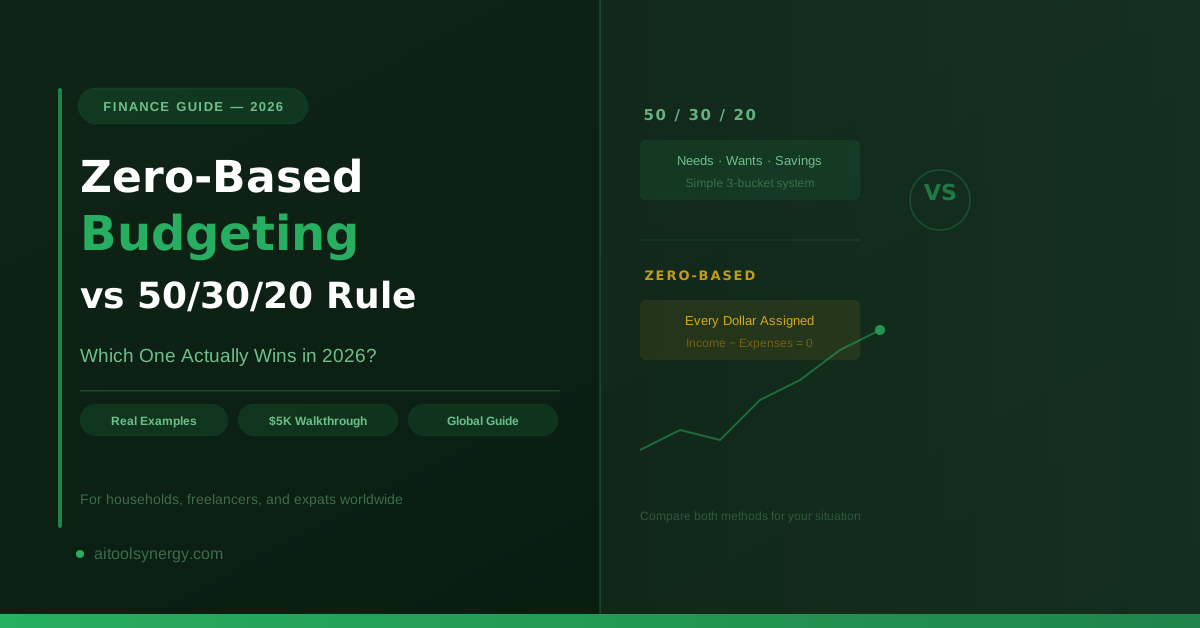
According to NerdWallet’s budgeting research, 74% of Americans say they follow a budget — but fewer than half feel confident that their method actually fits their lifestyle. That gap tells you everything about why so many people feel financially stuck despite technically “having a budget.”
The debate between zero-based budgeting and the 50/30/20 rule dominates personal finance discussions because both methods genuinely work — just for different people, in different situations. One is precise and demanding. The other is simple and forgiving. Picking the wrong one for your situation is like wearing the wrong shoes for a hike: the footwear isn’t broken, it’s just the wrong fit.
This guide breaks down both methods completely — what they are, how they were created, real examples with actual numbers, which wins for debt payoff vs savings, and why the 50/30/20 rule is being seriously challenged in 2026 by rising housing costs. You’ll also get a complete setup guide for both methods, a look at the hybrid approach most financial professionals quietly recommend, and guidance for international readers in the UAE, UK, and Australia.
By the end, you won’t just know which method is theoretically better — you’ll know which one is right for you.
Why Your Budgeting Method Matters More Than Your Income
Here’s the uncomfortable truth that most personal finance content skips: income doesn’t automatically create financial stability. Systems do. A household earning $120,000 a year with no budget and unchecked lifestyle creep can end up with less financial security than a household earning $55,000 with a consistent system.
The failure rate for budgets isn’t caused by weak willpower or insufficient income — it’s caused by mismatched methods. Zero-based budgeting in the hands of someone who hates detail work gets abandoned by week three. The 50/30/20 rule applied by someone carrying $22,000 in credit card debt doesn’t attack the problem with enough force.
The right question isn’t “which budgeting method is better?” It’s “which budgeting method matches how I think about money, how stable my income is, and what financial problem I’m actually trying to solve right now?”
What Is the 50/30/20 Rule — and Where Did It Come From?
The 50/30/20 rule is one of the most widely taught personal finance frameworks in the world. It divides your after-tax income into three categories: 50% to needs, 30% to wants, and 20% to savings and debt repayment.
The method was developed by U.S. Senator Elizabeth Warren and her daughter Amelia Warren Tyagi in their 2005 book All Your Worth: The Ultimate Lifetime Money Plan. Warren, a bankruptcy law professor at Harvard before entering politics, designed it as a response to how complex and alienating most financial advice was for average households. The goal was a framework simple enough that anyone could implement it in an afternoon.
What Goes in Each Bucket?
| Category | % of After-Tax Income | What Belongs Here |
|---|---|---|
| Needs | 50% | Rent/mortgage, utilities, groceries, insurance, minimum debt payments, transportation to work |
| Wants | 30% | Dining out, entertainment, subscriptions, travel, shopping, gym memberships, hobbies |
| Savings | 20% | Emergency fund, retirement (Roth IRA, 401k), extra debt payments, investment accounts |
The appeal is simplicity. Instead of tracking 40 spending categories, you track three. Instead of debating whether to allocate $120 or $145 to entertainment, you check whether your “wants” spending stays under 30%. For people who have never maintained a budget, this low-friction starting point often makes the difference between building a habit and giving up.
The 50/30/20 rule works best when:
- You have a stable, predictable paycheck
- You have low or no high-interest debt
- You want a system that doesn’t require weekly attention
- You’re a budgeting beginner who needs a simple framework to start
- You earn above approximately $40,000–$50,000 per year (below this, the “30% wants” allocation can become unrealistically tight)
How Zero-Based Budgeting Works — The Complete Explanation
Zero-based budgeting (ZBB) takes the opposite approach. Every dollar of your income is assigned to a specific category before the month begins. When income minus all assigned expenses equals zero, your budget is complete. No dollar is left unaccounted for — hence the name.
This method didn’t start in someone’s kitchen — it started in a corporate boardroom. Peter Pyhrr, a manager at Texas Instruments, developed zero-based budgeting in 1969 as a way to force departments to justify every expense from scratch each budget cycle, rather than simply adding a percentage to last year’s numbers. The U.S. federal government briefly adopted it under President Jimmy Carter in the late 1970s.
Its jump to personal finance came decades later, primarily through Dave Ramsey’s EveryDollar app and the YNAB (You Need A Budget) platform, both of which adapted the core principle for household use. The Consumer Financial Protection Bureau (CFPB) now recommends zero-based budgeting specifically for households with irregular or project-based income, noting that it forces intentional spending decisions rather than passive ones.
How ZBB Actually Works Month to Month
At the start of each month, you list your total expected income. You then assign dollar amounts to every category — housing, groceries, utilities, transportation, entertainment, savings, extra debt payments — until every dollar has a destination and the balance reaches zero. If you earn $4,800 this month, $4,800 gets assigned. Nothing floats.
The key psychological shift is this: you’re not tracking where money went — you’re deciding where it goes before it arrives.
Zero-based budgeting works best when:
- You have variable or irregular income (freelancers, commission earners, gig workers)
- You’re actively paying off consumer debt and need granular control
- You’ve struggled with overspending in specific categories
- You want complete visibility into where every dollar goes
- You or your partner enjoy detail-oriented financial management
Side-by-Side Comparison: Zero-Based Budgeting vs 50/30/20
| Factor | 50/30/20 Rule | Zero-Based Budgeting |
|---|---|---|
| Monthly setup time | 5–10 minutes | 30–60 minutes |
| Maintenance | Monthly check-in | Weekly tracking required |
| Best income type | Stable salary | Variable or irregular |
| Debt payoff focus | Basic (20% bucket) | Strong (line-item control) |
| Flexibility | High (3 buckets) | Lower (every category planned) |
| Spending visibility | Moderate | Very high |
| Beginner-friendly | ✅ Yes | ⚠ Moderate learning curve |
| Impulse spending control | Moderate | Strong |
| Recommended tools | Spreadsheet, Mint alternative | YNAB, EveryDollar |
| Works at any income | Best above $40K/year | Works at any income level |
Neither method is universally superior. As the CFPB’s budgeting guidance notes, matching the method to your income pattern and behavioral style is more predictive of success than the method itself.
Real Budget Walkthrough: What Each Method Looks Like at $5,000 Per Month
Abstractions are useful. Numbers are better. Here’s what both methods look like applied to a real household with $5,000 after-tax income per month.
The 50/30/20 Approach at $5,000/Month
| Category | Percentage | Monthly Amount |
|---|---|---|
| Needs (rent, utilities, groceries, insurance, transport) | 50% | $2,500 |
| Wants (dining, entertainment, subscriptions, shopping) | 30% | $1,500 |
| Savings + debt repayment | 20% | $1,000 |
| Total | 100% | $5,000 |
The Zero-Based Approach at $5,000/Month
| Category | Monthly Amount |
|---|---|
| Rent / mortgage | $1,400 |
| Groceries | $380 |
| Utilities (electricity, internet, water) | $180 |
| Car payment + insurance + fuel | $420 |
| Health insurance | $180 |
| Minimum credit card payments | $150 |
| Dining out | $200 |
| Streaming + subscriptions | $60 |
| Entertainment + hobbies | $150 |
| Clothing / personal care | $100 |
| Emergency fund contribution | $300 |
| Retirement (Roth IRA / 401k) | $400 |
| Extra credit card payoff | $300 |
| Sinking funds (car repairs, gifts, travel) | $180 |
| Total assigned | $5,000 |
Notice what the zero-based breakdown reveals that the 50/30/20 version doesn’t: the $60 in streaming subscriptions, the $180 in sinking funds, and the split between the $300 emergency fund and $400 retirement contribution. In the 50/30/20 version, these are invisible inside the “20% savings” bucket.
That visibility is zero-based budgeting’s biggest advantage. And its biggest demand — because building and updating that table every month takes real time.
Which Method Wins for Paying Off Debt?
Verdict: Zero-Based Budgeting wins for aggressive debt payoff
The 50/30/20 rule’s fixed 20% savings-and-debt bucket often under-allocates toward debt repayment for households carrying significant balances. Zero-based budgeting forces you to explicitly assign extra dollars to debt each month — there’s no vague bucket for it to hide in.
Consider this real scenario: a household earning $60,000 per year after taxes ($5,000/month) carrying $18,000 in credit card debt at 20% APR.
Under the 50/30/20 rule, $1,000/month goes to savings and debt combined. After minimum payments on other accounts and a modest emergency fund contribution, perhaps $400/month goes toward the high-interest balance. At that rate, the $18,000 debt takes approximately 5.5 years to clear and costs around $9,200 in interest.
Under a zero-based budget, the same household explicitly assigns $700/month to that credit card payoff — cutting dining out, subscriptions, and discretionary spending to create that allocation. The debt is cleared in 2.5 years and costs approximately $4,100 in interest. The difference: $5,100 saved and 3 fewer years of financial stress.
The math works because zero-based budgeting removes the passive assumption that “the 20% bucket handles it.” With ZBB, you actively decide how much extra debt payoff you can do each month — and because it’s explicitly assigned, it actually happens.
Which Method Wins for Building Long-Term Savings?
Verdict: 50/30/20 can win for long-term savings — when automated
For low-debt households focused on retirement and wealth building, the 50/30/20 rule’s simplicity combined with automation is surprisingly effective. The key word is automation — set it and forget it is the real secret.
When a stable-income household automates 20% of their monthly take-home pay — routing it automatically to a Roth IRA, 401(k), and high-yield savings account the same day their paycheck arrives — the 50/30/20 system essentially runs itself. There’s no monthly decision-making, no willpower required, and no risk of the savings bucket being raided for a spontaneous purchase.
Zero-based budgeting for savings works just as well — it simply requires more active management. If you enjoy optimizing and tweaking, ZBB gives you more levers to pull. If you’d rather set a system and not think about it, automate the 50/30/20 approach and use the freed-up mental energy elsewhere.
Is the 50/30/20 Rule Still Realistic With 2026’s Cost of Living?
This is the honest question that most 50/30/20 explainers avoid. The short answer: in many cities, the 50% needs threshold is already broken before you buy a single grocery item.
According to the U.S. Census Bureau’s Housing Vacancy Survey, national median rent in the United States crossed $1,700 per month in recent years. For a household earning $5,000 per month after taxes, that’s 34% of income on rent alone — before utilities, groceries, insurance, or transportation. In cities like New York, San Francisco, Toronto, London, or Sydney, the numbers are significantly worse.
| City | Avg. 1-Bed Rent (2026) | Monthly Income Needed to Stay Under 50% | Reality |
|---|---|---|---|
| New York City | ~$3,500 | $14,000+/month | 50% rule broken for most earners |
| London | ~£2,100 (~$2,650) | £8,400/month | 50% rule tight for average earner |
| Sydney | ~A$2,800 (~$1,850) | A$11,200/month | Challenging for median household |
| Dubai (UAE) | ~AED 8,500 (~$2,300) | AED 34,000/month | Difficult for most expat packages |
| Dallas / Phoenix | ~$1,400 | $5,600/month | Achievable for many households |
Many financial planners now recommend adjusting the needs threshold to 55–60% in high-cost cities rather than abandoning the framework entirely. The 30% wants bucket is often trimmed to 20–25% to compensate, while the 20% savings target is preserved as non-negotiable.
If you live in a high-cost city and housing alone exceeds 35% of your take-home, the strict 50/30/20 split isn’t realistic. Use the adjusted versions below:
| Cost of Living Context | Needs | Wants | Savings |
|---|---|---|---|
| Low cost of living city | 45% | 35% | 20% |
| Average cost of living | 50% | 30% | 20% |
| High cost of living city | 55% | 25% | 20% |
| Very high cost city (NYC, London, Sydney) | 60% | 20% | 20% |
The savings percentage stays at 20% regardless of where you live. That’s the number to protect — it’s the one that builds your future. Adjust everything else around it.
How to Set Up a Zero-Based Budget From Scratch — Your First Month
Calculate Your Total Monthly Income
Write down every source of after-tax income you expect this month: salary, freelance payments, side hustle income, rental income. If your income varies, use the lowest realistic figure — you can always allocate surplus later. Never budget with best-case income.
List All Fixed Expenses First
Write every expense that has a fixed, predictable amount: rent/mortgage, car payment, insurance premiums, loan minimums, subscription fees. These get assigned first because they don’t flex — they happen regardless.
Assign Your Savings and Debt Payoff Goals
Before discretionary spending gets a number, assign your savings and extra debt payments. Emergency fund contribution, retirement contribution, extra credit card payoff. This is the “pay yourself first” principle inside a zero-based framework — it prevents savings from becoming whatever’s left over.
Assign Variable Necessities
Groceries, utilities, fuel, and other variable but necessary expenses. Use your last 3 months of spending as a baseline. Round up slightly to avoid underpowering these categories.
Allocate Discretionary Spending
Whatever remains after fixed costs, savings, and necessities goes to discretionary categories: dining out, entertainment, clothing, personal care. If there’s very little left, this is where the tradeoff decisions happen. Zero-based budgeting makes those tradeoffs explicit rather than invisible.
Verify the Balance Hits Zero
Add up all assigned amounts. The total must equal your income exactly. If you have money left over, assign it — extra debt payment, sinking fund, savings boost. If you’re over budget, cut a discretionary category. The budget is complete only when income minus assigned expenses equals zero.
How to Set Up a 50/30/20 Budget in Under 30 Minutes
The appeal of the 50/30/20 method is how fast it is to implement. Here’s the three-step setup:
- Find your monthly after-tax income. This is your take-home pay — after income tax, national insurance or social security, and any other automatic deductions. If you have multiple income sources, add them all.
- Calculate your three buckets. Multiply your after-tax income by 0.50 (needs), 0.30 (wants), and 0.20 (savings). Write these three numbers down — they’re your monthly targets.
- Automate the savings bucket immediately. Set up an automatic transfer on payday that routes 20% of your income directly to your savings account or retirement contribution. Don’t wait to see what’s left — this is the most important step. Once the automation is running, you simply monitor that your needs stay under 50% and your wants stay under 30%.
Track your actual spending against these targets once a month. If the needs bucket goes over, look at what’s driving it. If the wants bucket is consistently over, find two or three recurring expenses to cut or reduce. That monthly 15-minute review is all the maintenance the 50/30/20 system requires.
The Hybrid Approach — What Most Finance Professionals Actually Recommend
Here’s a pattern you’ll notice in financial planning communities: experienced budgeters rarely describe themselves as pure 50/30/20 followers or pure zero-based devotees. Most end up somewhere in between.
The most effective hybrid approach works like this:
- Use 50/30/20 as your macro framework — the three-bucket structure tells you at a glance whether your overall allocation is healthy.
- Apply zero-based logic inside the “needs” bucket — assign specific dollar amounts to rent, utilities, groceries, insurance, and minimum debt payments. These are fixed and important enough to track specifically.
- Keep “wants” as a flexible bucket — within the 30% wants allocation, don’t track individual subcategories obsessively. Set a total and stay under it.
- Track savings goals specifically within the 20% — split the savings bucket into named targets: emergency fund ($X), retirement ($X), extra debt payoff ($X). This gives ZBB’s specificity where it matters most without applying it everywhere.
The CFPB’s budgeting resources note this hybrid approach — using broad percentage targets as macro guardrails while applying line-item precision to high-stakes categories — is particularly effective for households managing both savings goals and debt simultaneously.
The result: the simplicity of three buckets with the discipline of assigned dollars where it counts most.
How to Apply These Methods With Irregular Income
Freelancers, commission-based salespeople, seasonal workers, gig economy earners, and the millions of expat workers in the UAE and Gulf region who receive variable bonuses all face the same challenge: budgeting on an income that changes month to month.
For variable-income earners, these adjustments make both methods work:
- Budget using your lowest monthly income from the past 6 months. Don’t budget with your average or your best month — budget with the floor. Surplus months become windfall opportunities.
- Create a “income holding” account. When income is above average, hold the excess in a separate account rather than spending it immediately. This buffers lean months.
- Zero-based budgeting is generally better for highly irregular income — rebuilding the budget from scratch each month is less disruptive than trying to hit fixed percentage targets when income swings by 40–60%.
- The 50/30/20 rule works better for moderately variable income (±10–15% monthly variation), where percentages still provide meaningful guardrails.
- Build a 2-month income buffer before relying heavily on either method. With irregular income, the first financial goal is income stability — the buffer is your safety net.
A Note for International Readers — UAE, UK, Australia, and Canada
UAE and Saudi Arabia: The most significant difference for UAE and KSA expats is the absence of personal income tax. Your take-home pay equals your gross salary — which means the “after-tax income” starting point for either method is your full salary. This makes both methods more favorable in theory, but high rents in Dubai and Abu Dhabi (where a one-bedroom apartment averages AED 7,000–10,000/month) often strain the 50% needs threshold significantly. Use the 55–60% adjusted needs allocation if you live in Dubai or Abu Dhabi. The zero-based approach works particularly well for expats managing a combination of monthly salary, quarterly bonus, and end-of-service gratuity planning.
United Kingdom: UK households have National Insurance contributions and income tax already deducted, so after-tax income is the correct starting point. London renters face the same housing-cost squeeze as New York — the 60/20/20 adjusted split is more realistic than the strict 50/30/20 for most London earners.
Australia: The Australian compulsory superannuation system (currently 11.5% employer contribution) means some retirement saving already happens outside your budget. This effectively creates more headroom in your 20% savings bucket, which can be redirected to emergency fund, property deposit, or discretionary savings.
Canada: Similar to the UK, the combination of income tax and CPP contributions means take-home is the calculation base. Canadian housing markets in Vancouver and Toronto face extreme affordability challenges — the adjusted needs allocation approach is essential for earners in those cities.
If you’re an expat in the UAE or working in any country and want to understand your real take-home on an hourly basis — which helps calibrate the 50/30/20 targets precisely — use our free Salary to Hourly Calculator to convert your annual or monthly salary into a true hourly rate.
Know Your Real Hourly Rate Before You Budget
Both budgeting methods start with your after-tax income. Use our free calculator to convert your salary into an accurate monthly take-home figure — including adjustments for your country, working hours, and commuting time.
Calculate Your Real Take-Home Rate →





2 Responses
[…] covers both the emergency fund and sinking funds — so allocation between them matters. Read our Zero-Based Budgeting vs 50/30/20 comparison for a full breakdown of how each handles irregular […]
[…] your money once you know what you’re earning, see our guides on how to set up a sinking fund, zero-based budgeting vs 50/30/20, and how to stop living paycheck to […]