

API vs Subscription: Why ChatGPT and Claude Keep Them Separate
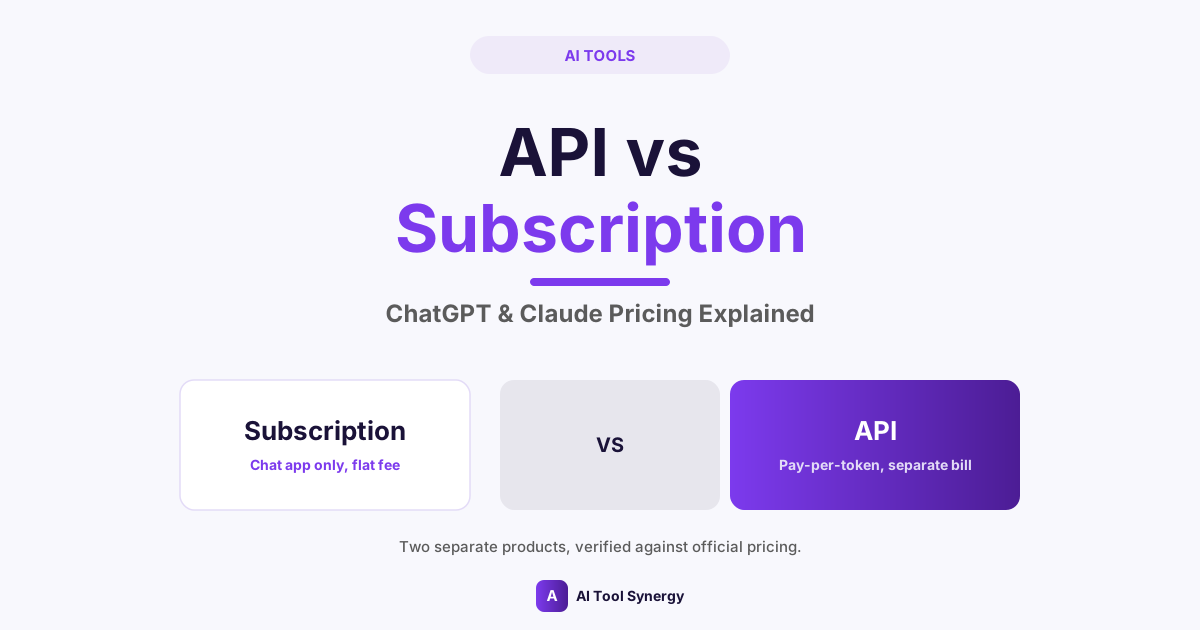
If you’ve ever paid for ChatGPT Plus or Claude Pro and then hit a paywall trying to connect a tool to “your AI,” you’ve run into the single most common point of confusion in this space: API vs subscription are two entirely different products, sold by the same company, that share no billing relationship at all. Your $20/month subscription and your API usage are invoiced separately, authenticated separately, and priced on completely different models — even though both ultimately talk to the same underlying AI.
This guide walks through exactly why that separation exists, what each side actually includes, real current pricing for both ChatGPT and Claude, and — using the real questions people search on Google — the specific confusions that come up most often.
API vs Subscription: What Each One Actually Is
A subscription — ChatGPT Plus, ChatGPT Pro, Claude Pro, Claude Max — is a flat monthly fee for using the company’s own consumer app: the chat website, the mobile app, and features built specifically for that app, like Claude Code or ChatGPT’s Codex agent. You get a usage allowance, not unlimited access, and that allowance resets on a rolling window rather than a hard monthly cap.
The API is a completely different product aimed at developers: a raw connection to the underlying models, billed per token, with no chat interface included at all. It’s what powers third-party AI tools, custom integrations, and anything you build yourself. There’s no flat fee — you pay for exactly what you use, and nothing more.
What a ChatGPT or Claude Subscription Actually Buys You
A subscription buys convenience and predictability: one flat price, a generous but capped usage allowance, and access to the polished consumer product — memory, file uploads, voice mode, image generation, and platform-specific agents like Codex or Claude Code. What it does not buy is the ability to call the model from your own code, connect it to a third-party tool, or use it inside an application that isn’t the official app itself.
What the API Actually Buys You Instead
The API buys raw, programmatic access — an API key you generate on a developer platform, used to send requests directly to the model from your own code or through a tool that’s been built to use it. There’s no chat interface, no memory between sessions unless you build it yourself, and no flat monthly fee. You’re billed for every token processed, input and output counted separately, with the meter running only when you actually send a request.
Claude Pricing: Subscription vs API, Side by Side
Per Anthropic’s own official pricing page, Claude’s consumer subscriptions are entirely separate from its per-token API rates.
| Claude subscription | Price | What it includes |
|---|---|---|
| Free | $0 | Claude Sonnet 5, capped usage, no Claude Code |
| Pro | $17-20/mo | Higher usage caps, Claude Code included |
| Max 5x | $100/mo | ~5x Pro’s usage allowance |
| Max 20x | $200/mo | ~20x Pro’s usage allowance |
| Claude API model | Input / Output (per million tokens) |
|---|---|
| Claude Haiku 4.5 | $1 / $5 |
| Claude Sonnet 5 | $2 / $10 |
| Claude Opus 5 | $5 / $25 |
| Claude Fable 5 | $10 / $50 |
None of these API rates are included in any subscription tier — Free, Pro, or Max. A separate account on Anthropic’s developer platform, with its own billing, is required regardless of which consumer plan you already pay for.
Estimate Your Real Token Usage First
Know your actual token count before comparing subscription vs API costs — free, no signup.
Try the Token CounterChatGPT Pricing: Subscription vs API, Side by Side
OpenAI structures things almost identically. Per OpenAI’s own ChatGPT pricing page, subscriptions and API usage are billed on entirely separate accounts.
| ChatGPT subscription | Price | What it includes |
|---|---|---|
| Free | $0 | GPT-5.6 Terra, ads, ~10 messages per 5-hour window |
| Go | $8/mo | Higher usage caps than Free |
| Plus | $20/mo | First tier with GPT-5.6 Sol access |
| Pro (base) | $100/mo | Codex included, limited Sora |
| Pro (top) | $200/mo | Codex, unlimited Sora, Operator agent |
Worth flagging directly since it trips people up: OpenAI currently runs two different plans both labeled “Pro” at $100 and $200 — they are not the same tier, and the gap between them is mainly Sora video generation and the Operator agent, not the underlying chat model.
Per OpenAI’s official API pricing documentation, GPT-5.6 Sol costs $5 per million input tokens and $30 per million output tokens via the API (with a promotional rate of $4/$20 active as of this writing) — again, entirely separate from any ChatGPT subscription tier, including the $200 Pro plan.
Is API vs Subscription Cheaper? The Real Breakeven Point
This depends entirely on your usage volume, and it’s the single most-searched version of this question for good reason. For light, occasional use — a few conversations a day — the API is almost always cheaper, since you’re only paying for the tokens you actually send. For heavy daily use, the math flips: a developer burning several million tokens a week can exceed $300 in raw API costs, well past the $200 flat rate of the top subscription tier. That crossover point, somewhere in the low hundreds of dollars a month, is the real answer to “is API more expensive than subscription” — it depends entirely on which side of that line your actual usage falls. Running your typical prompt length through our free Token Counter a few times gives you a realistic starting estimate before committing to either path.
Can You Use Your Subscription as an API Key?
No. This is one of the most direct real questions people search, and the answer is a flat no for both companies. Your ChatGPT or Claude subscription login has no connection to an API key at all — API keys are generated separately, on a separate developer platform, tied to a separate billing method. Paying $200/month for the top consumer tier of either product does not unlock any API usage.
How to Actually Get API Access
Since API vs subscription accounts are completely separate, here’s the actual setup process for each platform:
- For OpenAI: create a separate account at platform.openai.com, add a payment method, and generate an API key from the dashboard.
- For Anthropic: create a separate account at platform.claude.com (formerly console.anthropic.com), add billing, and generate a key the same way.
- Neither process requires or benefits from an existing ChatGPT Plus or Claude Pro subscription — they’re unrelated signups.
- Before funding either account, check your actual prompt lengths with our Token Counter so your budget estimate is based on real numbers, not a guess.
Budget Your API Costs Accurately
Count exact tokens before you commit to a usage estimate — free, unlimited.
Use the Token CounterWhen You Genuinely Need the API Instead of a Subscription
- You’re building a product or internal tool that calls the model programmatically.
- You’re using a third-party app (a browser extension, a coding assistant, an automation platform) that requires you to supply your own key.
- You need to specify an exact model version for consistency, rather than whatever the chat app happens to be routing to that week.
When the Subscription Is Genuinely the Better Choice
- You’re a person chatting directly with the AI, not writing code against it.
- You want predictable monthly spend rather than a metered bill that scales with usage.
- You’re a heavy daily user — past the breakeven point, the flat rate is simply cheaper than the equivalent API usage.
The “Extra Usage” Feature: Where the Line Blurs Slightly
Both companies have recently introduced a middle ground between the two sides of the API vs subscription divide. Anthropic’s paid plans now include an opt-in “extra usage” toggle — once you hit your subscription’s included allowance, you can choose to continue at standard API rates instead of waiting for your limit to reset, with a spend cap you control. It’s not free API access bundled into your subscription; it’s a controlled way to overflow into metered billing on the same account when you genuinely need to keep working.
Is There a Free API? What “Free” Actually Means Here
Neither OpenAI nor Anthropic offers an ongoing free tier for their flagship API models the way a subscription’s Free plan works. New developer accounts sometimes receive a small amount of starting credit, but it’s a one-time trial allowance, not a permanent free option — once it’s used, standard per-token billing applies. If you’re specifically looking to experiment without spending anything, the Free subscription tiers of ChatGPT or Claude (chat-only, no API) are the actual no-cost option, not the API.
Which Is Cheaper: Claude API or ChatGPT API?
At the budget end, Claude Haiku 4.5 ($1/$5 per million tokens) and OpenAI’s GPT-5.6 Luna are both aimed at high-volume, low-cost use, with Luna currently priced lower per token. At the flagship end, Claude Opus 5 ($5/$25) and GPT-5.6 Sol ($5/$30 standard, promotional $4/$20) land close to each other, with the real difference usually coming down to task performance rather than sticker price. Neither company is reliably cheaper across every tier in this API vs subscription comparison — it depends on which specific model tier you’re comparing.
Is There an “OpenAI API Subscription”? Clearing Up a Common Search
A lot of people search for an “OpenAI API subscription,” expecting a flat monthly plan similar to ChatGPT Plus. There isn’t one. The API is pure pay-as-you-go: you add funds or a payment method, and usage is deducted per token as you go, with no fixed monthly fee and no included allowance. The closest thing to a “subscription” on the API side is simply setting up automatic recurring billing so your balance tops up on its own — the underlying pricing model is still fully metered, not flat-rate.
How API Billing Actually Works, Step by Step
Both companies handle API billing the same general way. You create a developer account, add a payment method, and usage accrues against that account as you send requests — there’s no separate “API vs subscription” toggle to worry about once you understand the account itself is entirely separate from any chat subscription. Most accounts start on prepaid billing (you add credit, and usage draws down from it) before graduating to postpaid billing (a monthly invoice) once a spending history is established. Rate limits — how many requests per minute you can send — typically scale up automatically as your account’s total spend and account age increase, which matters if you’re building something that needs to handle real traffic rather than occasional personal use.
Why Pay $20 for ChatGPT If the API Exists?
This is a genuinely reasonable question once you understand the API vs subscription split, and the honest answer is convenience, not necessity. The $20 Plus subscription bundles a polished chat interface, memory across conversations, file uploads, voice mode, and image generation into one predictable price — recreating all of that yourself through the API would mean building your own interface and likely paying a comparable or higher amount in metered usage for an equivalent volume of daily conversation. For someone who just wants to talk to the AI rather than build something with it, the subscription is almost always the simpler and often cheaper path.
Privacy and Data: Another Real Difference Between the Two
Beyond pricing, subscription and API usage are also handled differently around data. On ChatGPT’s Free and Plus tiers, conversations can be used to help train future models unless you specifically turn that off in your data controls. API usage works the other way by default — OpenAI states that data sent through the API is not used to train models, reflecting the API’s positioning toward business and production use where that guarantee matters. This is a genuinely separate consideration from the API vs subscription cost question, but it’s often just as relevant when deciding which one fits a specific use case, especially for any work involving sensitive or proprietary text.
A Concrete Example: Doing the API vs Subscription Math
Numbers make the API vs subscription decision much clearer than percentages alone. Say you’re using Claude Sonnet 5 for a daily coding workflow, averaging roughly 2 million input tokens and 400,000 output tokens per day across a work month. At Anthropic’s API rates ($2/$10 per million), that’s about $4 in input costs and $4 in output costs per day — around $170-190 over a 22-day work month, before accounting for prompt caching discounts that typically apply to repeated context. That lands comfortably under the $200 Max 20x subscription, making the raw API the cheaper choice at this specific usage level.
Now double that usage — a genuinely heavy day involving multiple long agent sessions — and the math flips well past $300-400 a month, at which point the flat $200 subscription becomes the clearly cheaper option. This is exactly why there’s no single universal answer to “is API more expensive than subscription“: the honest answer always depends on where your specific usage actually lands relative to that crossover point, not on which product is inherently cheaper.
Signs You Actually Need the API, Not Just a Bigger Subscription
A genuinely common mistake is upgrading to the most expensive subscription tier when what’s actually needed is API access instead — the two solve different problems entirely. You need the API specifically if: a tool or extension is asking you to paste in an API key rather than log in with your account, you’re writing any code that sends requests to the model programmatically, you need a specific pinned model version rather than whatever the chat app is currently routing to, or you’re integrating the model into a product other people will use. If none of those apply and you’re simply hitting usage limits inside the chat app itself, a higher subscription tier — not the API — is almost always the right fix.
FAQ: API vs Subscription (ChatGPT & Claude)
Yes. They’re separate products with separate accounts, separate billing, and separate pricing — a Claude Pro or Max subscription does not include any API access.
No, not even the $200/month Max 20x tier. API access always requires a separate account on Anthropic’s developer platform with its own billing.
It depends on usage. Light use is typically cheaper on the API since you only pay for tokens sent. Heavy daily use often exceeds $300/month on raw API, at which point the $200 flat-rate Max plan becomes the cheaper option.
No. Subscription logins and API keys are entirely unrelated credentials on both platforms, generated through separate developer accounts.
No. ChatGPT Plus, and even the $200 Pro tier, only grant access to the ChatGPT app itself — API usage requires a separate OpenAI developer account and billing.
Not on an ongoing basis. New developer accounts sometimes get a small one-time trial credit, but there’s no permanent free API tier for either company’s flagship models — the free option is the chat app’s Free subscription, not the API.
Per million tokens: Haiku 4.5 at $1/$5, Sonnet 5 at $2/$10, Opus 5 at $5/$25, and Fable 5 at $10/$50 for input/output respectively, per Anthropic’s official pricing.
GPT-5.6 Sol costs $5 per million input tokens and $30 per million output tokens at standard rates, with a promotional $4/$20 rate active as of this writing, per OpenAI’s official documentation.
It depends on whether you need unlimited Sora video generation and the Operator agent — those are the main differences from the $100 Pro tier. Neither Pro tier includes any API access regardless of price.
They serve different audiences with different cost structures. A subscription is a flat rate for predictable personal use of the chat app; the API is metered, pay-per-token access built for developers whose usage varies widely and needs to scale independently of a fixed monthly fee.
Use our free ChatGPT Token Counter to get an exact token count for any text before estimating your API cost.
The short version, and the one worth remembering: API vs subscription isn’t a pricing tier within the same product — it’s two separate products, on two separate accounts, billed two separate ways, for both ChatGPT and Claude. Knowing which side of the API vs subscription split you actually need, based on real usage rather than assumption, is what decides whether you should be signing up for a subscription or a developer account.
Know Your Real Token Costs Before You Choose
Free, accurate, and works for both ChatGPT and Claude prompts.
Use the Token Counter Free