

AI Detector False Positives: Why ESL Writers Get Flagged
AI detector false positives aren’t evenly distributed. If you write in a second language, your odds of being wrongly flagged as “AI-generated” are dramatically higher than a native English speaker’s — not because your writing is less original, but because of a specific, well-documented technical bias in how these tools actually work.
This isn’t a fringe complaint. It comes from peer-reviewed Stanford research, and it’s serious enough that OpenAI shut down its own AI detector over a closely related accuracy problem. This post walks through why AI detector false positives happen to non-native writers specifically, what the real research actually found, and what you can genuinely do about it.
AI Detector False Positives: Why ESL Writers Get Flagged
The short answer: AI detectors don’t actually read for meaning or originality. Most rely on a statistical measure called perplexity — roughly, how predictable a piece of text is to a language model. Text that uses simpler vocabulary, shorter sentences, or more repetitive structure scores as more “predictable,” and predictable text looks statistically similar to AI output. Non-native English writing frequently has exactly these characteristics, not because it’s lower quality, but because it reflects a smaller working vocabulary in a second language.
What Actually Counts as an AI Detector False Positive
A false positive is specifically when a detector flags genuine, human-written text as AI-generated. This is a different failure than a false negative, where actual AI text slips through undetected. The two errors matter very differently in practice: a false negative is a minor miss, but AI detector false positives can mean a real accusation against someone who did nothing wrong.
That distinction matters because most vendor “accuracy” claims blend both error types into one headline number, which can hide a genuinely serious false-positive problem behind an impressive-sounding overall score.
How AI Detectors Actually Work
Most AI detectors don’t read for meaning, originality, or quality. Instead, they measure two statistical properties of text: perplexity, how predictable the next word is given what came before, and burstiness, how much sentence length and structure vary across a passage. AI-generated text tends to score low on both — smooth, evenly-paced, and statistically predictable. Human writing, on the other hand, is usually burstier: mixing short and long sentences, taking occasional unexpected turns.
The problem is that these two measurements are proxies, not direct evidence of authorship. Anything that happens to produce smooth, predictable, low-burstiness text — including a second-language writer working with a smaller vocabulary — can trigger the same statistical signature the detector was built to catch. This is the mechanical root of most AI detector false positives, not a flaw specific to any one vendor’s tool. You can see this dynamic directly by running the same paragraph through our own AI Content Detector in a few different phrasings and comparing how the confidence score shifts.
The Stanford Research Behind This Problem
The most cited study on this exact issue comes from Stanford researchers Weixin Liang, Mert Yuksekgonul, Yining Mao, Eric Wu, and James Zou, published in the peer-reviewed journal Patterns. Their study tested seven widely used GPT detectors against two groups of genuinely human-written essays: US eighth-grade student writing, and TOEFL essays written by non-native English speakers.
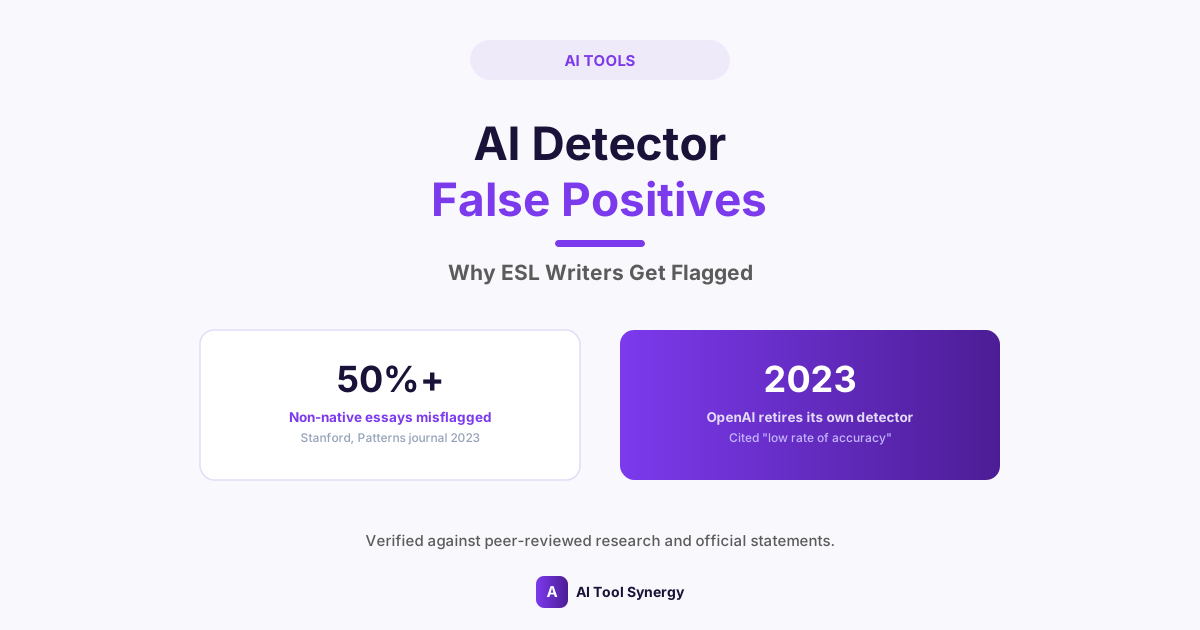
Per Stanford’s own research summary, the detectors were nearly perfectly accurate on the native-speaker essays. On the non-native TOEFL essays, more than half were incorrectly flagged as AI-generated. Same detectors, same task, wildly different outcomes depending on who wrote the text. The full methodology and results are available in the peer-reviewed paper itself, for anyone who wants to see the raw data rather than a summary.
Check Text Before You Rely on a Detector Score
See a clear, honest breakdown instead of a single unexplained percentage.
Try the AI Content DetectorWhat a False Positive Actually Costs Someone
The Stanford team’s senior author, James Zou, was direct about the real-world stakes: these tools are already being used to evaluate job applications, college admissions essays, and classroom assignments. A wrongly flagged essay isn’t an abstract statistic in those contexts — it’s a real accusation with real consequences for a real person, disproportionately falling on non-native English speakers.
In an academic setting, a false positive can trigger a formal misconduct investigation over work a student genuinely wrote themselves. In a hiring context, it can mean a writing sample gets silently discarded before a human ever reads it. Because AI detector false positives hit non-native writers hardest, these consequences land disproportionately on exactly the group least equipped to contest an automated, unexplained accusation.
OpenAI Retired Its Own Detector Over This Same Problem
This isn’t a criticism unique to third-party detector companies. OpenAI built and launched its own AI Text Classifier in January 2023, then quietly shut it down just six months later. Per OpenAI’s own official announcement, the tool was discontinued specifically “due to its low rate of accuracy.”
If the company that built the underlying models couldn’t make a reliable detector for its own output, that’s a genuinely strong signal about the ceiling on this entire category of tool — including free and paid third-party alternatives.
Who Faces the Highest Risk of a False Positive
Not every writer faces the same odds of running into AI detector false positives. The pattern below reflects the general research findings, not a guarantee for any individual case:
| Writer type | Relative false-positive risk |
|---|---|
| Native English speakers, standard prose | Low |
| Non-native English speakers | Significantly elevated |
| Technical or scientific writing | Elevated — formal, formulaic phrasing reads as predictable |
| Very short text (under a few hundred words) | Elevated — less data for the detector to work with |
| Heavily edited or “humanized” AI text | Unpredictable in both directions |
None of these categories are fixed sentences — a native English speaker writing in an unusually formal register can still trigger an AI detector false positive, just as a non-native speaker writing in a distinctly personal voice can sometimes pass cleanly. The pattern is a statistical tendency across large samples, not a rule that applies to any individual piece of writing with certainty, which is itself another reason a single score should never be treated as a definitive verdict. If you want to see where a specific piece of text actually lands, checking it directly with a tool that explains its reasoning — like our AI Content Detector — is more useful than guessing based on general risk categories alone.
Get a Transparent Breakdown, Not Just a Score
Free, unlimited checks — with context on what the result actually means.
Use the AI Content DetectorHow to Reduce Your Risk of Being Falsely Flagged
- Vary your sentence length deliberately. Mixing short and long sentences reduces the uniform, predictable rhythm detectors associate with AI output.
- Write with more specific, less generic vocabulary where natural. This directly raises perplexity, the exact signal these detectors rely on.
- Keep a copy of your drafting process. Document revision history or notes can serve as real evidence if a false positive is ever contested.
- Never treat a single detector’s score as final. Run genuinely important text through more than one tool before drawing any conclusion.
What to Do If You’ve Already Been Flagged
First, don’t panic — a single detector score is not proof of anything, and given what the Stanford research shows, it may say more about the detector than about your writing. Request the specific report rather than accepting a bare percentage. If possible, provide your actual drafting history, notes, or earlier versions as direct evidence. If you’re a non-native English speaker specifically, it’s reasonable and fair to raise the documented bias in this exact research as context for why the score may be unreliable.
Why No Single Detector Score Should Be Treated as Proof
Given everything the Stanford research and OpenAI’s own retirement decision demonstrate, a responsible AI detection tool shouldn’t hand back a bare, unexplained percentage and let you draw your own conclusion. It should show its work — confidence level, which signals contributed to the result, and an honest acknowledgment that any single score carries real uncertainty, especially for non-native writers. Our own AI Content Detector was built around exactly that philosophy: a clear breakdown rather than a single number presented as fact.
Between the documented non-native writer bias and OpenAI’s own decision to retire its detector over accuracy concerns, the responsible way to use any AI detector is as one weak signal among several, never as a standalone verdict. Reasonable institutions increasingly pair a detector score with a human conversation before drawing any real conclusion — and that standard is worth insisting on if you’re ever on the receiving end of a flagged result.
FAQ: AI Detector False Positives
AI detector false positives happen when a detector incorrectly flags text that a human genuinely wrote as AI-generated. It’s a different, often more consequential error than a false negative, where real AI text goes undetected.
Most detectors rely on perplexity, a measure of how predictable text is. Non-native writing often uses simpler vocabulary and more regular sentence structure, which reads as statistically “predictable” in a way that resembles AI-generated text, even though it’s entirely human-written.
Researchers tested seven widely used GPT detectors on real human writing. Detectors were nearly perfectly accurate on native-speaker essays, but more than half of non-native-authored TOEFL essays were incorrectly flagged as AI-generated.
OpenAI discontinued its AI Text Classifier in July 2023, just six months after launch, explicitly citing its own tool’s low rate of accuracy — a strong signal about the real-world limits of this entire category of tool.
Varying sentence length, using more specific vocabulary, and keeping your draft history as evidence can all help. None of these guarantee a clean result, but they reduce the statistical patterns detectors tend to misread.
No. Given how well-documented AI detector false positives are, especially for non-native writers, a detector score should inform a human conversation, not replace one.
Yes. Detectors generally need enough text to build a reliable statistical picture — very short passages give the algorithm less to work with, which is another documented driver of AI detector false positives in either direction.
Ask for the specific report rather than a bare score, provide any draft history you have, and if relevant, cite the documented non-native writer bias as legitimate context for why the result may be unreliable.
AI detector false positives aren’t a rare glitch — for non-native English writers specifically, they’re a documented, peer-reviewed pattern, serious enough that OpenAI retired its own detector over a closely related accuracy problem. Treat any single score as one weak signal, never as proof.
Get an Honest AI Content Check
Free, unlimited, and clear about what a result does and doesn’t prove.
Use the AI Content Detector