

What Is a Good Flesch Reading Ease Score?
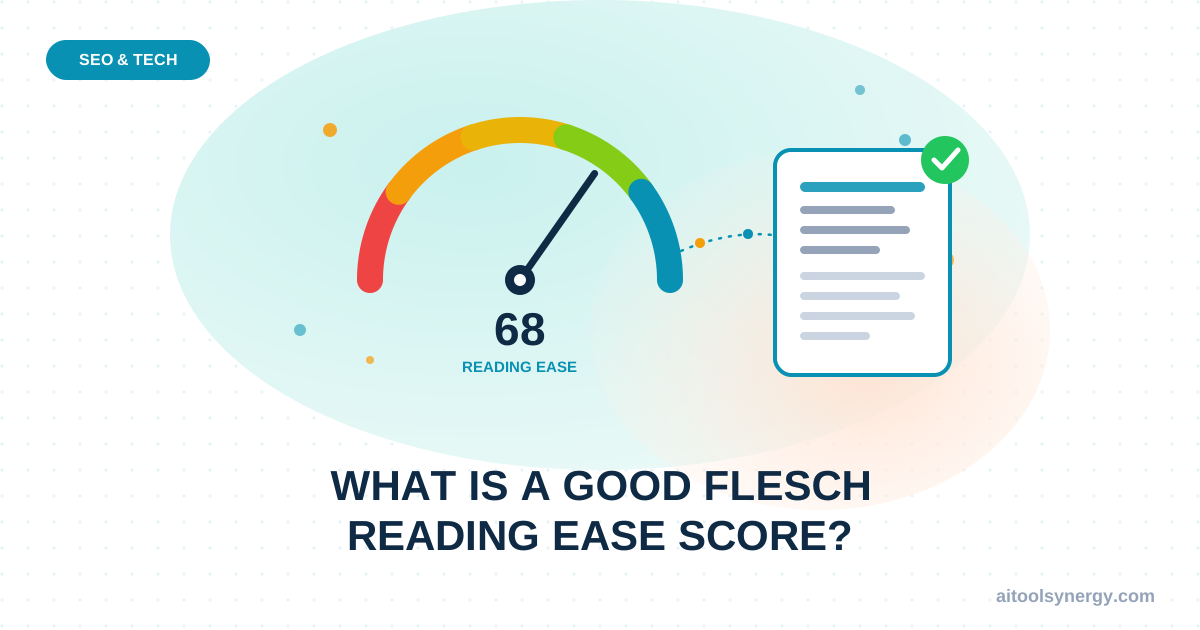
A good Flesch reading ease score is 60–70 for most blog and website content — that range corresponds to roughly an 8th-to-9th-grade reading level, which the average adult reads comfortably. But “good” depends heavily on context: a Flesch reading ease score in the 30s is normal for academic writing, while a children’s book or simple instructions might score 80 or higher. There’s no single correct number here — there’s only the right score for your specific audience.
This guide breaks down what this score actually measures, what counts as good for different types of content, and how a real state law uses it as a legal readability requirement. If you want to check your own Flesch reading ease score right now rather than read the theory first, paste your text into our free word counter and scroll to the Full Analysis section.
Check Your Flesch Reading Ease Score Instantly
Paste any text into our free word counter to see your exact Flesch score, word count, sentence count, and full readability breakdown — no signup required.
Get Your Score Free →What Counts as a Good Flesch Reading Ease Score?
A Flesch reading ease score is reported on a 0-to-100 scale, where higher numbers mean easier reading. For general-audience web content, a good Flesch reading ease score sits between 60 and 70 — this is the same benchmark cited in the Federal Plain Language Guidelines used by U.S. government agencies writing for the public. Below 60, text starts to demand more effort from an average reader; above 80, it reads almost like children’s material.
Flesch Reading Ease Score Benchmarks by Content Type
These ranges aren’t strict rules — they’re starting points. A SaaS onboarding email should aim near the top of this chart; a peer-reviewed research paper is expected to sit lower, and that’s normal.
How the Flesch Reading Ease Score Is Calculated
The Flesch reading ease formula only uses two inputs — how long your sentences are, and how many syllables are in your words:
Flesch Reading Ease = 206.835 − (1.015 × ASL) − (84.6 × ASW)
ASL = Average Sentence Length (total words ÷ total sentences)
ASW = Average Syllables per Word (total syllables ÷ total words)
Rudolf Flesch first published this formula in 1948 in the Journal of Applied Psychology, and it remains one of the most widely used readability measures nearly 80 years later — it’s built into Microsoft Word, Grammarly, and most SEO content tools, as documented on Wikipedia’s overview of the Flesch–Kincaid readability tests. The takeaway: shorter sentences and simpler words push your score up; long, syllable-heavy sentences push it down.
The Flesch Reading Ease Scale, Visualized
Real-World Flesch Score Requirements: Why Florida Law Sets a Minimum of 45
The Flesch score isn’t just a content-marketing metric — it’s written directly into state law. Under Florida Statute 627.4145, every insurance policy sold in the state must score a minimum of 45 on the Flesch reading ease test to be considered legally “readable,” using the exact same formula covered above. Insurers must certify their policy’s score before it can be filed with the state. It’s a useful real-world anchor: if insurance contract language only needs to clear 45, a good Flesch reading ease score of 60–70 for a blog post is a genuinely high bar for everyday readability, not an arbitrary marketing target.
Flesch Reading Ease vs. Flesch-Kincaid Grade Level
These two scores are easy to confuse because they’re calculated from the same inputs, but they report different things:
| Flesch Reading Ease Score | Reading Level | Approx. Flesch-Kincaid Grade |
|---|---|---|
| 90–100 | Very Easy | 5th grade |
| 70–89 | Easy / Fairly Easy | 6th–7th grade |
| 60–69 | Standard | 8th–9th grade |
| 50–59 | Fairly Difficult | 10th–12th grade |
| 30–49 | Difficult | College |
| 0–29 | Very Confusing | College graduate |
They move in opposite directions — a high score on one corresponds to a low grade level on the other. Most SEO and writing tools show both side by side.
See Exactly Where Your Writing Lands
Don’t guess at your score — paste your draft into our free word counter and get your exact score, sentence length average, and syllable count in real time.
Check My Score →How to Improve a Low Flesch Reading Ease Score
- Shorten your sentences. Aim for 15–20 words on average — anything consistently over 25 drags your score down. Our guide to ideal sentence length for readability covers the research behind this number.
- Cut multi-syllable words when a simpler one works. “Utilize” → “use.” “Facilitate” → “help.”
- Break up long paragraphs. This won’t move your score directly, but it makes dense text feel more readable, which is the actual goal.
- Read it out loud. If you run out of breath mid-sentence, it’s too long.
- Re-check your score after every edit pass using a free word counter rather than guessing whether your changes helped.
FAQ: Good Flesch Reading Ease Score
Is a Flesch reading ease score of 70 good?
Yes. A score of 70 sits right in the “fairly easy to read” range and is considered a good Flesch reading ease score for most blog and web content aimed at a general adult audience.
What Flesch score do email newsletters need?
Aim for 60–70. Emails are read quickly, often on mobile, so a score in this range performs better and gets read to the end.
Can a Flesch score be too high?
Yes, in some contexts. A score of 90+ signals very short, simple sentences — great for children’s content or ads, but it can feel choppy or oversimplified for professional or technical writing.
Does Google use Flesch score as a ranking factor?
No. Google doesn’t confirm using Flesch score directly as a ranking signal, but readable content tends to earn longer time-on-page and more shares, both of which correlate with better search performance.
What’s a bad Flesch reading ease score?
Anything below 30 is considered “very confusing” and college-graduate level. Unless you’re writing for a highly specialized or academic audience, this usually means your sentences need trimming.
Why does Florida require a minimum Flesch reading ease score for insurance policies?
Florida Statute 627.4145 requires a minimum Flesch reading ease score of 45 so that insurance policies are legally considered readable by an average consumer, not just by lawyers and underwriters.