


Learn how to optimize your site SEO with a free Best Meta Tag Generator. Discover 10 powerful ways to boost Google rankings and click-through rates effortlessly!
Best Meta Tag Generator
Table of Contents
- Introduction: Demystifying Metadata for Search Engine Excellence
- What Are Meta Tags and Why Do Search Engines Rely on Them?
- 10 Best Ways to Use a Free Meta Tag Generator Tool Easily
- 1. Crafting Click-Worthy Title Tags That Drive Organic Traffic
- 2. Generating Standard-Compliant Meta Descriptions Within Ideal Limits
- 3. Structuring Open Graph Tags for Flawless Social Media Previews
- 4. Configuring Twitter Card Metadata for High-Engagement Content
- 5. Setting Robots Directives to Control Search Engine Crawling
- 6. Ensuring Mobile Responsiveness with Viewport Meta Tag Setup
- 7. Preventing Duplicate Content Issues via Canonical Tag Integration
- 8. Eliminating Manual HTML Syntax Errors for Faster Deployment
- 9. Auditing and Refreshing Legacy Web Content for Modern SEO
- 10. Accelerating Workflow Efficiency for Developers and Marketing Agencies
- How to Implement Generated Meta Tags on Your Website
- Common Meta Tag Mistakes to Avoid for Maximum Rank Math Optimization
- Why Webmasters Choose AI Tool Synergy for Web Utilities
- Conclusion & Next Steps
Introduction: Demystifying Metadata for Search Engine Excellence
Using a reliable Best Meta Tag Generator is one of the fastest, most effective steps you can take to upgrade your website search engine performance. Search engines like Google crawl billions of web pages daily, relying heavily on structured metadata hidden within the <head> section of your HTML source code. This hidden information communicates the core message of your page, guides search engine spiders on how to process your content, and dictates how your website snippets appear across Search Engine Result Pages (SERPs) and social media feeds.
When you manage a digital property, precision in your technical markup determines whether your pages rank on page one or get lost in search index obscurity. Modern SEO tools and plugins—such as Rank Math—heavily emphasize clean, precise, and fully populated metadata. However, hand-writing HTML tags or manually formatting Open Graph properties often leads to syntax errors, truncated titles, or broken social previews.
By utilizing a free Best Meta Tag Generator on platforms like AI Tool Synergy, webmasters, digital marketers, and developers can construct error-free, search-engine-ready code in seconds. Whether you manage a WordPress site, a custom static HTML platform, or an e-commerce catalog, mastering metadata creation guarantees higher click-through rates (CTR), better indexing, and superior search visibility.
What Are Meta Tags and Why Do Search Engines Rely on Them?
Meta tags are snippet elements of HTML code that describe a web page’s content to search engine crawlers and browser user agents. Unlike the main body text visible to visitors, meta tags live exclusively inside the <head> tag of a document. Although invisible on the actual page body, their influence on web accessibility, brand perception, and search rankings is profound.
Google and other major search providers analyze metadata to understand contextual hierarchy. The primary meta tags include the Title Tag, Meta Description, Viewport Tag, Meta Robots, and Open Graph protocol tags. When a search engine spider scans a page, these elements act as an executive summary. If your metadata accurately reflects user intent and incorporates your primary keywords, search algorithms reward your page with enhanced SERP placement and richer visual snippets.
Furthermore, plugins like Rank Math actively audit your website’s metadata completeness. A high Rank Math SEO score relies heavily on key factors: placing your focus keyword near the beginning of your meta title, writing a compelling meta description within character boundaries, and establishing proper social sharing standards. An automated Best Meta Tag Generator ensures every single one of these technical parameters is satisfied without requiring manual coding expertise.
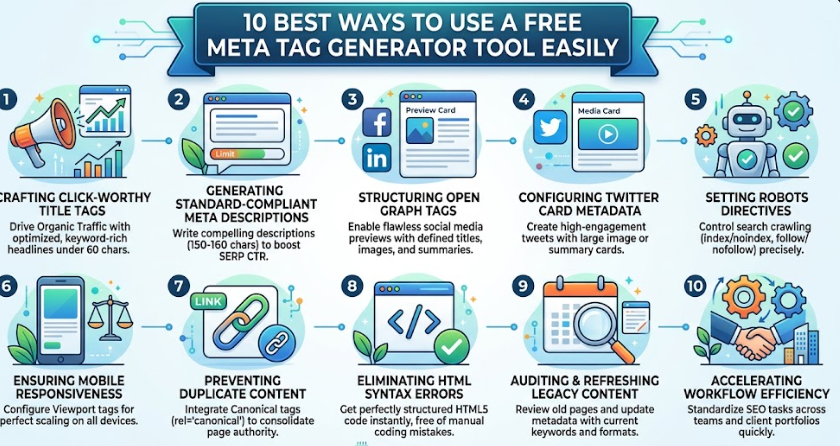
10 Best Ways to Use a Free Best Meta Tag Generator Tool Easily
1. Crafting Click-Worthy Title Tags That Drive Organic Traffic
The Title Tag is arguably the single most important meta tag for on-page SEO. It serves as the clickable headline in organic search results and appears on browser tabs. A major advantage of using a Best Meta Tag Generator is the ability to craft optimized title tags that align with search engine guidelines while capturing user attention.
Rank Math and Google both recommend keeping title length between 50 and 60 characters (or under 580 pixels). If your title exceeds this limit, search engines will truncate it with ellipses, potentially hiding your main call to action or brand name. When inputting your page title into a Best Meta Tag Generator, you can preview the character length live, ensuring your primary keyword appears naturally near the beginning.
Moreover, effective titles strike a balance between search algorithm requirements and human psychology. Incorporating power words, numbers, or clear benefit statements increases your organic Click-Through Rate (CTR). Higher CTR signals to Google that your snippet is highly relevant, which sequentially boosts your overall search rankings.
2. Generating Standard-Compliant Meta Descriptions Within Ideal Limits
While Google has confirmed that meta descriptions are not a direct ranking factor, they exert a massive indirect influence on search success. Your meta description acts as organic ad copy. It summarizes the page content and gives users a compelling reason to click on your link over competitors.
Using a free Best Meta Tag Generator simplifies the creation of meta descriptions by ensuring they strictly adhere to character guidelines—typically between 150 and 160 characters. Descriptions that are too short fail to utilize valuable SERP real estate, while overly long descriptions get cut off midway through a sentence.
When formatting descriptions with a Best Meta Tag Generator, ensure your focus keyword appears early in the text. Google frequently bolds search query terms inside SERP descriptions, drawing immediate visual attention to your listing. Writing clear, action-oriented meta descriptions with a strong CTA guarantees higher engagement across search engine result pages.
3. Structuring Open Graph Tags for Flawless Social Media Previews
Search engine optimization extends beyond traditional SERPs; social media channels represent a massive source of referral traffic. The Open Graph (OG) protocol, originally developed by Facebook, enables web pages to become rich objects in social feeds. Without valid OG tags, sharing a website link on Facebook, LinkedIn, or Pinterest often results in missing thumbnails, generic headlines, or broken text layouts.
A specialized Best Meta Tag Generator automatically formats Open Graph elements, including og:title, og:description, og:image, og:url, and og:type. By filling in a few simple form fields, you obtain perfect code blocks ready to paste into your header.
Using customized Open Graph metadata ensures that every time a visitor shares your content from AI Tool Synergy or your own domain, the shared card displays high-resolution visuals and compelling headlines customized specifically for social audiences.
4. Configuring Twitter Card Metadata for High-Engagement Content
Similar to Open Graph protocols, Twitter relies on its own proprietary metadata system known as Twitter Cards. When a user tweets a link to your content, Twitter reads tags such as twitter:card, twitter:title, twitter:description, and twitter:image to construct a visually engaging media card.
By deploying a free Best Meta Tag Generator, you can quickly select between standard summary cards or large-image summary cards. Large image summary cards consistently yield higher conversion rates and retweet frequencies because they occupy significantly more visual real estate on user timelines.
Integrating both Open Graph and Twitter Card markup simultaneously creates a seamless cross-platform sharing framework. Automated tools eliminate the risk of forgetting essential social tags, guaranteeing your brand maintains a polished professional image regardless of where your link is posted.
5. Setting Robots Directives to Control Search Engine Crawling
Not every page on your site should be indexed by search engines. Admin dashboards, staging environments, privacy policies, and duplicate filter pages often require specific indexing restrictions. This is managed via the Meta Robots tag, which dictates whether search engines should index a page (index / noindex) and whether they should follow the links on that page (follow / nofollow).
A modern Best Meta Tag Generator provides toggle options for configuring meta robots directives effortlessly. Instead of riskily editing template files or remembering precise syntax variations, you can select the desired crawl behavior within the tool interface.
Proper application of robots tags protects your site’s crawl budget. By preventing Googlebot from spending time on low-value internal pages, search engines focus their resources on indexing your primary money pages and high-value content assets.
6. Ensuring Mobile Responsiveness with Viewport Meta Tag Setup
In a mobile-first indexing era, responsive web design is a non-negotiable requirement for ranking on Google. The viewport meta tag tells mobile browsers how to adjust page dimensions and scaling to fit various screen sizes.
Without a properly configured viewport tag, mobile devices render your site at desktop width, causing shrunk text, horizontal scrolling, and a terrible user experience. Google explicitly penalizes non-mobile-friendly pages in search results.
Generating a clean viewport tag—such as <meta name="viewport" content="width=device-width, initial-scale=1.0">—via a Best Meta Tag Generator ensures your layout adapts instantly across smartphones, tablets, and desktop displays. This technical foundation supports optimal user retention and helps satisfy Google’s Core Web Vitals criteria.
7. Preventing Duplicate Content Issues via Canonical Tag Integration
Duplicate content can severely dilute your search engine authority. E-commerce sites with multiple URL parameters, tracking links, or category filters often render identical content under multiple URLs. Search engines struggle to determine which version to index, leading to keyword cannibalization and split page authority.
Canonical tags (rel="canonical") solve this challenge by telling search engine crawlers which URL represents the master copy of a page. A comprehensive Best Meta Tag Generator assists in outputting clean canonical link tags alongside your primary metadata.
By consistently applying canonical metadata across your web properties, you consolidate backlink equity and rank signaling directly onto your target primary URL, elevating its overall search authority.
8. Eliminating Manual HTML Syntax Errors for Faster Deployment
Hand-coding HTML header elements is prone to human error. A single missing quotation mark, unclosed tag, or typo in an attribute name can break your metadata structure or cause browsers to misinterpret your page setup.
Utilizing a free Best Meta Tag Generator automates the code construction process entirely. The software generates perfectly structured, modern HTML5 code that adheres strictly to World Wide Web Consortium (W3C) web standards.
For web developers and site owners managing tight launch deadlines, generating error-free code blocks drastically decreases debugging time and accelerates page deployment workflows.
9. Auditing and Refreshing Legacy Web Content for Modern SEO
SEO is not a one-time setup; it requires continuous optimization and updates. Older articles and landing pages frequently suffer from outdated meta descriptions, missing social sharing tags, or titles that no longer reflect current search volume trends.
An online Best Meta Tag Generator serves as an agile staging workspace during content audits. As you review older pages, you can plug updated titles and refreshed descriptions into the tool to verify character lengths and syntax before pushing changes live.
Refreshing legacy metadata regularly signals active maintenance to search engines, frequently resulting in immediate ranking boosts and restored organic traffic flow to aging assets.
10. Accelerating Workflow Efficiency for Developers and Marketing Agencies
Managing SEO across client portfolios demands speed and consistency. Digital marketing agencies, freelancers, and web developers frequently configure metadata for dozens of new pages weekly. Manually writing code for each project is inefficient and scales poorly.
By incorporating an online Best Meta Tag Generator into your core agency toolkit, team members can rapidly input page parameters and output complete, standardized header code blocks within seconds.
Tools hosted on central platforms like AI Tool Synergy allow teams to standardize metadata formatting across diverse client sites, maintaining high quality control and maximum SEO efficiency across all deliverables.
How to Implement Generated Meta Tags on Your Website
Once you have generated your custom metadata block using a Best Meta Tag Generator, the next step is applying the code correctly to your site architecture. Depending on your content management system or technical infrastructure, implementation varies slightly:
- Static HTML Websites: Open your document file (
index.html,about.html) in a code editor. Paste the generated output block directly between the opening<head>and closing</head>tags. Save the file and upload it to your web server. - WordPress Platforms: If you utilize custom themes without an SEO plugin, you can insert header tags into the
header.phpfile of your child theme. Alternatively, if you use Rank Math, simply copy the generated title and description text directly into the Rank Math meta boxes on your post editor page. - Custom CMS or E-Commerce Engines: Access your system’s global head script manager or custom SEO fields. Insert the generated meta elements into the dedicated head code injection setting.
After publishing your updated metadata, always clear your server-side and browser cache. You can verify proper installation by right-clicking your web page, selecting “View Page Source,” and confirming that your new meta tags appear correctly inside the document head.
Common Meta Tag Mistakes to Avoid for Maximum Rank Math Optimization
To achieve a perfect score in Rank Math and maximize your search engine performance, avoid these frequent metadata traps:
| Common Metadata Error | Negative SEO Impact | Correct Optimization Approach |
| Keyword Stuffing | Triggers search engine spam filters and ruins readability. | Place your focus keyword naturally once near the title beginning. |
| Exceeding Character Limits | Results in SERP truncation and hidden calls to action. | Keep titles under 60 chars and descriptions under 160 chars. |
| Duplicate Title Tags | Confuses search crawlers and causes internal competition. | Ensure every single page on your website has a unique meta title. |
| Missing Social OG Tags | Causes broken or generic previews when shared on social media. | Always generate Open Graph and Twitter card markup simultaneously. |
| Ignoring Meta Robots | Unintentionally indexes private pages or blocks key content. | Explicitly configure index/noindex directives using a tool. |
Why Webmasters Choose AI Tool Synergy for Web Utilities
Navigating modern technical SEO requires reliable, fast, and accessible developer tools. Platforms like AI Tool Synergy provide webmasters, digital marketers, and software developers with an ecosystem of browser-based utilities designed to streamline site optimization.
Using a free Best Meta Tag Generator on AI Tool Synergy removes the technical barriers associated with manual coding. By offering instant generation, real-time input validation, and clean copy-paste code outputs, the platform empowers site owners to maintain flawless technical SEO standards without relying on heavy third-party plugins or expensive enterprise software.
Integrating lightweight, web-based tools into your regular site maintenance routine ensures your web properties remain fast, properly indexed, and fully compliant with evolving search engine guidelines.
Conclusion & Next Steps
Optimizing your website metadata is one of the highest-leverage technical tasks in modern search engine optimization. From improving your organic click-through rates on search results pages to ensuring rich visual cards across social media channels, proper metadata directly influences how the digital world perceives your content.
By leveraging a free Best Meta Tag Generator, you eliminate technical syntax errors, maintain perfect character boundaries, and satisfy all major Rank Math content parameters effortlessly. Take control of your technical SEO strategy today by auditing your current web pages, generating clean metadata, and giving search engines the exact signals they need to rank your content higher.


