


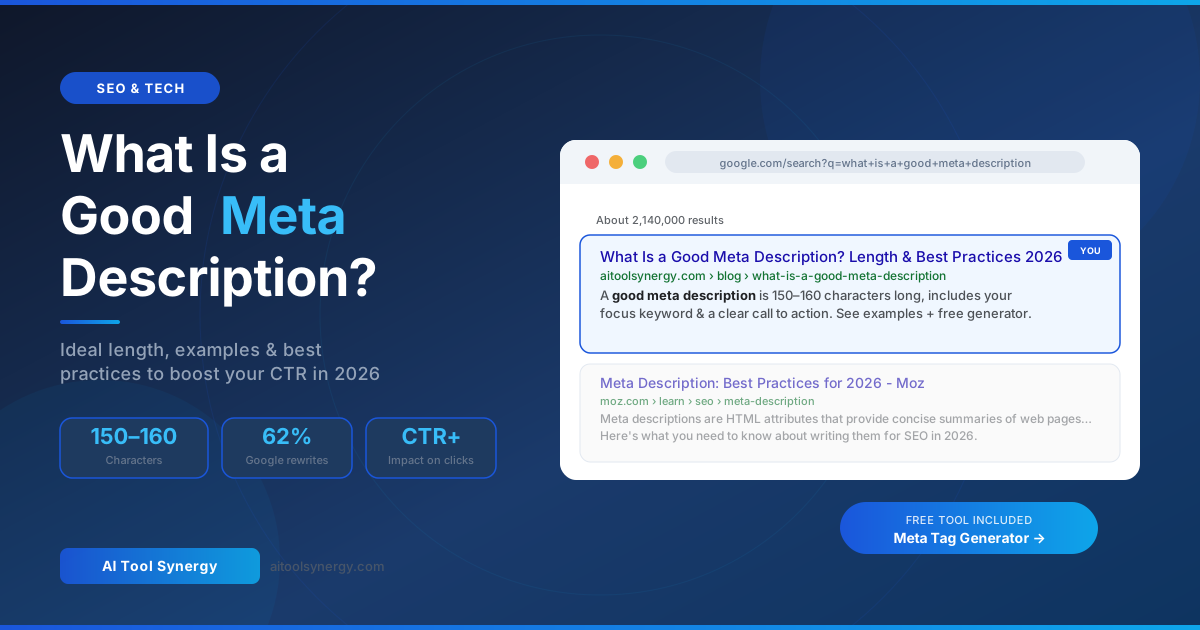
A good meta description is 150–160 characters long, includes your focus keyword, matches the page’s search intent, and ends with a clear call to action. In this guide you will learn exactly how to write one, what the ideal meta description length is, why it matters for click-through rate, and see real before-and-after examples.
What Is a Meta Description?
A meta description is a short HTML attribute that summarises a webpage’s content. It appears beneath the page title in Google search results and gives users a preview of what they will find if they click. While it is not a direct ranking factor, a well-written meta tag description significantly influences click-through rate (CTR) — the percentage of people who see your result and actually click on it.
Here is how a meta description looks inside your HTML:
Google rewrites more than 62% of meta descriptions when it believes its own auto-generated snippet better matches the searcher’s intent. Writing a strong, keyword-aligned description reduces how often Google overrides yours — and keeps your messaging in front of the user.
What Is the Ideal Meta Description Length?
The most important technical rule is meta description length. Google measures snippets in pixels, not characters. However, as a practical guide, these thresholds apply:
The good meta description length rule: write 150–160 characters but front-load your keyword and value proposition within the first 120 characters. That way, even if a mobile device truncates the end, the most important part still displays.
Does Meta Description Affect SEO Rankings?
This is one of the most debated questions in SEO meta description practice. The direct answer: Google’s official documentation confirms that meta descriptions are not a direct ranking signal. Google does not use the description to determine where to rank a page.
However, the indirect impact is very real. Here is how a good meta description for SEO affects your performance:
- Higher CTR: A compelling snippet draws more clicks from the same ranking position.
- Lower bounce rate: When the description accurately reflects the page content, visitors who click stay longer because they found what they expected.
- Keyword bolding: Google bolds the words in your description that match the user’s query, making your listing visually stand out in SERPs.
- AI Overview eligibility: Well-structured, intent-matched descriptions make it easier for Google’s AI Overview to pull your content into generated answers.
What Should a Meta Description Include?
Knowing what should a meta description include is half the battle. Every high-performing description has five components:
- The focus keyword — placed as early as possible. Google bolds it, drawing the searcher’s eye.
- A clear benefit or value proposition — tell the reader what they will gain from visiting the page.
- Search intent match — if the user’s query is informational (“how to write…”), your description should promise an answer, not a product.
- A soft call to action — words like “Learn”, “Discover”, “See examples”, or “Get started” nudge the user toward clicking.
- Uniqueness per page — over 50% of websites use duplicate meta descriptions. Unique descriptions help search engines differentiate your pages and improve individual page CTR.
Good Meta Description Examples vs. Bad Ones
The fastest way to understand meta description best practices is to compare real examples. The table below shows weak descriptions rewritten as strong ones — notice how the meta description character limit is respected while the message becomes far more compelling.
| Page Type | Weak Description | Strong Description | Quality |
|---|---|---|---|
| Blog Post | “This post talks about meta descriptions and SEO.” | “Learn what a good meta description is, the ideal 150–160 char length, and real examples that boost CTR. Free generator included.” | Good |
| Tool Page | “Our meta tag generator tool.” | “Generate perfect title tags & meta descriptions in seconds. Free SEO meta tag generator — no signup needed.” | Good |
| Homepage | “Welcome to our website. We have many tools and blog posts.” | “15 free AI & SEO tools — no signup. Meta tag generator, AI content detector, domain rating checker & more. Try now free.” | Good |
| Blog Post | “Click here to read about SEO tips.” | — | Bad |
| Product Page | “Best meta description meta tag meta SEO meta description tool free online.” | — | Keyword stuffed |
| Any page | “SEO.” | — | Too short |
How to Write a Meta Description Step by Step
Following a repeatable process is the best way to write a meta description consistently well across every page on your site.
Identify the page’s primary keyword
Every page targets one primary keyword. Your ideal meta description must contain that keyword, preferably in the first 60 characters. This ensures Google bolds it and the user immediately confirms they are in the right place.
Write for the searcher, not the algorithm
Ask: what does the person typing this query actually want? If they search “how to write meta description,” they want a tutorial. If they search “meta description generator,” they want a tool. Match the description to that specific need — this is called search intent alignment.
State the benefit clearly
Your description is a shop window. State the outcome the user gets: “Learn the ideal length”, “See 10 real examples”, “Generate yours free in 30 seconds.” Concrete, specific benefits outperform vague promises every time.
Keep it under 160 characters
Count your characters before publishing. The meta description character limit of 160 on desktop and 120 on mobile is not a guideline — exceeding it results in your message being cut off mid-sentence with a “…” that kills your CTA.
Add a soft call to action
End with an action word: “Learn more”, “Try free today”, “See examples”, “Discover now”. This final nudge has been shown to meaningfully improve clicks even for informational pages where no commercial action is being taken.
Meta Description vs. Meta Title: Key Differences
Many beginners confuse the meta tag description with the meta title. They serve different purposes and have different rules.
| Element | Purpose | Ideal Length | Ranking Factor? |
|---|---|---|---|
| Meta Title | The clickable blue headline in SERPs | 50–60 characters | Yes |
| Meta Description | The summary snippet below the title | 150–160 characters | Indirect (CTR) |
| H1 Tag | On-page headline visible to readers | 20–70 characters | Yes |
For a deeper guide on all three and how they interact, read our post on what meta tags are in SEO — and how each one plays a role in your overall on-page optimisation strategy.
How Many Words Should a Meta Description Be?
If you prefer thinking in words rather than characters: a good meta description is typically 20–30 words. That translates to roughly 150–160 characters depending on word length. A reliable formula is: [Keyword] + [specific benefit] + [call to action].
🚀 Generate Your Meta Description in Seconds
Stop guessing character counts and keyword placement. Our free Meta Tag Generator creates perfectly optimised title tags and meta descriptions — no signup, no cost, ever.
Try Free Meta Tag Generator →Common Meta Description Mistakes to Avoid
Free Meta Description Length Checker Tools
You do not need a paid SEO suite to check your description length. These free tools give you an accurate character count and SERP preview:
- Google Search Console — shows actual descriptions Google is displaying for your pages and flags missing ones.
- Yoast SEO (WordPress) — provides a real-time SERP preview and character counter as you type.
- RankMath (WordPress) — shows a live snippet preview with pixel-accurate width measurement.
- AI Tool Synergy’s Meta Tag Generator — generates a complete, SEO-optimised meta title and description from any topic. Free, no login required.
Pair any of these with domain rating analysis to understand which of your pages have the most authority to rank — and therefore the most to gain from improved meta descriptions.
Meta Descriptions in 2026: AI Overviews & What’s Changed
In 2026, the role of a good meta description has evolved alongside Google’s AI Overviews. Here is what matters now:
- AI Overviews pull from well-structured pages. A clear, intent-matched meta description signals to Google’s AI that your page directly answers a specific query — increasing the chance of being cited in AI-generated summaries.
- Organic click rates have fallen for broad queries. AI-generated answers absorb clicks for simple questions. This makes long-tail, specific queries more important — and a compelling description for those queries even more valuable.
- Google rewrites 62% of descriptions. The best defence is writing a description so well-matched to the query intent that Google prefers yours over its own auto-generated version.
- Mobile truncation is harsher. With over 60% of searches on mobile, designing your description to work within 120 characters is more important than ever. Write the most critical information first.
Frequently Asked Questions
Final Thoughts
A good meta description is one of the quickest on-page wins available to any website. It costs nothing to write, takes under two minutes per page, and can meaningfully improve your CTR from the same ranking position — essentially giving you more free traffic without building a single new backlink.
The rules are simple: keep it between 150–160 characters, front-load your focus keyword, match the searcher’s intent, state a clear benefit, and end with a soft call to action. Avoid duplicate descriptions, keyword stuffing, and truncation. Review your descriptions regularly through Google Search Console to spot pages where Google is overriding your snippet — those are your highest-priority rewrites.
Ready to generate your meta tags instantly? Our free tool handles the heavy lifting — just enter your page topic and get an SEO-optimised title and description in seconds.
✅ Generate Your Meta Tags Free — No Signup
AI Tool Synergy’s Meta Tag Generator creates optimised title tags and meta descriptions for any page. 100% free, forever.
Open Meta Tag Generator →



5 Responses
[…] What Is a Good Meta Description? Length, Examples & Best Practices 2026 […]
[…] using the eight signs above. For SEO blog content specifically, also check whether the URL slug and meta description match the actual content — AI generators sometimes produce inconsistent signals across page […]
[…] What Is a Good Meta Description? Length, Examples & Best Practices […]
[…] the full mechanics of each of these elements, see our guides on what meta tags actually do in SEO, what makes a good meta description, and how to structure an SEO-friendly […]
[…] that work alongside your meta tags, see our guides on what every meta tag type actually does, what makes a meta description perform well, how to write SEO-friendly URLs, and ideal keyword density for body […]